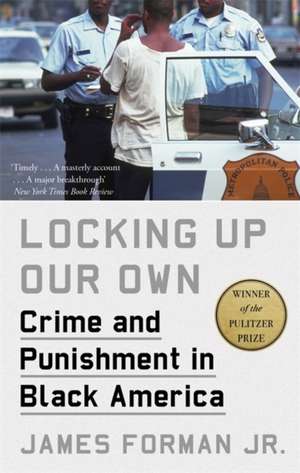
Locking Up Our Own: Winner of the Pulitzer Prize
Autor James Forman, Jr.en Limba Engleză Paperback – 4 oct 2018
Longlisted for the National Book Award
One of the New York Times Book Review's 10 Best Books of 2017
Former public defender James Forman, Jr. is a leading critic of mass incarceration and its disproportionate impact on people of colour. In Locking Up Our Own, he seeks to understand the war on crime that began in the 1970s and why it was supported by many African American leaders in the nation's urban centres.
Forman shows us that the first substantial cohort of black mayors, judges and police chiefs took office amid a surge in crime and drug addiction. Many prominent black officials, including Washington, DC mayor Marion Barry and federal prosecutor Eric Holder, feared that the gains of the civil rights movement were being undermined by lawlessness - and thus embraced tough-on-crime measures, including longer sentences and aggressive police tactics. In the face of skyrocketing murder rates and the proliferation of open-air drug markets, they believed they had no choice. But the policies they adopted would have devastating consequences for residents of poor black neighbourhoods.
A former public defender, Forman tells riveting stories of politicians, community activists, police officers, defendants and crime victims. He writes with compassion about individuals trapped in terrible dilemmas - from the men and women he represented in court to officials struggling to respond to a public safety emergency. Locking Up Our Own enriches our understanding of why American society became so punitive and offers important lessons to anyone concerned about the future of race and the criminal justice system.
Preț: 67.14 lei
Preț vechi: 91.74 lei
-27%
Puncte Express: 101
Carte disponibilă
Livrare economică 09-23 noiembrie
Livrare express 23-29 octombrie pentru 46.00 lei
Livrare prin curier în România Termenul estimat este afișat lângă disponibilitate.
Transport gratuit de la 400.00 lei Plată online sau ramburs, în funcție de opțiunile comenzii.
Retur gratuit în 14 zile Comandă securizată și suport în română.
Specificații
ISBN-13: 9780349143682
ISBN-10: 0349143684
Pagini: 320
Ilustrații: Integrated pics
Dimensiuni: 201 x 132 x 21 mm
Greutate: 0.25 kg
Editura: Little Brown
Colecția Abacus
Locul publicării:London, United Kingdom
ISBN-10: 0349143684
Pagini: 320
Ilustrații: Integrated pics
Dimensiuni: 201 x 132 x 21 mm
Greutate: 0.25 kg
Editura: Little Brown
Colecția Abacus
Locul publicării:London, United Kingdom
V-ar putea interesa
-
 America on FireElizabeth HintonPreț: 80.05 lei
 -
 Open SeasonBen CrumpPreț: 100.27 lei
 -
 The New Jim CrowMichelle Alexander-30%Preț: 64.98 lei93.37 lei
 -
 Sunbelt Capitalism and the Making of the Carceral StateKirstine TaylorPreț: 226.83 lei
 -
 Preț: 186.61 lei
 -
 -26%Preț: 116.69 lei157.14 lei
 -
 Locking Up Our OwnJames FormanPreț: 96.46 lei
 -
 Policing the Black ManAngela J DavisPreț: 98.83 lei
 -
 This Is Ear HustleNigel PoorPreț: 101.09 lei
 -
 -31%Preț: 104.60 lei152.07 lei
 -
 Are Prisons Obsolete?Angela Davis-20%Preț: 72.88 lei91.64 lei
 -
 Race to IncarcerateMarc MauerPreț: 137.53 lei
 -
 The New Jim Crow. 10th Anniversary EditionMichelle AlexanderPreț: 118.66 lei
 -
 The New Jim CrowMichelle AlexanderPreț: 239.88 lei
 -
 Preț: 161.23 lei
 -
 Preț: 125.83 lei
 -
 States of IncarcerationJarrod ShanahanPreț: 127.46 lei
Recenzii
Former public defender James Forman, Jr. is a leading critic of mass incarceration and its disproportionate impact on people of colour. In Locking Up Our Own, he seeks to understand the war on crime that began in the 1970s and why it was supported by many African American leaders in the nation's urban centres.
Forman shows us that the first substantial cohort of black mayors, judges and police chiefs took office amid a surge in crime and drug addiction. Many prominent black officials, including Washington, DC mayor Marion Barry and federal prosecutor Eric Holder, feared that the gains of the civil rights movement were being undermined by lawlessness - and thus embraced tough-on-crime measures, including longer sentences and aggressive police tactics. In the face of skyrocketing murder rates and the proliferation of open-air drug markets, they believed they had no choice. But the policies they adopted would have devastating consequences for residents of poor black neighbourhoods.
A former public defender, Forman tells riveting stories of politicians, community activists, police officers, defendants and crime victims. He writes with compassion about individuals trapped in terrible dilemmas - from the men and women he represented in court to officials struggling to respond to a public safety emergency. Locking Up Our Own enriches our understanding of why American society became so punitive and offers important lessons to anyone concerned about the future of race and the criminal justice system.
This superb, shattering book probably made a deeper impression on me than any other this year
A beautiful book, written so well, that gives us the origins and consequences of where we are . . . I can see why [the Pulitzer prize] was awarded
Remarkable . . . Forman's beautifully written narrative, enriched by firsthand knowledge of the cops and courts, neither condemns black leaders in hindsight nor exonerates the white-dominated institutions . . . He adds historical nuance to the story of 'mass incarceration' told in . . . The New Jim Crow
Surprising . . . [Forman's] moving, nuanced, and candid account challenges another aspect of the 'New Jim Crow' thesis. He shows that some of the most ardent proponents of tough·on-crime policies in the era that brought us mass incarceration were black politicians and community leaders?many of whom were veterans of the civil rights movement . . . The correctives offered by Forman . . . have consequences not only for how we understand mass incarceration, but for how we go about fixing it
Eloquent . . . A gritty, often revelatory work of local history, interspersed with tales of Forman's experiences as a public defender . . . Locking Up Our Own is a sobering chronicle of how black people, in the hope of saving their communities, contributed to the rise of a system that has undone much of the progress of the civil rights era. But, as Forman knows, they could not have built it by themselves, and they are even less likely to be able to abolish it without influential white allies, and dramatic reforms in the structure of American society
A breakthrough . . . very engaging and lucidly written
Forman shows us that the first substantial cohort of black mayors, judges and police chiefs took office amid a surge in crime and drug addiction. Many prominent black officials, including Washington, DC mayor Marion Barry and federal prosecutor Eric Holder, feared that the gains of the civil rights movement were being undermined by lawlessness - and thus embraced tough-on-crime measures, including longer sentences and aggressive police tactics. In the face of skyrocketing murder rates and the proliferation of open-air drug markets, they believed they had no choice. But the policies they adopted would have devastating consequences for residents of poor black neighbourhoods.
A former public defender, Forman tells riveting stories of politicians, community activists, police officers, defendants and crime victims. He writes with compassion about individuals trapped in terrible dilemmas - from the men and women he represented in court to officials struggling to respond to a public safety emergency. Locking Up Our Own enriches our understanding of why American society became so punitive and offers important lessons to anyone concerned about the future of race and the criminal justice system.
This superb, shattering book probably made a deeper impression on me than any other this year
A beautiful book, written so well, that gives us the origins and consequences of where we are . . . I can see why [the Pulitzer prize] was awarded
Remarkable . . . Forman's beautifully written narrative, enriched by firsthand knowledge of the cops and courts, neither condemns black leaders in hindsight nor exonerates the white-dominated institutions . . . He adds historical nuance to the story of 'mass incarceration' told in . . . The New Jim Crow
Surprising . . . [Forman's] moving, nuanced, and candid account challenges another aspect of the 'New Jim Crow' thesis. He shows that some of the most ardent proponents of tough·on-crime policies in the era that brought us mass incarceration were black politicians and community leaders?many of whom were veterans of the civil rights movement . . . The correctives offered by Forman . . . have consequences not only for how we understand mass incarceration, but for how we go about fixing it
Eloquent . . . A gritty, often revelatory work of local history, interspersed with tales of Forman's experiences as a public defender . . . Locking Up Our Own is a sobering chronicle of how black people, in the hope of saving their communities, contributed to the rise of a system that has undone much of the progress of the civil rights era. But, as Forman knows, they could not have built it by themselves, and they are even less likely to be able to abolish it without influential white allies, and dramatic reforms in the structure of American society
A breakthrough . . . very engaging and lucidly written