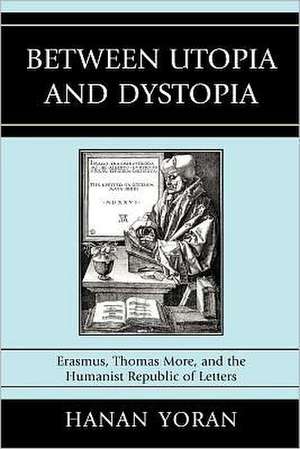
Between Utopia and Dystopia: Erasmus, Thomas More, and the Humanist Republic of Letters
Autor Hanan Yoranen Limba Engleză Paperback – sep 2011
Focusing on the writings of Erasmus and Thomas More, Hanan Yoran argues that, in contrast to other groups of humanists, Erasmus and the circle gathered around him generated the social space-the Erasmian Republic of Letters-that allowed them a considerable measure of independence. The identity of the autonomous intellectual enabled the Erasmian humanists to criticize established customs and institutions and to elaborate a reform program for Christendom. At the same time, however, the very notion of the universal intellectual presented a problem for the discourse of Erasmian humanism itself. It distanced the Erasmian humanists from concrete public activity and, as such, clashed with their commitment to the ideal of an active life. Furthermore, citizenship in the Republic of Letters threatened to lock the Erasmian humanists into a disembodied intellectual sphere, thus undermining their convictions concerning intellectual activity and the production of knowledge.
Between Utopia and Dystopia will be of interest to scholars and students interested in Renaissance humanism, early modern intellectual and cultural history, and political thought. It also has much to contribute to debates over the identity, social place, and historical role of intellectuals.
Preț: 321.90 lei
Preț vechi: 422.97 lei
-24%
Puncte Express: 483
Carte tipărită la comandă
Livrare economică 07-21 august
Livrare prin curier în România Termenul estimat este afișat lângă disponibilitate.
Transport gratuit de la 400.00 lei Plată online sau ramburs, în funcție de opțiunile comenzii.
Retur gratuit în 14 zile Comandă securizată și suport în română.
Specificații
ISBN-13: 9780739136485
ISBN-10: 0739136488
Pagini: 251
Dimensiuni: 154 x 231 x 15 mm
Greutate: 0.4 kg
Editura: Bloomsbury Publishing
Colecția Lexington Books
Locul publicării:New York, United States
ISBN-10: 0739136488
Pagini: 251
Dimensiuni: 154 x 231 x 15 mm
Greutate: 0.4 kg
Editura: Bloomsbury Publishing
Colecția Lexington Books
Locul publicării:New York, United States
Cuprins
Introduction
Part I. The Erasmian Republic of Letters
Chapter 1. Humanism as Form
Chapter 2. The Construction of the Erasmian Republic of Letters
Chapter 3. Erasmian Humanism: The Reform Program of the Universal Intellectual
Part II. The Erasmian Republic and Its Discontents
Chapter 4. The Politics of a Disembodied Humanist
Chapter 5. More's Richard III: The Fragility of Humanist Discourse
Chapter 6. Utopia and the No-place of the Erasmian Republic
Conclusion
Part I. The Erasmian Republic of Letters
Chapter 1. Humanism as Form
Chapter 2. The Construction of the Erasmian Republic of Letters
Chapter 3. Erasmian Humanism: The Reform Program of the Universal Intellectual
Part II. The Erasmian Republic and Its Discontents
Chapter 4. The Politics of a Disembodied Humanist
Chapter 5. More's Richard III: The Fragility of Humanist Discourse
Chapter 6. Utopia and the No-place of the Erasmian Republic
Conclusion
Recenzii
Elegantly written, passionate, and informed by a wide learning in Renaissance studies, HananYoran's book explores the origins of the modern figure of the 'intellectual' in the philosophical theories and life-stories of Erasmus of Rotterdam and Thomas More. He shows how these two Christian humanists turned the critical methodologies of their predecessors, the Italian humanists, into a new and much more radical ideology of modern humanity, based on some classical and early Christian conceptions of civic morality. Inasmuch as they dared to challenge the ecclesiastical and political authorities of their time and to create an independent Republic of Letters, they set a compelling example of intellectual nonconformity that is still relevant today.
This study should prompt readers to think carefully about the early sixteenth-century humanist movement from a fresh perspective.
Recommended.
Readers who resist Yoran's characterization of the autonomous universal intellectual for being tendentious will miss some of the more provocative insights this approach yields....Yoran's bold and insightful investigation solves old problems and raises new questions, and specialists in Northern humanism generally, as well as interpreters of the two focal figures [Erasmus and More], will be instructed and stimulated by this comparative study.
Indeed, the whole book is redolent of deep immersion in its subject, and of a passionate desire to make Milton's masque speak to contemporary society.
Between Utopia and Dystopia will be of considerable interest to those concerned with the history of ideas for its exploration of oppositions in humanist texts.
This study should prompt readers to think carefully about the early sixteenth-century humanist movement from a fresh perspective.
Recommended.
Readers who resist Yoran's characterization of the autonomous universal intellectual for being tendentious will miss some of the more provocative insights this approach yields....Yoran's bold and insightful investigation solves old problems and raises new questions, and specialists in Northern humanism generally, as well as interpreters of the two focal figures [Erasmus and More], will be instructed and stimulated by this comparative study.
Indeed, the whole book is redolent of deep immersion in its subject, and of a passionate desire to make Milton's masque speak to contemporary society.
Between Utopia and Dystopia will be of considerable interest to those concerned with the history of ideas for its exploration of oppositions in humanist texts.