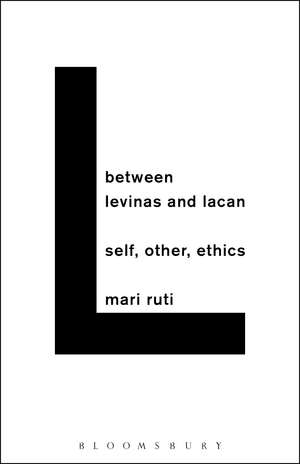
Between Levinas and Lacan: Self, Other, Ethics
Autor Professor Mari Rutien Limba Engleză Paperback – 30 iul 2015
At first glance, Levinansian and Lacanian approaches may seem more or less incompatible, and in many ways they are, particularly in their understanding of the self-other relationship. For both Levinas and Lacan, the subject's relationship to the other is primary in the sense that the subject, literally, does not exist without the other, but they see the challenge of ethics quite differently: while Levinas laments our failure to adequately meet the ethical demand arising from the other, Lacan laments the consequences of our failure to adequately escape the forms this demand frequently takes.
Although this book outlines the major differences between Levinas and Judith Butler on the one hand and Lacan, Slavoj Zizek, and Alain Badiou on the other, Ruti proposes that underneath these differences one can discern a shared concern with the thorny relationship between the singularity of experience and the universality of ethics.
Between Levinas and Lacan is an important new book for anyone interested in contemporary theory, ethics, psychoanalysis, and feminist and queer theory.
Preț: 206.77 lei
Preț vechi: 263.31 lei
-21%
Puncte Express: 310
Carte tipărită la comandă
Livrare economică 26 noiembrie-10 decembrie
Livrare prin curier în România Termenul estimat este afișat lângă disponibilitate.
Transport gratuit de la 400.00 lei Plată online sau ramburs, în funcție de opțiunile comenzii.
Retur gratuit în 14 zile Comandă securizată și suport în română.
Specificații
ISBN-13: 9781628926392
ISBN-10: 1628926392
Pagini: 240
Dimensiuni: 136 x 214 x 18 mm
Greutate: 0.34 kg
Editura: Bloomsbury Publishing
Colecția Bloomsbury Academic
Locul publicării:New York, United States
ISBN-10: 1628926392
Pagini: 240
Dimensiuni: 136 x 214 x 18 mm
Greutate: 0.34 kg
Editura: Bloomsbury Publishing
Colecția Bloomsbury Academic
Locul publicării:New York, United States
V-ar putea interesa
-
 Derrida: A Very Short IntroductionSimon GlendinningPreț: 68.81 lei
 -
 Art′s Claim to TruthGianni VattimoPreț: 191.10 lei
 -
 Hatred and ForgivenessJulia KristevaPreț: 224.99 lei
 -
 Preț: 335.32 lei
 -
 This Incredible Need to BelieveJulia KristevaPreț: 79.98 lei
 -
 Mute Speech – Literature, Critical Theory and PoliticsJacques RancièrePreț: 240.75 lei
 -
 Course in General LinguisticsFerdinand De SaussurePreț: 241.65 lei
 -
 Preț: 255.36 lei
 -
 Jacques Lacan, Past and PresentAlain BadiouPreț: 104.46 lei
 -
 The Political Unconscious: Narrative as a Socially Symbolic ActFredric JamesonPreț: 173.52 lei
 -
 Foucault's Last DecadeStuart EldenPreț: 166.00 lei
 -
 Companion DerridaDirek-9%Preț: 1272.44 lei1398.28 lei
 -
 SinthomeJacques LacanPreț: 456.03 lei
 -
 Introducing Levi-StraussBoris WisemanPreț: 63.43 lei
Cuprins
Preface
1. Breaking the Obstinacy of Being: Levinas's Ethics of the Face
2. The Ethics of Precarity: Judith Butler's Reluctant Universalism
3. The Lacanian Rebuttal: Zizek, Badiou, and Revolutionary Politics
4. Acts of Defiance: Resistance and Rebellion in Lacan and Marcuse
5. Beyond the Impasses: The Need for Normative Limits
Notes
Bibliography
Index
1. Breaking the Obstinacy of Being: Levinas's Ethics of the Face
2. The Ethics of Precarity: Judith Butler's Reluctant Universalism
3. The Lacanian Rebuttal: Zizek, Badiou, and Revolutionary Politics
4. Acts of Defiance: Resistance and Rebellion in Lacan and Marcuse
5. Beyond the Impasses: The Need for Normative Limits
Notes
Bibliography
Index
Recenzii
Ruti brilliantly elucidates a wholly original and utterly compelling argument for rethinking the post-Enlightenment ethical subject. She does this by demonstrating how some of our most deeply held theoretical paradigms hinge on false oppositions: between the universal and the singular; the subject and the other; agency and subjectivity. Like a magical tour guide, Ruti takes us on a completely fresh journey through previously familiar lands, unsettling received wisdoms so comprehensively and so sensibly that it becomes impossible to recall how one could have ever seen it otherwise.
An extraordinarily balanced book. By showing that Lacan and Levinas are both influenced by the enlightenment conception of subjectivity, Between Levinas and Lacan is one of the first books to bridge the theoretical divide between Lacanians and Levinasians, finding common ground where there is normally animosity and mistrust. It engages and explains these thinkers in a very accessible, and even often charming way, without sacrificing the complexity of anyone's thought. It's an impressive work of scholarship and a worthwhile guide to contemporary ethical debates.
An extraordinarily balanced book. By showing that Lacan and Levinas are both influenced by the enlightenment conception of subjectivity, Between Levinas and Lacan is one of the first books to bridge the theoretical divide between Lacanians and Levinasians, finding common ground where there is normally animosity and mistrust. It engages and explains these thinkers in a very accessible, and even often charming way, without sacrificing the complexity of anyone's thought. It's an impressive work of scholarship and a worthwhile guide to contemporary ethical debates.
Notă biografică
Mari Ruti (PhD, Harvard University) was Distinguished Professor of Critical Theory and of Gender and Sexuality Studies at the University of Toronto, Canada. She was the author of numerous important works, including thirteen books The Singularity of Being: Lacan and the Immortal Within (2012); Between Levinas and Lacan: Self, Other, Ethics (Bloomsbury, 2015); The Age of Scientific Sexism (Bloomsbury, 2015); Feminist Film Theory and Pretty Woman (Bloomsbury, 2016); Penis Envy and Other Bad Feelings: The Emotional Costs of Everyday Life (2018); Distillations: Theory, Ethics, Affect (editor; Bloomsbury, 2018); and Critical Theory Between Klein and Lacan: A Dialogue - with Amy Allen (Bloomsbury, 2019).