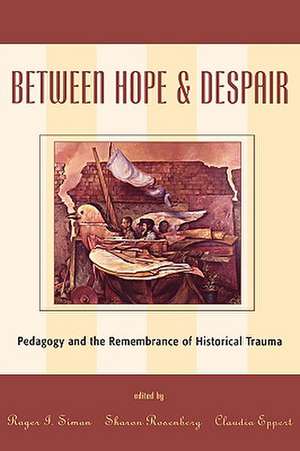
Between Hope and Despair: Pedagogy and the Remembrance of Historical Trauma: Culture and Education Series
Editat de Roger I. Simon, Sharon Rosenberg, Claudia Eppert Contribuţii de Rachel Baum, Deborah P. Britzman, Mario DiPaolantonio, Andrea Liss, Jody Ranck, Julie Salverson, Rinaldo Walcotten Limba Engleză Paperback – 15 mar 2000

Preț: 318.94 lei
Preț vechi: 398.67 lei
-20%
Puncte Express: 478
Carte tipărită la comandă
Livrare economică 30 noiembrie-14 decembrie
Livrare prin curier în România Termenul estimat este afișat lângă disponibilitate.
Transport gratuit de la 400.00 lei Plată online sau ramburs, în funcție de opțiunile comenzii.
Retur gratuit în 14 zile Comandă securizată și suport în română.
Specificații
ISBN-13: 9780847694631
ISBN-10: 0847694631
Pagini: 264
Dimensiuni: 155 x 222 x 14 mm
Greutate: 0.35 kg
Editura: Bloomsbury Publishing
Colecția Rowman & Littlefield
Seria Culture and Education Series
Locul publicării:New York, United States
ISBN-10: 0847694631
Pagini: 264
Dimensiuni: 155 x 222 x 14 mm
Greutate: 0.35 kg
Editura: Bloomsbury Publishing
Colecția Rowman & Littlefield
Seria Culture and Education Series
Locul publicării:New York, United States
V-ar putea interesa
-
 The Oxford Handbook of Latin American HistoryJose C. Moya-29%Preț: 400.84 lei564.70 lei
 -
 Processing the Past: Changing Authorities in History and the ArchivesFrancis X. Blouin, Jr-31%Preț: 791.51 lei1142.71 lei
 -
 Hollywood and the American Historical FilmJ. E. SmythPreț: 249.23 lei
 -
 The Future of HistoryAlun MunslowPreț: 278.68 lei
 -
 How to Write History That People Want to ReadA. CurthoysPreț: 253.95 lei
 -
 Gender and HistorySusan Kingsley KentPreț: 189.53 lei
 -
 Preț: 390.09 lei
 -
 Preț: 405.27 lei
 -
 The Future of HistoryJohn LukacsPreț: 253.00 lei
 -
 The History Written on the Classical Greek BodyRobin OsbornePreț: 303.00 lei
 -
 The Cambridge Introduction to Theatre HistoriographyThomas PostlewaitPreț: 262.02 lei
 -
 Natural Experiments of HistoryJames A. RobinsonPreț: 171.67 lei
 -
 Hobsbawm: History and Politics: History and PoliticsGregory ElliottPreț: 224.96 lei
 -
 How to Stop Living and Start WorryingSimon CritchleyPreț: 114.25 lei
 -
 Comparative and Transnational HistoryHeinz-Gerhard HauptPreț: 265.48 lei
 -
 Companion Philosophy HistoryTuckerPreț: 428.00 lei
Cuprins
Chapter 1 Introduction: Between Hope and Despair: The Pedagogical Encounter of Historical Rememberance
Chapter 2 1 The Paradoxical Practice of Zakhor: "Memories of That Which Has Never My Fault"
Chapter 3 2 If the Story Cannot End: Deferred Action, Ambivalence and Difficult Knowledge
Chapter 4 3 Anxiety and Contact in Attending to a Play about Landmines
Chapter 5 4 Standing in a Circle of Stone: Rupturing the Binds of Emblamatic Memory
Chapter 6 5 Never to Forget: Pedagogical Memory and Second Generation Witness
Chapter 7 6 Artifactual Testimonies and the Staging of Holocaust Memories
Chapter 8 7 Pedagogy and Trauma: The Middle
Passage, Slavery, and the Problem of Creolization
Chapter 9 8 Loss in Present Terms: Reading the Limits of Post-dictatorship Argentina's National Conciliation
Chapter 10 9 Beyond Reconciliation: Memory and Allerity in Post-Genocide Rwanda
Chapter 11 10 Re-Learning Questions: Responses to the Ethical Address of the Past and Present of Others
Chapter 12 Bibliography
Chapter 13 Index
Chapter 14 About the Editors and Contributors
Chapter 2 1 The Paradoxical Practice of Zakhor: "Memories of That Which Has Never My Fault"
Chapter 3 2 If the Story Cannot End: Deferred Action, Ambivalence and Difficult Knowledge
Chapter 4 3 Anxiety and Contact in Attending to a Play about Landmines
Chapter 5 4 Standing in a Circle of Stone: Rupturing the Binds of Emblamatic Memory
Chapter 6 5 Never to Forget: Pedagogical Memory and Second Generation Witness
Chapter 7 6 Artifactual Testimonies and the Staging of Holocaust Memories
Chapter 8 7 Pedagogy and Trauma: The Middle
Passage, Slavery, and the Problem of Creolization
Chapter 9 8 Loss in Present Terms: Reading the Limits of Post-dictatorship Argentina's National Conciliation
Chapter 10 9 Beyond Reconciliation: Memory and Allerity in Post-Genocide Rwanda
Chapter 11 10 Re-Learning Questions: Responses to the Ethical Address of the Past and Present of Others
Chapter 12 Bibliography
Chapter 13 Index
Chapter 14 About the Editors and Contributors
Recenzii
This is a book that is at once masterful, disturbing, and passionate. The scholarship is meticulous and the analysis penetrating and insightful. The writers challenge us all to confront the enormity of evil as well as to celebrate the profoundly human impulse for redemption.
These wide-ranging, courageous essays on the impact of the Holocaust, the Rwandan genocide and other instances of political terror and mass violence, acknowledge the limits of the social and psychological remedies that can be drawn from remembering the past. At the same time, through a close and intensive study of testimonies, memoirs, fiction (including second-generation witness), and other modes of story telling they scrupulously analyze the possibility of working-through recent trauma. The essayists jointly advocate a new direction, which they call the pedagogical rather than strategic practice of memorialization.
Between Hope and Despair is a well-documented, scholarly work. . . . The editors of [the book] should indeed be commended for offering us such a wonderful collection.
An exceptionally smart collection of essays.
Shoshana Felman observed that the unprecedented teaching possibilities opened up by the 'revolutionary pedagogy of psychoanalysis' have never been fully grasped or utilized in the classroom. The contributors to this collection and other educators now exploring the relations between history, trauma, and teaching, have begun that work. Their efforts lay the groundwork for nothing less than a fundamental rethinking of 'multicultural education' and teaching about and across social and cultural difference.
These wide-ranging, courageous essays on the impact of the Holocaust, the Rwandan genocide and other instances of political terror and mass violence, acknowledge the limits of the social and psychological remedies that can be drawn from remembering the past. At the same time, through a close and intensive study of testimonies, memoirs, fiction (including second-generation witness), and other modes of story telling they scrupulously analyze the possibility of working-through recent trauma. The essayists jointly advocate a new direction, which they call the pedagogical rather than strategic practice of memorialization.
Between Hope and Despair is a well-documented, scholarly work. . . . The editors of [the book] should indeed be commended for offering us such a wonderful collection.
An exceptionally smart collection of essays.
Shoshana Felman observed that the unprecedented teaching possibilities opened up by the 'revolutionary pedagogy of psychoanalysis' have never been fully grasped or utilized in the classroom. The contributors to this collection and other educators now exploring the relations between history, trauma, and teaching, have begun that work. Their efforts lay the groundwork for nothing less than a fundamental rethinking of 'multicultural education' and teaching about and across social and cultural difference.