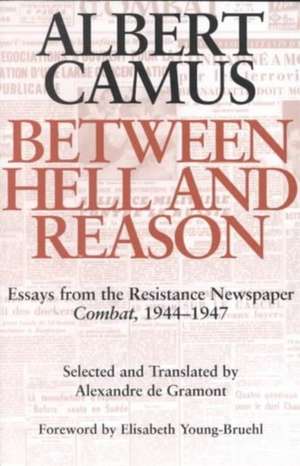
Between Hell and Reason
Autor Albert Camus Traducere de Alexandre de Gramonten Limba Engleză Paperback – aug 1991
Preț: 143.37 lei
Puncte Express: 215
Carte disponibilă
Livrare economică 15-29 decembrie
Livrare prin curier în România Termenul estimat este afișat lângă disponibilitate.
Transport gratuit de la 400.00 lei Plată online sau ramburs, în funcție de opțiunile comenzii.
Retur gratuit în 14 zile Comandă securizată și suport în română.
Specificații
ISBN-13: 9780819551894
ISBN-10: 0819551899
Pagini: 182
Dimensiuni: 140 x 215 x 15 mm
Greutate: 0.25 kg
Ediția:Trans. from the French edition
Editura: Wesleyan University Press
V-ar putea interesa
-
 The Illustrated Walden: Thoreau Bicentennial EditionHenry David ThoreauPreț: 157.60 lei
-
 Hannah Arendt: For Love of the WorldElisabeth Young-BruehlPreț: 203.07 lei
-
 Childism: Confronting Prejudice Against ChildrenElisabeth Young-BruehlPreț: 174.16 lei
-
 Knitting PearlsAnn HoodPreț: 90.49 lei
-
 The Ghosts of BirdsEliot WeinbergerPreț: 95.38 lei
-
 The Great CamouflageSuzanne CésairePreț: 102.43 lei
-
 Fire and StonePriscilla LongPreț: 159.95 lei
-
 Folklife and Museums: Twenty-First Century PerspectivesC. Kurt Dewhurst-11%Preț: 398.39 lei447.63 lei
-
 Remaking the American College CampusJonathan SilvermanPreț: 300.50 lei
-
 Dark Nature: Anti-Pastoral Essays in American Literature and CultureRichard Schneider-27%Preț: 704.94 lei965.67 lei
-
 The Poetry of Everyday LifeSteve ZeitlinPreț: 152.08 lei
-
 Neither Victims nor ExecutionersAlbert CamusPreț: 80.39 lei
-
 The Teller and the TaleGabriel JosipoviciPreț: 109.34 lei
-
 A Political Style of ThinkingKari Palonen-8%Preț: 681.46 lei740.73 lei
-
 Hannah ArendtElisabeth Young-BruehlPreț: 207.00 lei
-
 Hochzeit des Lichts NeuAlbert CamusPreț: 125.86 lei
Textul de pe ultima copertă
From 1943 to 1947, Albert Camus was editor-in-chief of the famous underground and post-Liberation French newspaper Combat. Among his journalist writings during this period were eloquent essays that grappled with questions of revolution, violence, freedom, justice, ethics, and the emerging social order. The 41 pieces collected here--most never before published in English--tell the story of a sensitive man's odyssey from "hell to reason" at a time of tremendous upheaval while also providing a missing link between Camus's pre-war and post-war works. Almost lyrical in their intensity of thought and language, these newspaper pieces show a Camus new to most American readers and are a unique testimony to an extraordinary period in history with parallels to current changes in Eastern Europe. At the time of Liberation in 1944, Camus called for a revolution in French society, including a violent purge of those who had sided with the Nazis. When this turned into a near civil war of personal vendettas and summary executions, he gradually became disillusioned with his hopes for a new society. His later pieces in Combat show him arriving at a more moderate theory of revolt later echoed in such books as The Plague and The Rebel: the individual mattered above all, human life was greater than social goals. "I have come to the conclusion", he wrote, "that men who want to change the world today must choose one of the following: the charnel house, the impossible dream of stopping history, or the acceptance of a relative Utopia that still leaves man the choice to act freely".