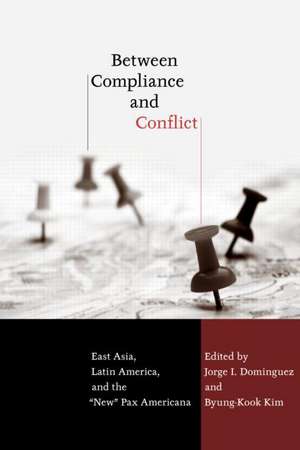
Between Compliance and Conflict: East Asia, Latin America and the "New" Pax Americana
Editat de Jorge Domínguez, Byung-Kook Kimen Limba Engleză Paperback – 30 mar 2005
Preț: 480.01 lei
Puncte Express: 720
Carte tipărită la comandă
Livrare economică 21 noiembrie-05 decembrie
Livrare prin curier în România Termenul estimat este afișat lângă disponibilitate.
Transport gratuit pentru acest produs Plată online sau ramburs, în funcție de opțiunile comenzii.
Retur gratuit în 14 zile Comandă securizată și suport în română.
Specificații
ISBN-13: 9780415951258
ISBN-10: 0415951259
Pagini: 278
Ilustrații: 3 b/w images and 5 tables
Dimensiuni: 152 x 229 x 15 mm
Greutate: 0.51 kg
Ediția:1
Editura: Taylor & Francis
Colecția Routledge
Locul publicării:Oxford, United Kingdom
ISBN-10: 0415951259
Pagini: 278
Ilustrații: 3 b/w images and 5 tables
Dimensiuni: 152 x 229 x 15 mm
Greutate: 0.51 kg
Ediția:1
Editura: Taylor & Francis
Colecția Routledge
Locul publicării:Oxford, United Kingdom
V-ar putea interesa
-
 Road of BonesFergal KeanePreț: 109.57 lei
 -
 Songs of Blood and SwordFatima Bhutto-24%Preț: 71.17 lei93.20 lei
 -
 The Burma CampaignFrank McLynn-18%Preț: 87.57 lei107.14 lei
 -
 Bodh GayaFrederick AsherPreț: 109.68 lei
 -
 Preț: 415.64 lei
 -
 The Making of Modern AfghanistanB. HopkinsPreț: 272.51 lei
 -
 -26%Preț: 69.40 lei93.92 lei
 -
 Golden–Silk Smoke – A History of Tobacco in China, 1550–2010Carol Benedict-23%Preț: 488.91 lei634.95 lei
 -
 IndochinaPierre BrocheuxPreț: 255.82 lei
 -
 China and Maritime Europe, 1500-1800Jr John E. WillsPreț: 330.17 lei
 -
 The Spirit of Modern IndiaRobert A McDermottPreț: 215.33 lei
 -
 I Sailed with Chinese PiratesAleko LiliusPreț: 106.66 lei
 -
 Decadence Mandchoue: The China Memoirs of Sir Edmund Trelawny BackhouseEdmund Trelawny BackhousePreț: 150.24 lei
Cuprins
1) Between Compliance and Conflict: Comparing U.S.-East Asian and U.S.-Latin American Relations,Jorge I. Domínguez, Harvard University, and Byung-Kook Kim, Korea University,2) A New Pax Americana? The U.S. Exercise of Hard Power East Asia and Latin America,Robert Paarlberg, Wellesley College,
Descriere
This book examines the responses to U.S. power in the two areas of the world where U.S. primacy was first successfully consolidated: East Asia and Latin America. The U.S. has faced no comparably powerful challengers to the exercise of its power in Latin America for much of the past century. It established its primacy over much of East Asia in the aftermath of WW II and extended its influence in the late 1970's and after the end of the Vietnam War through its entente with China to balance the Soviet Union. By contrast, the U.S. has always encountered rivals and challengers in Europe, has attempted unsuccessfully thus far to impose its primacy in the Middle East, and has paid only intermittent attention to South Asia and Africa. The essays in this volume will explore three important themes 1.) How do region-wide economic trends and arrangements sustain or modify U.S. influence in the region? 2.) How do rising powers in these regions (Japan, China, Brazil) reshape their policies to cope with the U.S. and 3.) How do new (South Korea) and old (Cuba) challengers to U.S. power shape their policies to account for the unrivaled exercise of U.S. power. This collection will place the United States at the hub of relations with countries in East Asia and Latin America and examine the new policies and new styles of engagement that are employed to address the prolonged U.S. interest in these areas-approaches from which the rest of the world might learn.