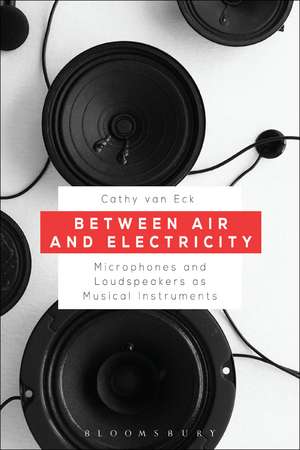
Between Air and Electricity: Microphones and Loudspeakers as Musical Instruments
Autor Dr. Cathy van Ecken Limba Engleză Paperback – 6 sep 2018
www.microphonesandloudspeakers.com
The ebook editions of this book are available open access under a CC BY-NC-ND 3.0 licence on bloomsburycollections.com. Open access was funded by Knowledge Unlatched.
Preț: 255.34 lei
Preț vechi: 340.41 lei
-25%
Puncte Express: 383
Carte tipărită la comandă
Livrare economică 13-27 noiembrie
Livrare prin curier în România Termenul estimat este afișat lângă disponibilitate.
Transport gratuit de la 400.00 lei Plată online sau ramburs, în funcție de opțiunile comenzii.
Retur gratuit în 14 zile Comandă securizată și suport în română.
Specificații
ISBN-13: 9781501344718
ISBN-10: 1501344714
Pagini: 216
Dimensiuni: 148 x 226 x 16 mm
Greutate: 0.3 kg
Ediția:NIPPOD
Editura: Bloomsbury Publishing
Colecția Bloomsbury Academic
Locul publicării:New York, United States
ISBN-10: 1501344714
Pagini: 216
Dimensiuni: 148 x 226 x 16 mm
Greutate: 0.3 kg
Ediția:NIPPOD
Editura: Bloomsbury Publishing
Colecția Bloomsbury Academic
Locul publicării:New York, United States
V-ar putea interesa
-
 Preț: 285.58 lei
 -
 Art of Digital AudioJohn W. Atkinson-15%Preț: 684.32 lei805.08 lei
 -
 iPad Music: In the Studio and on StageMark Jenkins-20%Preț: 292.50 lei365.62 lei
 -
 Underwater Acoustic Modelling and SimulationP.C. Etter-25%Preț: 2298.63 lei3064.84 lei
 -
 Applied Architectural AcousticsMichael Rettinger-19%Preț: 450.26 lei555.88 lei
 -
 Engineering Applications of AcousticsJohn A. Kleppe-14%Preț: 871.53 lei1013.41 lei
 -
 Handbook for Industrial Noise ControlW. Graham OrrPreț: 277.82 lei
 -
 Underwater Acoustic System AnalysisWilliam S. Burdic-23%Preț: 534.95 lei694.75 lei
 -
 Church Pa System HandbookCharlie EdwardsPreț: 61.67 lei
 -
 Preț: 113.42 lei
 -
 Molecular Dynamics and Structure of SolidsNational Bureau of StandardsPreț: 176.16 lei
 -
 Aerodynamic NoiseTarit Bose-18%Preț: 859.85 lei1048.59 lei
 -
 Engineering Principles of Mechanical VibrationDouglas D. ReynoldsPreț: 420.98 lei
 -
 Exterior Sound Level Measurements of Snowcoaches at Yellowstone NationalU. S. Department of TransportationPreț: 134.67 lei
 -
 Noise Characteristics of the Transrapid Tr08 Maglev SystemU. S. De Federal Railroad AdministrationPreț: 193.92 lei
 -
 -24%Preț: 257.19 lei336.50 lei
 -
 Sound Works: A Cultural Theory of Sound DesignProfessor Holger Schulze-33%Preț: 840.24 lei1245.42 lei
 -
 L'Ascolto ProfessionaleGilberto MartinelliPreț: 150.38 lei
 -
 Preț: 179.65 lei
 -
 Preț: 84.53 lei
 -
 Scattering of Wedges and Cones with Impedance Boundary ConditionsMikhail A. Lyalinov-15%Preț: 611.92 lei719.91 lei
 -
 -23%Preț: 417.70 lei542.47 lei
 -
 Preț: 124.18 lei
Cuprins
Acknowledgements
Introduction
1 Beyond the curtain: the "true nature" of microphones and loudspeakers
An empty stage: listening according to the Konzertreform
A concert at home: the invention of sound reproduction technologies
Storage of air pressure waves
Transportation of air pressure waves
Amplification of air pressure waves
Between air and electricity
A standard, almost perfect amplifier and loudspeaker
Microphones and loudspeakers: the musical instruments of our age?
The "true nature" of microphones and loudspeakers
2 reproducing - supporting - generating - interacting: four approaches towards microphones and loudspeakers
Made for music: concepts on musical instruments
Violins, mixing desks and spoons
Piano lessons or a phonograph: how sound reproduction technologies entered the living room
The instrumental phonograph and the reproducing radio
Semantic acts of sound creation
Hearing voices through the noise: completely satisfactory recordings in 1902
Electricity, bodies and diaphragms
Reproducing: one sound system for all music
Supporting: the same sound but louder
Transparent technology
The record as a copy of the concert and the concert as a copy of the record
Generating: music without musical instruments
Interacting: resonance and resistance
3 The sound of microphones and loudspeakers
Acoustic feedback: an electro-mechanical oscillator
The tuning fork: an early sine wave generator
Transforming sound into a researchable object
Hermann von Helmholtz: tuning fork experiments
Hermann von Helmholtz: tuning forks reproduce human vowels
The tympanic principle and the tuning fork principle
Alexander Bell: metal rods reproduce sound
Alexander Bell: metal plates reproduce sound
Richard Eisenmann: an electric piano with tuning forks
George Dieckmann: a piano string oscillator
Bechstein-Siemens-Nernst-piano: piano, radio and gramophone through the same loudspeaker
4 movement, material and space: interacting with microphones and loudspeakers
Acoustic feedback: from mistake to music
MOVEMENT
Quintet by Hugh Davies: changing the distance between microphone and loudspeaker
Pendulum Music by Steve Reich: introducing silence
Bird and Person Dyning by Alvin Lucier: listening as a performative act
Green Piece by Anne Wellmer: interacting with another sound source
Mikrophonie I by Karlheinz Stockhausen: amplification only
Speaker Swinging by Gordon Monahan and Three Short Stories and an Apotheosis by Annea Lockwood: moving loudspeakers
MATERIAL
coffee making by Valerian Maly and 0'00'' by John Cage: everyday actions amplified
Inside Piano by Andrea Neumann: musical instruments and contact microphones
Apple Box Double by Pauline Oliveros and Shozyg by Hugh Davies: new instruments through amplification
Nodalings by Nicolas Collins: acoustic feedback through objects
Rainforest by David Tudor: every loudspeaker a different voice
Aptium by Lynn Pook, and Merzbow: the audible becomes feelable
SPACE
Music for piano with amplified sonorous vessels by Alvin Lucier: interaction between microphones and small spaces
Loudspeakers in brass instruments and focused loudspeakers: interaction between loudspeakers and small spaces
...sofferte onde serene. and Guai ai gelidi mostri by Luigi Nono: interaction between loudspeakers and performance space
Acousmonium by François Bayle: loudspeaker orchestras
Performances by Eliane Radigue and Der tönende See by Kirsten Reese: sound unified in space and dispersed in space
Audible EcoSystemics by Agostino Di Scipio: closing the acoustic feedback loop again
5 Composing with microphones and loudspeakers
Beyond musical instruments: a hybrid of approaches
The Edison tone tests: no difference
Nothing Is Real (Strawberry Fields Forever) by Alvin Lucier: a piano in a teapot
Windy Gong by Ute Wassermann: singing through the gong
snare drum pieces by Wolfgang Heiniger: invisible beating
tubes by Paul Craenen: musicians, dancers and technicians
Open Air Bach by Lara Stanic: speeding up a sonata
Resistances and resonances of microphones and loudspeakers
The future of microphones and loudspeakers: between air and electricity
Appendix
Biographies
Bibliography
Introduction
1 Beyond the curtain: the "true nature" of microphones and loudspeakers
An empty stage: listening according to the Konzertreform
A concert at home: the invention of sound reproduction technologies
Storage of air pressure waves
Transportation of air pressure waves
Amplification of air pressure waves
Between air and electricity
A standard, almost perfect amplifier and loudspeaker
Microphones and loudspeakers: the musical instruments of our age?
The "true nature" of microphones and loudspeakers
2 reproducing - supporting - generating - interacting: four approaches towards microphones and loudspeakers
Made for music: concepts on musical instruments
Violins, mixing desks and spoons
Piano lessons or a phonograph: how sound reproduction technologies entered the living room
The instrumental phonograph and the reproducing radio
Semantic acts of sound creation
Hearing voices through the noise: completely satisfactory recordings in 1902
Electricity, bodies and diaphragms
Reproducing: one sound system for all music
Supporting: the same sound but louder
Transparent technology
The record as a copy of the concert and the concert as a copy of the record
Generating: music without musical instruments
Interacting: resonance and resistance
3 The sound of microphones and loudspeakers
Acoustic feedback: an electro-mechanical oscillator
The tuning fork: an early sine wave generator
Transforming sound into a researchable object
Hermann von Helmholtz: tuning fork experiments
Hermann von Helmholtz: tuning forks reproduce human vowels
The tympanic principle and the tuning fork principle
Alexander Bell: metal rods reproduce sound
Alexander Bell: metal plates reproduce sound
Richard Eisenmann: an electric piano with tuning forks
George Dieckmann: a piano string oscillator
Bechstein-Siemens-Nernst-piano: piano, radio and gramophone through the same loudspeaker
4 movement, material and space: interacting with microphones and loudspeakers
Acoustic feedback: from mistake to music
MOVEMENT
Quintet by Hugh Davies: changing the distance between microphone and loudspeaker
Pendulum Music by Steve Reich: introducing silence
Bird and Person Dyning by Alvin Lucier: listening as a performative act
Green Piece by Anne Wellmer: interacting with another sound source
Mikrophonie I by Karlheinz Stockhausen: amplification only
Speaker Swinging by Gordon Monahan and Three Short Stories and an Apotheosis by Annea Lockwood: moving loudspeakers
MATERIAL
coffee making by Valerian Maly and 0'00'' by John Cage: everyday actions amplified
Inside Piano by Andrea Neumann: musical instruments and contact microphones
Apple Box Double by Pauline Oliveros and Shozyg by Hugh Davies: new instruments through amplification
Nodalings by Nicolas Collins: acoustic feedback through objects
Rainforest by David Tudor: every loudspeaker a different voice
Aptium by Lynn Pook, and Merzbow: the audible becomes feelable
SPACE
Music for piano with amplified sonorous vessels by Alvin Lucier: interaction between microphones and small spaces
Loudspeakers in brass instruments and focused loudspeakers: interaction between loudspeakers and small spaces
...sofferte onde serene. and Guai ai gelidi mostri by Luigi Nono: interaction between loudspeakers and performance space
Acousmonium by François Bayle: loudspeaker orchestras
Performances by Eliane Radigue and Der tönende See by Kirsten Reese: sound unified in space and dispersed in space
Audible EcoSystemics by Agostino Di Scipio: closing the acoustic feedback loop again
5 Composing with microphones and loudspeakers
Beyond musical instruments: a hybrid of approaches
The Edison tone tests: no difference
Nothing Is Real (Strawberry Fields Forever) by Alvin Lucier: a piano in a teapot
Windy Gong by Ute Wassermann: singing through the gong
snare drum pieces by Wolfgang Heiniger: invisible beating
tubes by Paul Craenen: musicians, dancers and technicians
Open Air Bach by Lara Stanic: speeding up a sonata
Resistances and resonances of microphones and loudspeakers
The future of microphones and loudspeakers: between air and electricity
Appendix
Biographies
Bibliography
Recenzii
This is a genuinely fascinating and under-represented area of compositional research and activity, and the strongest portion of van Eck's book is the riveting overview of the repertoire.
There is much to like about Between Air and Electricity ... An interesting feature of the book is a website ... There are a lot of examples and new text on the website, and one could spend numerous hours there alone.
The book was a combination of amazingly thoughtful critiques of pieces and techniques ... with new pieces and new ways of looking at (or listening to) equipment ... Anyone who is working in the area of sound art, interactive electronic composition or sound studies needs to read this book ... Van Eck brings a mature approach to the study of electronically produced sound, and I see a myriad of future scholarship written using the concepts and ontologies she developed for this book.
One of the most informative aspects of this book is its citation, and discussion of, documents and patents published many decades ago ... A succinct, well-researched text.
The subjects of this book, microphones and loudspeakers, are observed from an interesting and unusual perspective ... The opportunity for the author to exchange ideas with many different artists ... makes this research extremely lively and rich.
It is obvious that the influence of technology is a key issue in the study of music. Van Eck goes one step further: she explores the conscious use of speakers and microphones themselves as instruments ... An ambitious book.
Van Eck offers a captivating history of the development of loudspeakers and microphones and their fundamental influence on music practice-and the world beyond. In addition she covers an exciting collection of music, which she uses to analyse their fluid identity as a composing method and a musical instrument.
The large number of female composers represented here is noteworthy - it seems as though the allegedly male-dominated field of electronic music is just as much in the hands of women. (Bloomsbury translation)
The book is worth reading and aimed in particular at an audience without technical expertise ... A particularly informative addition is the accompanying website (www.microphonesandloudspeakers.com), where you can find not only audio and video documents discussed in the book but also numerous examples of other relevant works ... This book's originality lies in its dedication to these unconventional interactions with technology.
Cathy van Eck takes us on a wondrous journey from pressure waves to electric currents and reveals behind the curtain of technology historical narratives, cultural ideologies and artistic imaginings that bring its norms and capabilities into a new light. Her book draws out insightful connections between standards and possibilities, and permits the timely questioning of technological determinism and instrumental inevitability.
Between Air and Electricity fills a long standing niche. The text sets itself apart from the many technical books on microphones and loudspeakers, as Cathy van Eck gives refreshing and well-articulated insight into the artistic potential of working with these mediums.
In the hands of creative sound artists and composers, microphones and loudspeakers have challenged and changed our traditional definition of the musical instrument as well as the relationship of performance gesture to sound. Cathy van Eck's groundbreaking book systematically explores these alternative and radical new uses, finding four key approaches - 'reproducing - supporting - generating - interacting' - to help us navigate. Using a wide range of practical examples she shows how musicians and sound artists have explored this new found land which lies Between Air and Electricity. This book will be essential reading for practitioners and writers in music and media arts, as well as anyone interested in how things work in experimental art and music made with technology.
There is much to like about Between Air and Electricity ... An interesting feature of the book is a website ... There are a lot of examples and new text on the website, and one could spend numerous hours there alone.
The book was a combination of amazingly thoughtful critiques of pieces and techniques ... with new pieces and new ways of looking at (or listening to) equipment ... Anyone who is working in the area of sound art, interactive electronic composition or sound studies needs to read this book ... Van Eck brings a mature approach to the study of electronically produced sound, and I see a myriad of future scholarship written using the concepts and ontologies she developed for this book.
One of the most informative aspects of this book is its citation, and discussion of, documents and patents published many decades ago ... A succinct, well-researched text.
The subjects of this book, microphones and loudspeakers, are observed from an interesting and unusual perspective ... The opportunity for the author to exchange ideas with many different artists ... makes this research extremely lively and rich.
It is obvious that the influence of technology is a key issue in the study of music. Van Eck goes one step further: she explores the conscious use of speakers and microphones themselves as instruments ... An ambitious book.
Van Eck offers a captivating history of the development of loudspeakers and microphones and their fundamental influence on music practice-and the world beyond. In addition she covers an exciting collection of music, which she uses to analyse their fluid identity as a composing method and a musical instrument.
The large number of female composers represented here is noteworthy - it seems as though the allegedly male-dominated field of electronic music is just as much in the hands of women. (Bloomsbury translation)
The book is worth reading and aimed in particular at an audience without technical expertise ... A particularly informative addition is the accompanying website (www.microphonesandloudspeakers.com), where you can find not only audio and video documents discussed in the book but also numerous examples of other relevant works ... This book's originality lies in its dedication to these unconventional interactions with technology.
Cathy van Eck takes us on a wondrous journey from pressure waves to electric currents and reveals behind the curtain of technology historical narratives, cultural ideologies and artistic imaginings that bring its norms and capabilities into a new light. Her book draws out insightful connections between standards and possibilities, and permits the timely questioning of technological determinism and instrumental inevitability.
Between Air and Electricity fills a long standing niche. The text sets itself apart from the many technical books on microphones and loudspeakers, as Cathy van Eck gives refreshing and well-articulated insight into the artistic potential of working with these mediums.
In the hands of creative sound artists and composers, microphones and loudspeakers have challenged and changed our traditional definition of the musical instrument as well as the relationship of performance gesture to sound. Cathy van Eck's groundbreaking book systematically explores these alternative and radical new uses, finding four key approaches - 'reproducing - supporting - generating - interacting' - to help us navigate. Using a wide range of practical examples she shows how musicians and sound artists have explored this new found land which lies Between Air and Electricity. This book will be essential reading for practitioners and writers in music and media arts, as well as anyone interested in how things work in experimental art and music made with technology.