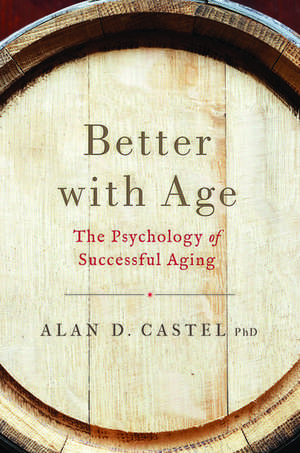
Better With Age: The Psychology of Successful Aging
Autor Alan D. Castelen Limba Engleză Hardback – 4 oct 2018
Preț: 215.03 lei
Preț vechi: 285.81 lei
-25%
Puncte Express: 323
Carte tipărită la comandă
Livrare economică 27 noiembrie-08 decembrie
Livrare express 23-29 octombrie pentru 218.18 lei
Livrare prin curier în România Termenul estimat este afișat lângă disponibilitate.
Transport gratuit de la 400.00 lei Plată online sau ramburs, în funcție de opțiunile comenzii.
Retur gratuit în 14 zile Comandă securizată și suport în română.
Specificații
ISBN-13: 9780190279981
ISBN-10: 0190279982
Pagini: 256
Dimensiuni: 163 x 236 x 25 mm
Greutate: 0.55 kg
Editura: Oxford University Press
Colecția OUP USA
Locul publicării:New York, United States
ISBN-10: 0190279982
Pagini: 256
Dimensiuni: 163 x 236 x 25 mm
Greutate: 0.55 kg
Editura: Oxford University Press
Colecția OUP USA
Locul publicării:New York, United States


Recenzii
A highly readable, engaging and worthwhile book.
This author's text promotes a positive approach toward aging, buttressed by recent research and interviews with famous older Americans ... Recommended.
There is no single formula to successful aging, but UCLA psychology professor Alan D. Castel provides a comprehensive and practical guide for shaping a life that is joyful, productive, healthy and meaningful. He debunks negative myths and self-defeating mind-sets about aging ... He reviews research studies that suggest that many people are happiest between the ages of 50 and 70 - sense of contentment resulting from some combination of a lessened financial burden due to an emptied nest, the opportunity to do something new and different in retirement, and a sense of gratitude for being able to look back on the joys and accomplishments of a lifetime. He provides compelling evidence that staying active physically helps us remain sharp mentally. Perhaps his most important advice is that youre never too young to develop habits that can help sustain healthy aging in the future.
This author's text promotes a positive approach toward aging, buttressed by recent research and interviews with famous older Americans ... Recommended.
There is no single formula to successful aging, but UCLA psychology professor Alan D. Castel provides a comprehensive and practical guide for shaping a life that is joyful, productive, healthy and meaningful. He debunks negative myths and self-defeating mind-sets about aging ... He reviews research studies that suggest that many people are happiest between the ages of 50 and 70 - sense of contentment resulting from some combination of a lessened financial burden due to an emptied nest, the opportunity to do something new and different in retirement, and a sense of gratitude for being able to look back on the joys and accomplishments of a lifetime. He provides compelling evidence that staying active physically helps us remain sharp mentally. Perhaps his most important advice is that youre never too young to develop habits that can help sustain healthy aging in the future.
Notă biografică
Alan D. Castel is a Professor in the Department of Psychology at the University of California, Los Angeles. His research focuses on how cognition changes with age and how people selectively remember important events. His work the National Institute on Aging. His work has been featured in The New York Times and Time Magazine. He received his PhD from the University of Toronto in 2004, completed a post-doctoral fellowship at Washington University in St. Louis, and has been a faculty member in the Department of at UCLA since 2006. He lives in Los Angeles, California, with his wife and three children.