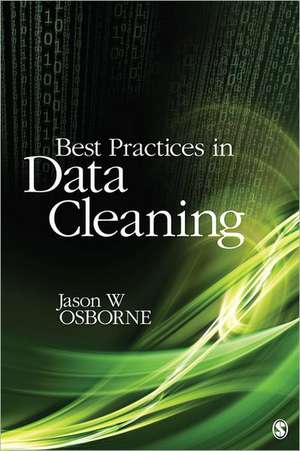
Best Practices in Data Cleaning
Autor Jason W Osborneen Limba Engleză Paperback – 10 ian 2012
Preț: 529.78 lei
Preț vechi: 623.27 lei
-15%
Puncte Express: 795
Carte disponibilă
Livrare economică 28 septembrie-12 octombrie
Livrare prin curier în România Termenul estimat este afișat lângă disponibilitate.
Transport gratuit pentru acest produs Plată online sau ramburs, în funcție de opțiunile comenzii.
Retur gratuit în 14 zile Comandă securizată și suport în română.
Specificații
ISBN-13: 9781412988018
ISBN-10: 1412988012
Pagini: 296
Dimensiuni: 152 x 229 x 17 mm
Greutate: 0.34 kg
Ediția:First Edition
Editura: SAGE Publications
Locul publicării:Thousand Oaks, United States
ISBN-10: 1412988012
Pagini: 296
Dimensiuni: 152 x 229 x 17 mm
Greutate: 0.34 kg
Ediția:First Edition
Editura: SAGE Publications
Locul publicării:Thousand Oaks, United States
V-ar putea interesa
-
 -26%Preț: 227.55 lei305.84 lei
 -
 Preț: 357.08 lei
 -
 Reflective InterviewingKathryn Joy Roulston-11%Preț: 430.80 lei484.05 lei
 -
 Qualitative Research Methods in Organisation StudiesLise Justesen-23%Preț: 253.92 lei328.10 lei
Recenzii
“This book provides the perfect bridge between the formal study of statistics and the practice of statistics. It fills the gap left by many of the traditional texts that focus either on the technical presentation or recipe-driven presentation of topics.”
“The first comprehensive and generally accessible text in this area.”
“The first comprehensive and generally accessible text in this area.”
Cuprins
Chapter 1. Why Data Cleaning is Important: Debunking the Myth of Robustness
Part 1. Best Practices as you Prepare for Data Collection
Chapter 2. Power and Planning for Data Collection: Debunking the Myth of Adequate Power
Chapter 3. Being True to the Target Population: Debunking the Myth of Representativeness
Chapter 4. Using Large Data Sets with Probability Sampling Frameworks: Debunking the Myth of Equality
Part 2. Best Practices in Data Cleaning and Screening
Chapter 5. Screening your Data for Potential Problems: Debunking the Myth of Perfect Data
Chapter 6. Dealing with Missing or Incomplete Data: Debunking the Myth of Emptiness
Chapter 7. Extreme and Influential Data Points: Debunking the Myth of Equality
Chapter 8. Improving the Normality of Variables through Box-Cox Transformation: Debunking the Myth of Distributional Irrelevance
Chapter 9. Does Reliability Matter? Debunking the Myth of Perfect Measurement
Part 3. Advanced Topics in Data Cleaning
Chapter 10. Random Responding, Motivated Mis-Responding, and Response Sets: Debunking the Myth of the Motivated Participant
Chapter 11. Why Dichotomizing Continuous Variables is Rarely a Good Practice: Debunking the Myth of Categorization
Chapter 12. The Special Challenge of Cleaning Repeated Measures Data: Lots of Pits to Fall into
Chapter 13. Now that the Myths are Debunked... Visions of Rational Quantitative Methodology for the 21st Century
Part 1. Best Practices as you Prepare for Data Collection
Chapter 2. Power and Planning for Data Collection: Debunking the Myth of Adequate Power
Chapter 3. Being True to the Target Population: Debunking the Myth of Representativeness
Chapter 4. Using Large Data Sets with Probability Sampling Frameworks: Debunking the Myth of Equality
Part 2. Best Practices in Data Cleaning and Screening
Chapter 5. Screening your Data for Potential Problems: Debunking the Myth of Perfect Data
Chapter 6. Dealing with Missing or Incomplete Data: Debunking the Myth of Emptiness
Chapter 7. Extreme and Influential Data Points: Debunking the Myth of Equality
Chapter 8. Improving the Normality of Variables through Box-Cox Transformation: Debunking the Myth of Distributional Irrelevance
Chapter 9. Does Reliability Matter? Debunking the Myth of Perfect Measurement
Part 3. Advanced Topics in Data Cleaning
Chapter 10. Random Responding, Motivated Mis-Responding, and Response Sets: Debunking the Myth of the Motivated Participant
Chapter 11. Why Dichotomizing Continuous Variables is Rarely a Good Practice: Debunking the Myth of Categorization
Chapter 12. The Special Challenge of Cleaning Repeated Measures Data: Lots of Pits to Fall into
Chapter 13. Now that the Myths are Debunked... Visions of Rational Quantitative Methodology for the 21st Century
Notă biografică
Jason W. Osborne is a thought leader and professor in higher education. His background in educational psychology, statistics and quantitative methods, along with that gleaned from high-level positions within Academia gives a unique perspective on the real-world data factors. In 2015, he was appointed Associate Provost and Dean of the Graduate School at Clemson University in Clemson, South Carolina. As well as Associate Provost, at Clemson University, Jason was a Professor of applied statistics at the School of Mathematical Sciences, with a secondary appointment in Public Health Science. In 2019, he took on the role of Provost and Executive VP for Academic Affairs at Miami University. As Provost, Jason implemented a transformative strategic plan to reposition the institution as one prepared for new challenges with a modern, compelling curriculum, a welcoming environment, and enhanced support for student faculty positions and staff. In 2021, he was named by Stanford University as one of the top 2% researchers in the world, underlining his commitment to world-class research methods across particular domains, ultimately influencing a generation of learners. Currently, Jason teaches and publishes on data analysis "best practices" in quantitative and applied research methods. He has served as evaluator or consultant on research projects and in public education (K-12), instructional technology, health care, medicine and business. He served as founding editor of Frontiers in Quantitative Psychology and Measurement and has been on the editorial boards of several other journals (such as Practical Assessment, Research, and Evaluation). Jason W Osborne also publishes on identification with academics and on issues related to social justice and diversity. He has written seven books covering topics to communicate logistic regression and linear modeling, exploratory factor analysis, best practices and modern research methods, data cleaning, and numerous other topics.
Descriere
This book provides a clear, step-by-step process of examining and cleaning data in order to decrease error rates and increase both the power and replicability of results.