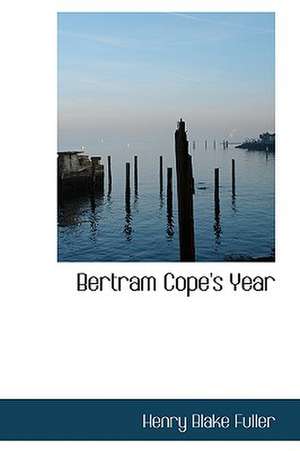
Bertram Cope's Year
Autor Henry Blake Fulleren Limba Engleză Paperback – 29 mai 2008
Preț: 150.78 lei
Puncte Express: 226
Carte tipărită la comandă
Livrare economică 30 noiembrie-14 decembrie
Livrare prin curier în România Termenul estimat este afișat lângă disponibilitate.
Transport gratuit de la 400.00 lei Plată online sau ramburs, în funcție de opțiunile comenzii.
Retur gratuit în 14 zile Comandă securizată și suport în română.
Specificații
ISBN-13: 9781426425745
ISBN-10: 1426425740
Pagini: 224
Dimensiuni: 127 x 203 x 12 mm
Greutate: 0.23 kg
Editura: Creative Media Partners, LLC
ISBN-10: 1426425740
Pagini: 224
Dimensiuni: 127 x 203 x 12 mm
Greutate: 0.23 kg
Editura: Creative Media Partners, LLC
V-ar putea interesa
-
 Jacob's RoomVirginia WoolfPreț: 28.01 lei
 -
 Franny and ZooeyJ. D. SalingerPreț: 63.66 lei
 -
 Keep the Aspidistra FlyingGeorge Orwell-27%Preț: 52.59 lei71.65 lei
 -
 MauriceEdward Morgan Forster-26%Preț: 58.62 lei78.93 lei
 -
 The Catcher in the Rye.J D SalingerPreț: 177.76 lei
 -
 The City And The PillarGore Vidal-27%Preț: 56.67 lei78.10 lei
 -
 This Side Of ParadiseF. Scott FitzgeraldPreț: 40.30 lei
 -
 The Picture of Dorian GrayOscar WildePreț: 35.93 lei
 -
 Preț: 50.02 lei
 -
 Classic Stories from the Age of DecadenceJane DesmaraisPreț: 78.53 lei
 -
 A Boy's Own StoryEdmund White-43%Preț: 47.14 lei82.61 lei
 -
 The Cliff-DwellersHenry Fuller-17%Preț: 165.01 lei199.13 lei
 -
 All The Sad Young MenF. Scott FitzgeraldPreț: 57.30 lei
 -
 DublinersJames JoycePreț: 28.01 lei
 -
 Age of InnocenceEdith WhartonPreț: 28.01 lei
 -
 Preț: 34.20 lei
 -
 UtopiaThomas MorePreț: 33.19 lei
 -
 Lucy GayheartWilla CatherPreț: 73.72 lei
 -
 Riverbay Road Men's Dormitory (Novel) Vol. 2Fei Tian Ye XiangPreț: 121.47 lei
Recenzii
In 1918, when Henry Blake Fuller was 62 years old, he completed the manuscript of a novel, Bertram Cope’s Year. Though Fuller was well known as an accomplished realist and had published twelve previous novels, this work was his first published fiction to address the topic of homosexuality. In the novel Bertram Cope, a handsome young college student, is befriended by Medora Phillips, a wealthy older woman who tries to match him with several eligible young women. However, Bertram is emotionally attached only to his friend and housemate, Arthur Lemoyne. The novel’s portrayal of their friendship is subtle, but has clear overtones of sexual attraction.
Appendices focus on the novel’s composition, reception, and place in contemporary discourses about attraction between men.
“Bertram Cope’s Year—Henry Blake Fuller’s alternately arch and melancholy riposte to the sentimental conventions of heterosexual romance—has been waiting almost a century for its due share of apt readers. At last it has a chance of finding them, thanks to Joseph Dimuro, whose expert editing, indispensable introductory essay, and judicious choice of supplemental writings and reviews open the novel up as never before to scholarly and non-scholarly audiences alike.” — Max Cavitch, University of Pennsylvania
“Joseph Dimuro has produced a critical edition of Bertram Cope’s Year that is lucid and well-researched; it is a fitting study of an important novel. Adding previously unpublished material from Fuller’s journals and—excitingly—from the novel itself makes this edition a delight for readers, critics, and researchers alike. This Broadview Edition shows how modern Fuller was in his treatment of gay men, and their relationships with women and each other.” — Keith Gumery, Temple University
Appendices focus on the novel’s composition, reception, and place in contemporary discourses about attraction between men.
“Bertram Cope’s Year—Henry Blake Fuller’s alternately arch and melancholy riposte to the sentimental conventions of heterosexual romance—has been waiting almost a century for its due share of apt readers. At last it has a chance of finding them, thanks to Joseph Dimuro, whose expert editing, indispensable introductory essay, and judicious choice of supplemental writings and reviews open the novel up as never before to scholarly and non-scholarly audiences alike.” — Max Cavitch, University of Pennsylvania
“Joseph Dimuro has produced a critical edition of Bertram Cope’s Year that is lucid and well-researched; it is a fitting study of an important novel. Adding previously unpublished material from Fuller’s journals and—excitingly—from the novel itself makes this edition a delight for readers, critics, and researchers alike. This Broadview Edition shows how modern Fuller was in his treatment of gay men, and their relationships with women and each other.” — Keith Gumery, Temple University
Descriere
Descriere de la o altă ediție sau format:
In 1918, when Henry Blake Fuller was 62 years old, he completed the manuscript of a novel, Bertram Cope’s Year. Though Fuller was well known as an accomplished realist and had published twelve previous novels, this work was his first published fiction to address the topic of homosexuality. In the novel Bertram Cope, a handsome young college student, is befriended by Medora Phillips, a wealthy older woman who tries to match him with several eligible young women. However, Bertram is emotionally attached only to his friend and housemate, Arthur Lemoyne. The novel’s portrayal of their friendship is subtle, but has clear overtones of sexual attraction.
Appendices focus on the novel’s composition, reception, and place in contemporary discourses about attraction between men.
In 1918, when Henry Blake Fuller was 62 years old, he completed the manuscript of a novel, Bertram Cope’s Year. Though Fuller was well known as an accomplished realist and had published twelve previous novels, this work was his first published fiction to address the topic of homosexuality. In the novel Bertram Cope, a handsome young college student, is befriended by Medora Phillips, a wealthy older woman who tries to match him with several eligible young women. However, Bertram is emotionally attached only to his friend and housemate, Arthur Lemoyne. The novel’s portrayal of their friendship is subtle, but has clear overtones of sexual attraction.
Appendices focus on the novel’s composition, reception, and place in contemporary discourses about attraction between men.
Cuprins
Acknowledgements
Introduction
Henry Blake Fuller: A Brief Chronology
A Note on the Text
Bertram Cope’s Year
Appendix A: Fuller’s Emendations to Bertram Cope’s Year
Appendix B: From Anatole France, The Garden of Epicurus (1923)
Appendix C: Writings by Henry Blake Fuller
Introduction
Henry Blake Fuller: A Brief Chronology
A Note on the Text
Bertram Cope’s Year
Appendix A: Fuller’s Emendations to Bertram Cope’s Year
Appendix B: From Anatole France, The Garden of Epicurus (1923)
Appendix C: Writings by Henry Blake Fuller
- From Edmund Dalrymple (1904)
- At Saint Judas’s from The Puppet Booth: Twelve Plays (1896)
- “When Robert Sings” (n.d.)
- From “A Legacy to Posterity” (1874–79)
- From “Allison Classical Academy” (1875)
- Burton Rascoe, Chicago Tribune (8 November 1919)
- Unsigned Review, Boston Evening Transcript (13 November 1919)
- Llewellyn Jones, “Henry B. Fuller Portrays Youth and Would-Be Youth,” Chicago Evening Post (28 November 1919)
- Unsigned Review, “Under the Microscope,” The Boston Post (n.d.)
- H.L. Mencken, “The Flood of Fiction,” The Smart Set (January 1920)
- Keith Preston, “North of Chicago,” “The Periscope,” Chicago Daily News (n.d.)
- From Carl Van Vechten, “Henry Blake Fuller,” Excavations: A Book of Advocacies (1926)