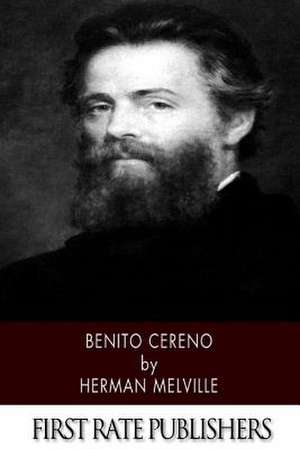
Benito Cereno
Autor Herman Melvilleen Limba Engleză Paperback
Preț: 37.90 lei
Puncte Express: 57
Carte disponibilă
Livrare economică 13-27 noiembrie
Livrare prin curier în România Termenul estimat este afișat lângă disponibilitate.
Transport gratuit de la 400.00 lei Plată online sau ramburs, în funcție de opțiunile comenzii.
Retur gratuit în 14 zile Comandă securizată și suport în română.
Specificații
ISBN-13: 9781496164575
ISBN-10: 1496164571
Pagini: 54
Dimensiuni: 152 x 229 x 3 mm
Greutate: 0.09 kg
Editura: CREATESPACE
ISBN-10: 1496164571
Pagini: 54
Dimensiuni: 152 x 229 x 3 mm
Greutate: 0.09 kg
Editura: CREATESPACE
V-ar putea interesa
-
 Robinson CrusoeDaniel DefoePreț: 28.01 lei
 -
 Billy Budd, Bartleby, and Other StoriesHerman Melville-18%Preț: 59.58 lei72.52 lei
 -
 Herman Melville: A Very Short IntroductionMaurice S. Lee-20%Preț: 56.65 lei70.82 lei
 -
 Twelve Years a SlaveSolomon NorthupPreț: 187.39 lei
 -
 Melville's Short NovelsHerman MelvillePreț: 123.11 lei
 -
 Heart Of Darkness And The Secret SharerJoseph ConradPreț: 38.67 lei
 -
 Heart of DarknessJoseph Conrad-19%Preț: 23.18 lei28.58 lei
 -
 Bartleby and Benito CerenoHerman MelvillePreț: 38.86 lei
 -
 TypeeHerman MelvillePreț: 52.01 lei
 -
 Moby-DickHerman Melville-30%Preț: 34.54 lei49.00 lei
 -
 Empire of NecessityGreg GrandinPreț: 152.09 lei
 -
 Two Orations of the Emperor JulianThomas TaylorPreț: 57.60 lei
 -
 The Call of the EastThurlow FraserPreț: 46.76 lei
 -
 Cape of StormsPercival PollardPreț: 44.99 lei
 -
 The Camp in the SnowWilliam Murray GraydonPreț: 39.06 lei
 -
 Cambridge Essays on EducationVariousPreț: 44.59 lei
 -
 Captivating Mary CarstairsHenry Sydnor HarrisonPreț: 46.55 lei
 -
 Carnac's FollyGilbert ParkerPreț: 45.77 lei
 -
 A Canadian Heroine a NovelMrs Harry CoghillPreț: 44.59 lei
 -
 Camps, Quarters, and Casual PlacesArchibald ForbesPreț: 52.65 lei
 -
 Chippinge BoroughStanley J. WeymanPreț: 68.61 lei
 -
 The Carter GirlsNell SpeedPreț: 44.99 lei
 -
 The Confidence-ManHerman MelvillePreț: 51.98 lei
 -
 -26%Preț: 67.83 lei92.14 lei
 -
 The Piazza TalesHerman MelvillePreț: 42.87 lei
 -
 Melville, H: Moby DickHerman MelvillePreț: 69.61 lei
 -
 -5%Preț: 63.35 lei66.57 lei
 -
 Moby DickHerman MelvillePreț: 39.32 lei
 -
 Heart of DarknessJoseph ConradPreț: 30.68 lei
Descriere
Descriere de la o altă ediție sau format:
“Benito Cereno,” a story of atmospheric Gothic horror and striking political resonance, represents Herman Melville’s most profound and unsettling engagement with the horrors of New World slavery. Narrating the story of a slave revolt using materials drawn from Amasa Delano’s non-fictional account of the Tryal Rebellion from earlier in the nineteenth century, Melville’s story probes the moral complexities of the antebellum United States and its position within the Americas. Melville explores the psychology of slavery and racism and the role of violence in both the resistance to, and the perpetuation of, slavery in the Americas.
The appendices to this volume illustrate how Melville’s satirical treatment of racism and his ambivalent response to violent resistance to slavery connect with antislavery literature (poetry, fiction, and non-fiction alike) in the middle of the nineteenth century, and they also consider how “Benito Cereno” functions as a central piece in Melville’s contribution to the literature of the Americas.
“Benito Cereno,” a story of atmospheric Gothic horror and striking political resonance, represents Herman Melville’s most profound and unsettling engagement with the horrors of New World slavery. Narrating the story of a slave revolt using materials drawn from Amasa Delano’s non-fictional account of the Tryal Rebellion from earlier in the nineteenth century, Melville’s story probes the moral complexities of the antebellum United States and its position within the Americas. Melville explores the psychology of slavery and racism and the role of violence in both the resistance to, and the perpetuation of, slavery in the Americas.
The appendices to this volume illustrate how Melville’s satirical treatment of racism and his ambivalent response to violent resistance to slavery connect with antislavery literature (poetry, fiction, and non-fiction alike) in the middle of the nineteenth century, and they also consider how “Benito Cereno” functions as a central piece in Melville’s contribution to the literature of the Americas.
Recenzii
“Benito Cereno,” a story of atmospheric Gothic horror and striking political resonance, represents Herman Melville’s most profound and unsettling engagement with the horrors of New World slavery. Narrating the story of a slave revolt using materials drawn from Amasa Delano’s non-fictional account of the Tryal Rebellion from earlier in the nineteenth century, Melville’s story probes the moral complexities of the antebellum United States and its position within the Americas. Melville explores the psychology of slavery and racism and the role of violence in both the resistance to, and the perpetuation of, slavery in the Americas.
The appendices to this volume illustrate how Melville’s satirical treatment of racism and his ambivalent response to violent resistance to slavery connect with antislavery literature (poetry, fiction, and non-fiction alike) in the middle of the nineteenth century, and they also consider how “Benito Cereno” functions as a central piece in Melville’s contribution to the literature of the Americas.
“The Broadview Press edition of Herman Melville’s ‘Benito Cereno’ is vital for teaching, research, and exploring the power of American short fiction. From abolitionist writings to texts about the Haitian Revolution to reflections by Melville’s contemporaries, Brian Yothers has reassembled crucial materials for a profound journey into Melville’s fictional universe. Whether you are interested in the historical context that inspired Melville or the philosophical questions that saturate his art, this captivating edition contains all of the major materials and literary artifacts. If you’re teaching, rereading, or even discovering ‘Benito Cereno’ for the first time, this edition is a fresh and fully updated take on Melville’s classic.” — Christopher Freeburg, University of Illinois, Urbana-Champaign
The appendices to this volume illustrate how Melville’s satirical treatment of racism and his ambivalent response to violent resistance to slavery connect with antislavery literature (poetry, fiction, and non-fiction alike) in the middle of the nineteenth century, and they also consider how “Benito Cereno” functions as a central piece in Melville’s contribution to the literature of the Americas.
“The Broadview Press edition of Herman Melville’s ‘Benito Cereno’ is vital for teaching, research, and exploring the power of American short fiction. From abolitionist writings to texts about the Haitian Revolution to reflections by Melville’s contemporaries, Brian Yothers has reassembled crucial materials for a profound journey into Melville’s fictional universe. Whether you are interested in the historical context that inspired Melville or the philosophical questions that saturate his art, this captivating edition contains all of the major materials and literary artifacts. If you’re teaching, rereading, or even discovering ‘Benito Cereno’ for the first time, this edition is a fresh and fully updated take on Melville’s classic.” — Christopher Freeburg, University of Illinois, Urbana-Champaign
Cuprins
Acknowledgements
Introduction
Herman Melville: A Brief Chronology
A Note on the Text
“Benito Cereno”
Appendix A: Representations of Slave Revolt and the Slave Trade
Introduction
Herman Melville: A Brief Chronology
A Note on the Text
“Benito Cereno”
Appendix A: Representations of Slave Revolt and the Slave Trade
- 1. From Amasa Delano, Narrative of Voyages and Travels in the Northern and Southern Hemispheres (1817)
- 2. From Frederick Douglass, “The Heroic Slave” (1853)
- 3. From John Quincy Adams, Argument of John Quincy Adams Before the Supreme Court of the United States, in the Case of United States, Appellants, Cinque, and Others, Africans (1841)
- 4. From Frederick Douglass, My Bondage and My Freedom (1855)
- 5. From Harriet Beecher Stowe, Dred, A Tale of the Great Dismal Swamp (1856)
- 6. From The Confessions of Nat Turner (1832)
- 7. Am I Not a Man and a Brother? (1787)
- 8. Stowage of the British Slave Ship Brookes under the Regulated Slave Trade Act of 1788
- 9. The Slave Deck of the Bark “Wildfire” Brought into Key West on 30 April 1860
- 10. The Abolition of the Slave Trade (1792)
- 11. Cinque, the Chief of the Amistad Captives (1840)
- 1. From Herman Melville, Typee (1846)
- 2. From Herman Melville, “Mr. Parkman’s Tour,” New York Literary World (31 March 1849)
- 3. From Herman Melville, “A Bosom Friend,” in Moby-Dick, or, The Whale (1851)
- 4. From Herman Melville, “Midnight, Forecastle,” in Moby-Dick, or, The Whale (1851)
- 5. Herman Melville, “Formerly a Slave,” in Battle-Pieces and Aspects of the War (1866)
- 6. Herman Melville, “The Swamp Angel,” in Battle-Pieces and Aspects of the War (1866)
- 7. From Herman Melville, Supplement to Battle-Pieces and Aspects of the War (1866)
- 8. From Herman Melville, Clarel, A Poem and Pilgrimage in the Holy Land (1876)
- 1. John Greenleaf Whittier, “Toussaint L’Ouverture” (1833)
- 2. William Wordsworth, “To Toussaint L’Ouverture” (1802)
- 3. From Frank J. Webb, The Garies and Their Friends (1857)
- 4. Toussaint Louverture
- 5. From Daniel Defoe, The Life and Strange Surprizing Adventures of Robinson Crusoe (1719)
- 6. From James Montgomery, The West Indies (1810)
- 1. From Frederick Douglass, “What to the Slave is the Fourth of July?” (5 July 1852)
- 2. Frederick Douglass, “A Parody,” in Narrative of the Life of Frederick Douglass (1845)
- 3. Elizabeth Barrett Browning, “The Runaway Slave at Pilgrim’s Point” (1849)
- 4. James Russell Lowell, “The Present Crisis” (1844)
- 5. James M. Whitfield, “To Cinque” (1853)
- 6. James M. Whitfield, “Lines on the Death of John Quincy Adams” (1853)
- 7. James M. Whitfield, “America” (1853)
- 8. Frances E.W. Harper, “The Slave Mother. A Tale of the Ohio” (1857)
- 9. Harriet Beecher Stowe, “Caste and Christ” (1853)
- 10. From Lydia Maria Child, An Appeal in Favor of that Class of Americans Called Africans (1833)
- 11. Lydia Maria Child, “The Influence of Slavery with Regard to Moral Purity” (1838)
- 12. Lydia Huntley Sigourney, “To the First Slave Ship” (1827)
- 1. From Herman Melville, “Hawthorne and his Mosses,” Literary World (1850)
- 2. From Edgar Allan Poe, Review of Nathaniel Hawthorne’s Twice-Told Tales, Graham’s Magazine (1842)
- 3. Review of The Piazza Tales, United States Democratic Review (September 1856)
- 4. Nathaniel Hawthorne, Preface to The House of the Seven Gables (1852)
Notă biografică
Herman Melville (1819 - 1891) was an American novelist, short story writer and poet of the American Renaissance period. His best known works include Typee (1846), a romantic account of his experiences in Polynesian life and his whaling novel Moby-Dick (1851). His work was almost forgotten during his last thirty years. Herman Melville's writing draws on his experience at sea as a common sailor, exploration of literature and philosophy and engagement in the contradictions of American society in a period of rapid change. He developed a complex, baroque style: the vocabulary is rich and original, a strong sense of rhythm infuses the elaborate sentences, the imagery is often mystical or ironic and the abundance of allusion extends to scripture, myth, philosophy, literature and the visual arts.