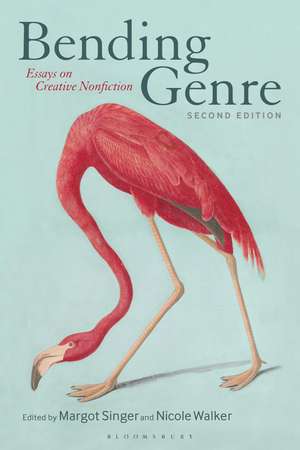
Bending Genre: Essays on Creative Nonfiction
Editat de Dr. Margot Singer, Dr. Nicole Walkeren Limba Engleză Paperback – 23 feb 2023
Written for writers and students of creative writing, this collection brings together perspectives from leading writers of creative nonfiction, including Michael Martone, Brenda Miller, Ander Monson, David Shields, Kazim Ali--and in the new edition--Catina Bacote, Ira Sukrungruang, Ingrid Horrocks, Elena Passarello, and Aviya Kushner. Each writer's innovative essay probes our notions of genre and investigates how creative nonfiction is shaped, modeling the forms of writing being discussed. Like creative nonfiction itself, Bending Genre is an exciting hybrid that breaks new ground.
Features in the second edition:
-Updated introduction to the new edition
-Expanded sections on Hybrids, Structures, and "Unconventions"
-A new section on Resistances
-50 essays in all
Preț: 188.36 lei
Preț vechi: 264.61 lei
-29%
Puncte Express: 283
Carte disponibilă
Livrare economică 07-21 noiembrie
Livrare express 24-30 octombrie pentru 114.10 lei
Livrare prin curier în România Termenul estimat este afișat lângă disponibilitate.
Transport gratuit de la 400.00 lei Plată online sau ramburs, în funcție de opțiunile comenzii.
Retur gratuit în 14 zile Comandă securizată și suport în română.
Specificații
ISBN-13: 9781501386060
ISBN-10: 1501386069
Pagini: 360
Dimensiuni: 152 x 228 x 26 mm
Greutate: 0.56 kg
Ediția:2nd edition
Editura: Bloomsbury Publishing
Colecția Bloomsbury Academic
Locul publicării:New York, United States
ISBN-10: 1501386069
Pagini: 360
Dimensiuni: 152 x 228 x 26 mm
Greutate: 0.56 kg
Ediția:2nd edition
Editura: Bloomsbury Publishing
Colecția Bloomsbury Academic
Locul publicării:New York, United States
Cuprins
Introduction to the Second Edition
I. Hybrids
1. Why Some Hybrids Work and Others Don't, Lia Purpura
2. Queering the Essay, David Lazar
3. The Everbent Genre, Patrick Madden
4. Don't Let Those Damn Genres Cross You Ever Again!, Lawrence Sutin
5. Genre-Queer: Notes Against Generic Binaries, Kazim Ali
6. On the EEO Genre Sheet, Jenny Boully
7. Reading Samuel R. Delany, T Clutch Fleischmann
8. Beautiful Muddied Waters: On Genre and Veracity, Sean Prentiss
9. Listening for the Sound, Sejal Shah
10. Split Tone, Lee Martin
11. Lyrebirds in the Impasse, David Carlin
12. Headiness, Karen Brennan
13. What's in Your Purse?: Essays Through the Eyes of a Character Actor, Elaine Passarello
14. Propositions; Provocations: Inventions, Mary Capello
II. Structures
15. On Scaffolding, Hermit Crabs, and the Real False Document, Margot Singer
16. Text Adventure, Ander Monson
17. Adventures in the Reference Section, Kevin Haworth
18. Meeting the Ancestor on the Road, Tina Makereti
19. Autogeographies, Barrie Jean Borich
20. Dissolving Genre: Writ with Water, Ingrid Horrocks
21. "Lions and Tigers and Bears, Oh My!": Courage and Creative Nonfiction, Brenda Miller
22. Traumatized Time, David McGlynn
23. Escapology, Justin Hocking
24. Play-Doh Fun Factory Poetics, Wayne Koestenbaum
25. A Sequence of Thoughts Without Any Kind of Order, Ira Sukrungruang
26. My Mistake, Nicole Walker
III. Unconventions
27. On Convention, Margot Singer
28. Losing Language, Camille Dungy
29. What the Bottles Know, Lina Ferreira Cabeza-Vanegas
30. 44 Tattoos, David Shields
31. Creative Exposition-Anther Way that Nonfiction Writing Can Be Good, Dave Madden
32. This Photograph is Evidence of You, Lawrence Lacambra Ypil
33. Ostrakons at Amphipolis, Postcards from Chicago: Thucydides and the Invention and Deployment of Lyric History, Michael Martone
34. On Fragmentation, Steve Fellner
35. Single Mindedness and Whole Heartedness in the Essay Writing Workshop: An Essay in Many Parts, Jenn Ashworth
36. Positively Negative, Dinty W. Moore
37. Study Questions for the Essay at Hand: A Speculative Essay, Robin Hemley
38. A Brief History of Disquiet, Deficit & Disbelief by FeiMan, Xu Xi
39. The Inclusivity of Metaphor, Nicole Walker
IV. Resistances
40. The Funk of Defiance, the Freedom of Refusal, Catina Bacote
41. The Essay as Resistance, Aviya Kushner
42. Prepositioning Resistance, Queerly Francesca Rendle-Short
43. Exposition as Resistance: Tell Me the Moon Is Shining, Matthew Batt
44. The Lyric Essay as a Mode of Resistance, LaTanya McQueen
45. It Is What It Is, Eula Biss
46. How It Is: Writing Towards Wonder, Jessica Hendry Nelson
47. On Not Being Able to Write It, Wendy Rawlings
48. Hermes Goes to College, Michael Martone
49. The Convex View, Karen Lloyd
50. The Moral Map, Stephanie Elizondo Griest
I. Hybrids
1. Why Some Hybrids Work and Others Don't, Lia Purpura
2. Queering the Essay, David Lazar
3. The Everbent Genre, Patrick Madden
4. Don't Let Those Damn Genres Cross You Ever Again!, Lawrence Sutin
5. Genre-Queer: Notes Against Generic Binaries, Kazim Ali
6. On the EEO Genre Sheet, Jenny Boully
7. Reading Samuel R. Delany, T Clutch Fleischmann
8. Beautiful Muddied Waters: On Genre and Veracity, Sean Prentiss
9. Listening for the Sound, Sejal Shah
10. Split Tone, Lee Martin
11. Lyrebirds in the Impasse, David Carlin
12. Headiness, Karen Brennan
13. What's in Your Purse?: Essays Through the Eyes of a Character Actor, Elaine Passarello
14. Propositions; Provocations: Inventions, Mary Capello
II. Structures
15. On Scaffolding, Hermit Crabs, and the Real False Document, Margot Singer
16. Text Adventure, Ander Monson
17. Adventures in the Reference Section, Kevin Haworth
18. Meeting the Ancestor on the Road, Tina Makereti
19. Autogeographies, Barrie Jean Borich
20. Dissolving Genre: Writ with Water, Ingrid Horrocks
21. "Lions and Tigers and Bears, Oh My!": Courage and Creative Nonfiction, Brenda Miller
22. Traumatized Time, David McGlynn
23. Escapology, Justin Hocking
24. Play-Doh Fun Factory Poetics, Wayne Koestenbaum
25. A Sequence of Thoughts Without Any Kind of Order, Ira Sukrungruang
26. My Mistake, Nicole Walker
III. Unconventions
27. On Convention, Margot Singer
28. Losing Language, Camille Dungy
29. What the Bottles Know, Lina Ferreira Cabeza-Vanegas
30. 44 Tattoos, David Shields
31. Creative Exposition-Anther Way that Nonfiction Writing Can Be Good, Dave Madden
32. This Photograph is Evidence of You, Lawrence Lacambra Ypil
33. Ostrakons at Amphipolis, Postcards from Chicago: Thucydides and the Invention and Deployment of Lyric History, Michael Martone
34. On Fragmentation, Steve Fellner
35. Single Mindedness and Whole Heartedness in the Essay Writing Workshop: An Essay in Many Parts, Jenn Ashworth
36. Positively Negative, Dinty W. Moore
37. Study Questions for the Essay at Hand: A Speculative Essay, Robin Hemley
38. A Brief History of Disquiet, Deficit & Disbelief by FeiMan, Xu Xi
39. The Inclusivity of Metaphor, Nicole Walker
IV. Resistances
40. The Funk of Defiance, the Freedom of Refusal, Catina Bacote
41. The Essay as Resistance, Aviya Kushner
42. Prepositioning Resistance, Queerly Francesca Rendle-Short
43. Exposition as Resistance: Tell Me the Moon Is Shining, Matthew Batt
44. The Lyric Essay as a Mode of Resistance, LaTanya McQueen
45. It Is What It Is, Eula Biss
46. How It Is: Writing Towards Wonder, Jessica Hendry Nelson
47. On Not Being Able to Write It, Wendy Rawlings
48. Hermes Goes to College, Michael Martone
49. The Convex View, Karen Lloyd
50. The Moral Map, Stephanie Elizondo Griest
Recenzii
Come for talk of the essay in all its formal wildness. Stay for a consideration of the form's power and politics of resistance. Even deeper and more expansive than its first edition, Bending Genre 2.0 is essential reading for serious students, teachers, and writers of nonfiction.
As creative nonfiction continues to break new ground, Bending Genre gives writers and readers a marvelous map to new literary terrain, as charted by some of the form's most interesting cartographers and practitioners. By turns earnest, argumentative, lyric, playful, and provocative, the authors of these pieces explore nonfiction forms as refuge, as rebellion, as intellectual practice, as erotics and aesthetics, as mode of making, and as liberating community. Encouraging exploration and seeded with compelling readings of familiar and less familiar texts, Bending Genre is suggestive rather than scholarly, offering a mode of making and a gloss on the meanings made by this rich, shifting, wonderfully hard to define literary playground that we call creative nonfiction.
Bending Genre is published into a landscape that has changed so much in the past ten years and will change even more in the next decades, and the essays that are the most convincing are those advocating that we cross, bend and break genre open in more disruptive ways - as writers and readers - and use our creative-critical powers to undo systems that have not been serving us. This book provides a solid anchor for thinking into genre-bending writing, and if readers supplement this text with the reading of many and diverse contemporary hybrid texts, they will experience first-hand how hot genre-bending writing can make their brains, how spacious it can make a heart.
Bending Genre is an exciting anthology of contemporary nonfiction that shifts the focus from ethical questions about 'truthtelling' to aesthetic questions about form. The contributors make up a who's-who of distinguished and new writers who have been enlivening the conversation about formal range in nonfiction for the past decade. What happens when writers 'push the line,' the editors ask, in terms of what defines genre? Oddball and exploratory, reflective and transgressive, musical and mindful, these essays brilliantly lay out the trail.
What a wonderful and needed anthology! The essay has always created itself by doing battle with its adjectives: formal, informal, personal, genteel, modern(ist). Now, just as we were getting comfortable-too comfortable-with lyrical, this anthology arrives to unsettle us again with a slew of new adjectives: queer, bent, bending, monstrous, hybrid, impertinent, fluid, transgressive, anarchic, faked, diabolic, mis-shelved, Dionysian, blissful, puzzling, vertiginous, saturated, unboxed. And then, when our heads are beginning to explode with the centrifugal force of these adjectives, Bending Genre pulls us back with an equally wondrous and innovative set of formal possibilities - creative nonfiction as video game, false document, encyclopedia, autogeography, murder mystery, sepia-tone picture, Play-Doh construction, train trip, user of white space, questionnaire, or the genre that dare not speak its name. I will adopt this book for my classes. It's time to shake things up.
Opens up via several essays by some of the best current practitioners and theorists of the essay-writing craft...The essays of Part II, 'Structures', offer numerous examples and ideas of shaping organizational frameworks for the essay...an excellent job discussing the uses of story, elements,montage, white spaces, lack of closure, etymology, and metaphor...I would recommend this collection to all serious writers.
A wonderfully queer enterprise. Collectively, it is not entirely criticism; not entirely creative writing. Singer and Walker collate the essays to destabilize the reader's assumptions and expectations of the text--and they do so successfully...Perplexing and intellectually stimulating, Bending Genre and all the questions it raises continues the discussion outside of the text. What is particularly noteworthy of Singer and Walker is that their project--much in vein of "queer" and of the notion that writing, like critical thinking, is interminable--remains alive online. They have harnessed the powers of new media to keep the discussion going, both on Facebook as well as the project's website.
As creative nonfiction continues to break new ground, Bending Genre gives writers and readers a marvelous map to new literary terrain, as charted by some of the form's most interesting cartographers and practitioners. By turns earnest, argumentative, lyric, playful, and provocative, the authors of these pieces explore nonfiction forms as refuge, as rebellion, as intellectual practice, as erotics and aesthetics, as mode of making, and as liberating community. Encouraging exploration and seeded with compelling readings of familiar and less familiar texts, Bending Genre is suggestive rather than scholarly, offering a mode of making and a gloss on the meanings made by this rich, shifting, wonderfully hard to define literary playground that we call creative nonfiction.
Bending Genre is published into a landscape that has changed so much in the past ten years and will change even more in the next decades, and the essays that are the most convincing are those advocating that we cross, bend and break genre open in more disruptive ways - as writers and readers - and use our creative-critical powers to undo systems that have not been serving us. This book provides a solid anchor for thinking into genre-bending writing, and if readers supplement this text with the reading of many and diverse contemporary hybrid texts, they will experience first-hand how hot genre-bending writing can make their brains, how spacious it can make a heart.
Bending Genre is an exciting anthology of contemporary nonfiction that shifts the focus from ethical questions about 'truthtelling' to aesthetic questions about form. The contributors make up a who's-who of distinguished and new writers who have been enlivening the conversation about formal range in nonfiction for the past decade. What happens when writers 'push the line,' the editors ask, in terms of what defines genre? Oddball and exploratory, reflective and transgressive, musical and mindful, these essays brilliantly lay out the trail.
What a wonderful and needed anthology! The essay has always created itself by doing battle with its adjectives: formal, informal, personal, genteel, modern(ist). Now, just as we were getting comfortable-too comfortable-with lyrical, this anthology arrives to unsettle us again with a slew of new adjectives: queer, bent, bending, monstrous, hybrid, impertinent, fluid, transgressive, anarchic, faked, diabolic, mis-shelved, Dionysian, blissful, puzzling, vertiginous, saturated, unboxed. And then, when our heads are beginning to explode with the centrifugal force of these adjectives, Bending Genre pulls us back with an equally wondrous and innovative set of formal possibilities - creative nonfiction as video game, false document, encyclopedia, autogeography, murder mystery, sepia-tone picture, Play-Doh construction, train trip, user of white space, questionnaire, or the genre that dare not speak its name. I will adopt this book for my classes. It's time to shake things up.
Opens up via several essays by some of the best current practitioners and theorists of the essay-writing craft...The essays of Part II, 'Structures', offer numerous examples and ideas of shaping organizational frameworks for the essay...an excellent job discussing the uses of story, elements,montage, white spaces, lack of closure, etymology, and metaphor...I would recommend this collection to all serious writers.
A wonderfully queer enterprise. Collectively, it is not entirely criticism; not entirely creative writing. Singer and Walker collate the essays to destabilize the reader's assumptions and expectations of the text--and they do so successfully...Perplexing and intellectually stimulating, Bending Genre and all the questions it raises continues the discussion outside of the text. What is particularly noteworthy of Singer and Walker is that their project--much in vein of "queer" and of the notion that writing, like critical thinking, is interminable--remains alive online. They have harnessed the powers of new media to keep the discussion going, both on Facebook as well as the project's website.