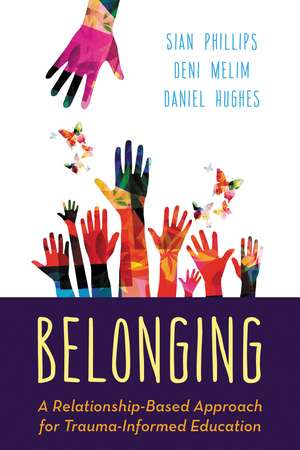
Belonging: A Relationship-Based Approach for Trauma-Informed Education
Autor Sian Phillips, Deni Melim, Daniel A. Hughesen Limba Engleză Paperback – 15 aug 2020
Even though it is relationships that have hurt students with developmental trauma, it is known that they must find safe relationships to learn and heal. Forming those relationships with children who have been hurt and no longer trust adults is not easy. This book focuses on three important and comprehensive areas of theory and research that provide a theoretical, clinical, and integrated intervention model for developing the relationships and felt sense of safety children with developmental trauma need. Using what is known from attachment theory, intersubjectivity theory, and interpersonal neurobiology, the reader is helped to understand why children behave in the challenging ways they do.
This book offers successes and ongoing challenges as a means to continue the conversation about how best to support some of our most at-risk youth.
Preț: 230.61 lei
Preț vechi: 301.09 lei
-23%
Puncte Express: 346
Carte tipărită la comandă
Livrare economică 28 noiembrie-12 decembrie
Livrare prin curier în România Termenul estimat este afișat lângă disponibilitate.
Transport gratuit de la 400.00 lei Plată online sau ramburs, în funcție de opțiunile comenzii.
Retur gratuit în 14 zile Comandă securizată și suport în română.
Specificații
ISBN-13: 9781538135990
ISBN-10: 153813599X
Pagini: 256
Ilustrații: 24 b/w illustrations; 2 b/w photos; 7 tables; 5 textboxes
Dimensiuni: 150 x 226 x 24 mm
Greutate: 0.51 kg
Editura: Bloomsbury Publishing
Colecția Rowman & Littlefield
Locul publicării:New York, United States
ISBN-10: 153813599X
Pagini: 256
Ilustrații: 24 b/w illustrations; 2 b/w photos; 7 tables; 5 textboxes
Dimensiuni: 150 x 226 x 24 mm
Greutate: 0.51 kg
Editura: Bloomsbury Publishing
Colecția Rowman & Littlefield
Locul publicării:New York, United States
Cuprins
Acknowledgments
Preface
Part I
1 Lessons from Poly Vagal Theory: If a Child Could Do Better, He or She Would 3
2 Lessons from Interpersonal Neurobiology
3 Lessons from Attachment Theory
4 Lessons from Intersubjectivity
5 Dyadic Developmental Practice and Its application to Education
6 Co-regulation of Affect: The Affective/Reflective (A/R) Dialogue
7 Using A/R Dialogue to Explore and Discover the Meanings of the Child's Behavior
Part II
8 Belong: A Classroom for Children with Attachment and Trauma Difficulties
9 Our Day: Structured Flexibility
10 Meeting Challenging Behavior with PACE
11 Lesson Planning
12 Working with Parents and Community Supports Parents
13 Case Study
14 What Have We Learned in Six Years?
15 Bloopers: Where We Got It Wrong
Part III
16 The J ourney of Three DDP-Informed Elementary Schools and One Alternative High School
17 PACE and A/R Dialogues in a Regular Classroom Setting
18 Two R's: Relationship and Resources
19 What Have We Learned?
20 Alarmed, Written by Sian Phillips
Appendix A
Appendix B
Appendix C
References
Preface
Part I
1 Lessons from Poly Vagal Theory: If a Child Could Do Better, He or She Would 3
2 Lessons from Interpersonal Neurobiology
3 Lessons from Attachment Theory
4 Lessons from Intersubjectivity
5 Dyadic Developmental Practice and Its application to Education
6 Co-regulation of Affect: The Affective/Reflective (A/R) Dialogue
7 Using A/R Dialogue to Explore and Discover the Meanings of the Child's Behavior
Part II
8 Belong: A Classroom for Children with Attachment and Trauma Difficulties
9 Our Day: Structured Flexibility
10 Meeting Challenging Behavior with PACE
11 Lesson Planning
12 Working with Parents and Community Supports Parents
13 Case Study
14 What Have We Learned in Six Years?
15 Bloopers: Where We Got It Wrong
Part III
16 The J ourney of Three DDP-Informed Elementary Schools and One Alternative High School
17 PACE and A/R Dialogues in a Regular Classroom Setting
18 Two R's: Relationship and Resources
19 What Have We Learned?
20 Alarmed, Written by Sian Phillips
Appendix A
Appendix B
Appendix C
References
Recenzii
The book belonging is a must read for educators, principals, teachers, educational assistants, administrators, parents and social service professionals. It offers a hands-on, how-to guide for transforming a classroom and school into trauma-informed safe-spaces for our vulnerable children. All day treatment and small behavior classes need to adopt this model. I have had the privilege of attending the Belong classroom on several occasions and am always amazed at the wonderful relationship the classroom staff has developed with these children who have attachment/trauma issues. Their method is tried and true.
This book offers educators a window into the minds of children who come to school playing defense, children who deeply mistrust the intentions of the very people who so want to teach and guide them. In these pages, educators will find what they need to know to help these students experience school as a safe-enough place to let down the walls to learning and start to reap the benefits of being in school. Please read Belonging and pass it along to everyone you know who wants to make school a safe haven for all children.
Belonging is an exciting contribution to the growing, international emphasis on neuroscience-informed schooling. The ways of "doing school" outlined in this book will benefit not only children and young people living with the outcomes of trauma but also their classmates and all the wonderful people working hard to educate them. The authors have drawn from the real worlds of students and translated vital areas of theory in a way that can be incorporated easily into any classroom and any school. I look forward to sharing this work with our schools in Australia!
Anchored in principles of interpersonal neurobiology, Dr. Phillips and Dr. Hughes again inspire readers to reconsider trauma repair from the lens of neuroscience. This research-informed roadmap invites parents, stewards, practitioners, and allies to work in concert with schools and educators to co-create a trauma-informed path toward posttraumatic growth of children. This is a brilliantly crafted call to action!
This book offers educators a window into the minds of children who come to school playing defense, children who deeply mistrust the intentions of the very people who so want to teach and guide them. In these pages, educators will find what they need to know to help these students experience school as a safe-enough place to let down the walls to learning and start to reap the benefits of being in school. Please read Belonging and pass it along to everyone you know who wants to make school a safe haven for all children.
Belonging is an exciting contribution to the growing, international emphasis on neuroscience-informed schooling. The ways of "doing school" outlined in this book will benefit not only children and young people living with the outcomes of trauma but also their classmates and all the wonderful people working hard to educate them. The authors have drawn from the real worlds of students and translated vital areas of theory in a way that can be incorporated easily into any classroom and any school. I look forward to sharing this work with our schools in Australia!
Anchored in principles of interpersonal neurobiology, Dr. Phillips and Dr. Hughes again inspire readers to reconsider trauma repair from the lens of neuroscience. This research-informed roadmap invites parents, stewards, practitioners, and allies to work in concert with schools and educators to co-create a trauma-informed path toward posttraumatic growth of children. This is a brilliantly crafted call to action!