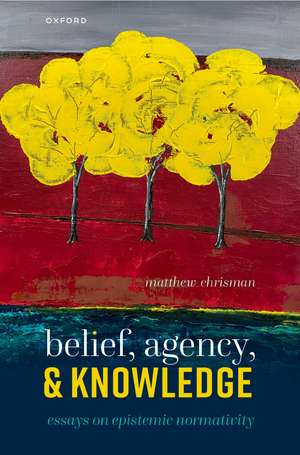
Belief, Agency, and Knowledge: Essays on Epistemic Normativity
Autor Matthew Chrismanen Limba Engleză Paperback – 31 dec 2025
Preț: 172.06 lei
Preț vechi: 233.66 lei
-26%
Puncte Express: 258
Carte tipărită la comandă
Livrare economică 05-16 iunie
Specificații
ISBN-13: 9780198993421
ISBN-10: 0198993420
Pagini: 234
Dimensiuni: 156 x 13 x 235 mm
Greutate: 0.36 kg
Editura: OUP OXFORD
Colecția OUP Oxford
Locul publicării:Oxford, United Kingdom
ISBN-10: 0198993420
Pagini: 234
Dimensiuni: 156 x 13 x 235 mm
Greutate: 0.36 kg
Editura: OUP OXFORD
Colecția OUP Oxford
Locul publicării:Oxford, United Kingdom
Recenzii
Belief, Agency and Knowledge is a triumph. It provides a sustained defense of a truly social approach to human knowledge, one which rejects the longstanding philosophical assumption that knowing is something we do in isolation, and instead embraces the community as the starting point of any epistemological investigation. In so doing, it provides a strikingly original account of the norms of inquiry and sheds light on free belief, the pursuit of truth and the role of responsible belief in democracy.
Wilfrid Sellars once said, "in characterizing an episode or a state as that of knowing... we are placing it in the logical space of reasons, of justifying and being able to justify what one says." Matthew Chrisman has done more than anybody else to make Sellar's idea about knowledge, and about epistemic evaluation more generally, both precise and plausible. His book is a pleasure to read.
In Belief, Agency, and Knowledge, Matthew Chrisman aims to illuminate the nature of epistemic normativity. His main innovation lies in how he traces the source and authority of epistemic norms to our social relationship with one other in our joint effort to determine how the world is. This is a bold vision, one informed not only by recent debates in the theory of knowledge but also by themes from philosophy of mind, action theory, and political philosophy.
Wilfrid Sellars once said, "in characterizing an episode or a state as that of knowing... we are placing it in the logical space of reasons, of justifying and being able to justify what one says." Matthew Chrisman has done more than anybody else to make Sellar's idea about knowledge, and about epistemic evaluation more generally, both precise and plausible. His book is a pleasure to read.
In Belief, Agency, and Knowledge, Matthew Chrisman aims to illuminate the nature of epistemic normativity. His main innovation lies in how he traces the source and authority of epistemic norms to our social relationship with one other in our joint effort to determine how the world is. This is a bold vision, one informed not only by recent debates in the theory of knowledge but also by themes from philosophy of mind, action theory, and political philosophy.
Notă biografică
Matthew Chrisman is Professor of Ethics and Epistemology at the University of Edinburgh. His research is focused on epistemology, metaethics, philosophy of language, and political philosophy. He has published widely in these areas, including articles in Noûs, Philosophical Studies, Philosophy and Phenomenological Research, Philosophy & Public Affairs, and The Journal of Philosophy. Chrisman is the author of The Meaning of 'Ought' and What Is This Thing Called Metaethics? He was elected a member of the Young Academy of Scotland in 2016, where he led in creation of the Young Academy of Scotland's Charter for Responsible Debate. He completed his PhD and MA at the University of North Carolina, and his BA at Rice University.