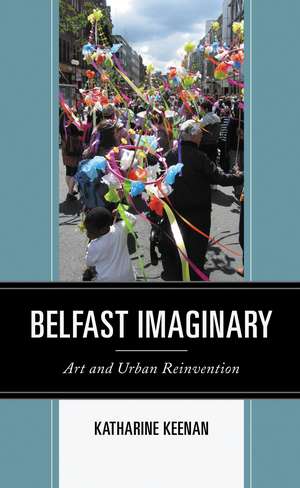
Belfast Imaginary: Art and Urban Reinvention: Culture, Humanity, and Urban Life
Autor Katharine Keenanen Limba Engleză Paperback – 15 apr 2024


Preț: 222.24 lei
Puncte Express: 333
Carte tipărită la comandă
Livrare economică 16-30 noiembrie
Livrare prin curier în România Termenul estimat este afișat lângă disponibilitate.
Transport gratuit de la 400.00 lei Plată online sau ramburs, în funcție de opțiunile comenzii.
Retur gratuit în 14 zile Comandă securizată și suport în română.
Specificații
ISBN-13: 9781793628138
ISBN-10: 1793628130
Pagini: 272
Ilustrații: 19 b/w illustrations;
Dimensiuni: 150 x 228 x 16 mm
Greutate: 0.4 kg
Editura: Bloomsbury Publishing
Colecția Lexington Books
Seria Culture, Humanity, and Urban Life
Locul publicării:New York, United States
ISBN-10: 1793628130
Pagini: 272
Ilustrații: 19 b/w illustrations;
Dimensiuni: 150 x 228 x 16 mm
Greutate: 0.4 kg
Editura: Bloomsbury Publishing
Colecția Lexington Books
Seria Culture, Humanity, and Urban Life
Locul publicării:New York, United States
Cuprins
Chapter 1: In Medias Res
Chapter 2: Third Way Art - Policy and Process
Chapter 3: The Painting on the Wall
Chapter 4: Performing Diversity
Chapter 5: Stopping in the Street
Conclusion: Belfast in the Meantime
Chapter 2: Third Way Art - Policy and Process
Chapter 3: The Painting on the Wall
Chapter 4: Performing Diversity
Chapter 5: Stopping in the Street
Conclusion: Belfast in the Meantime
Recenzii
The Belfast Imaginary provides a timely and important review of how artists, in concert with public officials, have pioneered what Katharine Keenan calls 'third way art' in the imagining and construction of a new Belfast. Keenan shows that we can all take heart that a city, so torn by decades of violent conflict and years of post-conflict liminality, can still imagine itself as a space of creativity and peace. The Belfast Imaginary may very well serve as a blueprint of similar imaginings in places geographically distant but close in spirit to this rapidly evolving global city.
The Belfast Imaginary is a much-needed addition to social scientific literature on Northern Ireland. While many book-length treatments have dwelt squarely on ethnonationalism and the infamous sectarian divide, Keenan's richly ethnographic work seeks to shift our attention to the social predicaments of Belfast in the years and decades following the Good Friday Agreement. By unpacking the frictions and contradictions that inhere in how 'history' and 'tradition' are defined and managed, materialized and performed in and for a post-Troubles era, Katherine Keenan succeeds brilliantly in untethering the anthropology of Northern Ireland from its longstanding moorings in the semiotics of binary social difference. In so doing, this book redresses a significant lacuna in ethnographic analysis of Northern Ireland and is essential reading for anyone wanting to understand how Belfast's people organize and navigate the uncertain symbolism and politics of the region today.
Keenan's book may offer a specific case of Belfast, but her methodology of tracing the changing dynamics and tensions that arise between policymakers, funding agencies, artists, and community organizations in shaping urban identity can easily apply to other cities. For instance, we can think about this in relation to cities that struggle with divisive politics and competing narratives of the past, or that are experiencing a critical turn in their identity formation. This book prompts geographers to consider how the culmination of these pressures trickles down to place making practices expressed by artists and other cultural producers. Place making and public art projects, after all, are complex, multiauthored processes that require untangling. By engaging artists in urban sociological research, we can better understand the role of public policy in shaping discourses of urban identity and arts processes, as well as the competing narratives that shape place.
The Belfast Imaginary is a much-needed addition to social scientific literature on Northern Ireland. While many book-length treatments have dwelt squarely on ethnonationalism and the infamous sectarian divide, Keenan's richly ethnographic work seeks to shift our attention to the social predicaments of Belfast in the years and decades following the Good Friday Agreement. By unpacking the frictions and contradictions that inhere in how 'history' and 'tradition' are defined and managed, materialized and performed in and for a post-Troubles era, Katherine Keenan succeeds brilliantly in untethering the anthropology of Northern Ireland from its longstanding moorings in the semiotics of binary social difference. In so doing, this book redresses a significant lacuna in ethnographic analysis of Northern Ireland and is essential reading for anyone wanting to understand how Belfast's people organize and navigate the uncertain symbolism and politics of the region today.
Keenan's book may offer a specific case of Belfast, but her methodology of tracing the changing dynamics and tensions that arise between policymakers, funding agencies, artists, and community organizations in shaping urban identity can easily apply to other cities. For instance, we can think about this in relation to cities that struggle with divisive politics and competing narratives of the past, or that are experiencing a critical turn in their identity formation. This book prompts geographers to consider how the culmination of these pressures trickles down to place making practices expressed by artists and other cultural producers. Place making and public art projects, after all, are complex, multiauthored processes that require untangling. By engaging artists in urban sociological research, we can better understand the role of public policy in shaping discourses of urban identity and arts processes, as well as the competing narratives that shape place.