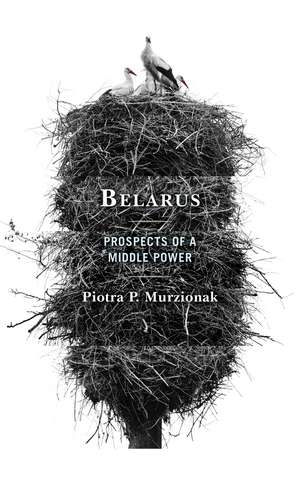
Belarus: Prospects of a Middle Power
Autor Piotra P. Murzionaken Limba Engleză Hardback – 18 mar 2022
Preț: 600.83 lei
Preț vechi: 930.97 lei
-35%
Puncte Express: 901
Carte tipărită la comandă
Livrare economică 14-28 noiembrie
Livrare prin curier în România Termenul estimat este afișat lângă disponibilitate.
Transport gratuit pentru acest produs Plată online sau ramburs, în funcție de opțiunile comenzii.
Retur gratuit în 14 zile Comandă securizată și suport în română.
Specificații
ISBN-13: 9781793654915
ISBN-10: 1793654913
Pagini: 350
Ilustrații: 5 b/w photos; 8 tables; 1 textboxes;
Dimensiuni: 160 x 227 x 32 mm
Greutate: 0.68 kg
Editura: Bloomsbury Publishing
Colecția Lexington Books
Locul publicării:New York, United States
ISBN-10: 1793654913
Pagini: 350
Ilustrații: 5 b/w photos; 8 tables; 1 textboxes;
Dimensiuni: 160 x 227 x 32 mm
Greutate: 0.68 kg
Editura: Bloomsbury Publishing
Colecția Lexington Books
Locul publicării:New York, United States
Cuprins
Preface
Prologue "Was, Worth, Will Be"
Maps
A Gallery of Prominent Belarusians Whose Contributions Supported Nation-Building
PART I. The History of Belarusian Statehood
1.From Ethnos to a Nation (Belarusians in the Ninth to Nineteenth Centuries)
2.Belarusian Statehood in the Twentieth Century
PART II. The Place of Belarusians Among Civilizations
3.Belarusian-Ukrainian/Western-Ruthenian Civilization
4.Belarusians and Ukrainians Belong to Western Civilization
PART III. Characteristics of the Modern Belarusian Nation
5.The Conditions for Nation-building in Belarus in the Twentieth Century
6.General Information about Modern Belarus
7.National Identity and Language
8.The Mentality of Belarusian Society (Belarusianess)
9.Church and Nation
PART IV. Belarus: In Search of Its Own Way
10.Theoretical Models of the Belarusian National State Construction
11.Under the "Patronage of Russia"
12."Belarus to
Prologue "Was, Worth, Will Be"
Maps
A Gallery of Prominent Belarusians Whose Contributions Supported Nation-Building
PART I. The History of Belarusian Statehood
1.From Ethnos to a Nation (Belarusians in the Ninth to Nineteenth Centuries)
2.Belarusian Statehood in the Twentieth Century
PART II. The Place of Belarusians Among Civilizations
3.Belarusian-Ukrainian/Western-Ruthenian Civilization
4.Belarusians and Ukrainians Belong to Western Civilization
PART III. Characteristics of the Modern Belarusian Nation
5.The Conditions for Nation-building in Belarus in the Twentieth Century
6.General Information about Modern Belarus
7.National Identity and Language
8.The Mentality of Belarusian Society (Belarusianess)
9.Church and Nation
PART IV. Belarus: In Search of Its Own Way
10.Theoretical Models of the Belarusian National State Construction
11.Under the "Patronage of Russia"
12."Belarus to
Recenzii
Peter Murzionak has written a passionate history of his homeland, Belarus, a country of 9.5 million that has a long history, but only brief periods of cultural development and independence. In 2020, it made world headlines for the protests that followed a rigged election to extend the rule of a ruthless dictator. Dr. Murzionak believes in the future of his country and that all Belarusians, including those outside the country, must strive to attain this goal. His description of the election and its aftermath is grimly stark, but his belief in a democratic future persists. If non-Belarusians wonder what inspires the sacrifices made for this goal, one that thrives in spite of the arrests, tortures, detention, murder, and the hijacking of a plane simply to arrest an opposition leader, then this is the book for you. It is not a "traditional" narrative, it is one from the heart.
The publication of the book is timely, because recently, under the influence of political events in Belarus, the country has returned to the top of the world's media, while there are still few English works on the past and present of Belarus. One could say that there is a shortage of these works. Therefore, Belarusian issues constitute a kind of 'terra incognita' for the English-speaking reader. The reviewed work, therefore, has a good chance to at least partially fill a significant gap in research on this country. With the help of this book, the reader can discover many unknown episodes in the past and present the Belarusian people. This book will be a source of knowledge on the shaping of statehood, language, and cultural identity of Belarusians. In addition, I would like to emphasize that the work aims to demythologize Belarus. In the minds of some people in the West, there is a certain stereotype about Belarus as a country that belongs to the Russian cultural, civilization, and political zone. This was favored, among others, by the fact that until 1991 there was no independent Belarusian state on the political map of the world. It is no coincidence that back in the twentieth century, in the English language, this country was not called Belarus, but White Russia, so many people in the West associated it only with Russia. This reviewed book challenges this myth and forces us to look at Belarus from a completely different perspective.
The publication of the book is timely, because recently, under the influence of political events in Belarus, the country has returned to the top of the world's media, while there are still few English works on the past and present of Belarus. One could say that there is a shortage of these works. Therefore, Belarusian issues constitute a kind of 'terra incognita' for the English-speaking reader. The reviewed work, therefore, has a good chance to at least partially fill a significant gap in research on this country. With the help of this book, the reader can discover many unknown episodes in the past and present the Belarusian people. This book will be a source of knowledge on the shaping of statehood, language, and cultural identity of Belarusians. In addition, I would like to emphasize that the work aims to demythologize Belarus. In the minds of some people in the West, there is a certain stereotype about Belarus as a country that belongs to the Russian cultural, civilization, and political zone. This was favored, among others, by the fact that until 1991 there was no independent Belarusian state on the political map of the world. It is no coincidence that back in the twentieth century, in the English language, this country was not called Belarus, but White Russia, so many people in the West associated it only with Russia. This reviewed book challenges this myth and forces us to look at Belarus from a completely different perspective.