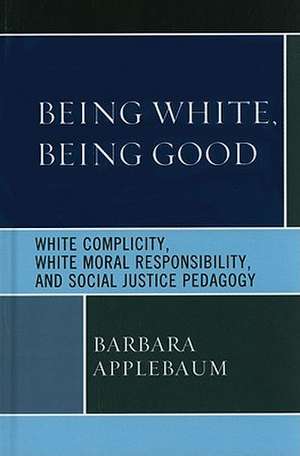
Being White, Being Good: White Complicity, White Moral Responsibility, and Social Justice Pedagogy
Autor Barbara Applebaumen Limba Engleză Hardback – 18 mar 2010
Being White, Being Good introduces an approach to social justice pedagogy called "white complicity pedagogy." The practical and pedagogical implications of this approach are fleshed out by emphasizing the role of uncertainty, vulnerability, and vigilance. White students who acknowledge their complicity have an increased potential to develop alliance identities and to engage in genuine cross-racial dialogue. White complicity pedagogy promises to facilitate the type of listening on the part of white students so that they come open and willing to learn, and "not just to say no." Applebaum also conjectures that systemically marginalized students would be more likely and willing to invest energy and time, and be more willing to engage with the systemically privileged, when the latter acknowledge rather than deny their complicity. It is a central claim of the book that acknowledging complicity encourages a willingness to listen to, rat
Preț: 632.87 lei
Preț vechi: 958.19 lei
-34%
Puncte Express: 949
Carte tipărită la comandă
Livrare economică 08-22 decembrie
Livrare prin curier în România Termenul estimat este afișat lângă disponibilitate.
Transport gratuit pentru acest produs Plată online sau ramburs, în funcție de opțiunile comenzii.
Retur gratuit în 14 zile Comandă securizată și suport în română.
Specificații
ISBN-13: 9780739144916
ISBN-10: 073914491X
Pagini: 221
Dimensiuni: 162 x 240 x 21 mm
Greutate: 0.48 kg
Editura: Bloomsbury Publishing
Colecția Lexington Books
Locul publicării:New York, United States
ISBN-10: 073914491X
Pagini: 221
Dimensiuni: 162 x 240 x 21 mm
Greutate: 0.48 kg
Editura: Bloomsbury Publishing
Colecția Lexington Books
Locul publicării:New York, United States
V-ar putea interesa
-
 The Great DivideJoseph E. Stiglitz-28%Preț: 78.61 lei108.44 lei
 -
 What's Wrong with Fat?Abigail C. Saguy-15%Preț: 217.26 lei254.38 lei
 -
 Durable InequalityCharles TillyPreț: 263.36 lei
 -
 The End of Tolerance: Racism in 21st Century BritainArun KundnaniPreț: 308.96 lei
 -
 Immigrant FamiliesCecilia MenjívarPreț: 178.25 lei
 -
 Dying in the City of the BluesKeith Wailoo-5%Preț: 298.31 lei314.01 lei
 -
 SegregationRobert Penn WarrenPreț: 151.36 lei
 -
 Race Talk and the Conspiracy of SilenceDerald Wing SuePreț: 188.19 lei
 -
 In Praise of PrejudiceTheodore DalrymplePreț: 117.45 lei
 -
 RacismAlana LentinPreț: 72.12 lei
 -
 Turning the TideAngela V. JohnPreț: 148.45 lei
Cuprins
Chapter 1: Introduction - The White Complicity Claim Chapter 2: White Ignorance and Denials of Complicity: Linking "Benefiting From" to "Contributing To" Chapter 3: The Subject of White Complicity Chapter 4: The Epistemology of Complicity: The Discourse of Not Knowing and Refusing to Know Chapter 5: Moral Responsibility and Complicity in Philosophical Scholarship Chapter 6: Rearticulating White Moral Responsibility 7 Chapter 7: White Complicity Pedagogy
Recenzii
By rigorously mapping the intricacies of white complicity vis-à-vis systemic racism, inspired by robust social justice concerns, and using white complicity pedagogy as her point of methodological embarkation, Barbara Applebaum, in Being White, Being Good, has profoundly troubled the waters of whiteness studies, identified its intrinsic limits, and forced a deeper and more honest self-reflexive posture on the part of its white practitioners to be cognizant (even as this is always already limited) of white moral self-glorification, white 'good intentions' and white self-cognitive sophistication-all forms of distancing strategies. Applebaum does all of this while simultaneously not shying away from offering a form of ethical responsibility that is fueled precisely through the recognition of the social ontology and ineluctability of racist complicity. This is racial theory and critical pedagogy born of fearless speech and fearless listening.
Applebaum has put together an impressive array of theoretical resources in this meticulously argued account of white complicity and its attendant pedagogical challenges. She intricately weaves together her analysis of poststructural subjectivity and agency with philosophical discussions of complicity to articulate a new form of moral responsibility no longer reliant on blame but robustly concerned with responsibility.
Applebaum's argument is ultimately a cautionary one, providing no doubt an important corrective to white social justice advocates who think they can somehow bracket or, even worse, move beyond their privilege. Applebaum makes this point extremely well. She also details a very thoughtful model for responsibility under complicity that offers some important broad guidelines for how we ought to think differently about our privilege, and about how we ought to teach about diversity issues.
Applebaum has put together an impressive array of theoretical resources in this meticulously argued account of white complicity and its attendant pedagogical challenges. She intricately weaves together her analysis of poststructural subjectivity and agency with philosophical discussions of complicity to articulate a new form of moral responsibility no longer reliant on blame but robustly concerned with responsibility.
Applebaum's argument is ultimately a cautionary one, providing no doubt an important corrective to white social justice advocates who think they can somehow bracket or, even worse, move beyond their privilege. Applebaum makes this point extremely well. She also details a very thoughtful model for responsibility under complicity that offers some important broad guidelines for how we ought to think differently about our privilege, and about how we ought to teach about diversity issues.