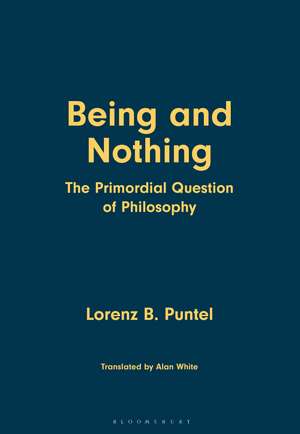
Being and Nothing: The Primordial Question of Philosophy
Traducere de Professor Alan White Autor Lorenz B. Puntelen Limba Engleză Hardback – 12 iun 2025
Considering the history of philosophy from Parmenides through to Heidegger and beyond, Puntel charges philosophy with persistently failing to adequately confront the question of Being. In response, Puntel sets out a systematic philosophy to rival Hegel's Science of Logic and Whitehead's Process and Reality.
In two parts, the book first surveys the history of Western philosophy through the theoretical framework of Structural-Systematic Philosophy (SSP), which unites continental philosophy's comprehensiveness with the precision and linguistic rigor of the analytic tradition. Analysing all of the major stages in the "forgetfulness of Being" in Western philosophy, Puntel establishes a dialogue with a vast number of thinkers and movements in the history of philosophy, including Plato, Aquinas, Duns Scotus, Francisco Suarez, Christian Wolff, Leibniz, Hegel, Nietzsche, Heidegger, Sartre, W.O. Quine, Peter van Inwagen, Kit Fine, Alexius Meinong, and Jean-Luc Marion. The second part develops the methodical question of a systematic theory of Being. Puntel sets out a universal metaphysics, introducing concepts of world, existence, and types of beings. Moreover, he examines the plurality of possible worlds, the disclosure of Being, and modern philosophies of subjectivity since Kant, including the analytic philosophies of Robert Brandom and Ernst Tugendhat. The book culminates in a theory of Being and explains the relation of Being to the concept of God.
Being and Nothing is the third in Puntel's trilogy comprising Structure and Being (2008) and Being and God (2011), and is a book that will appeal to all those with an interest in the history of philosophy, continental philosophy, theology, and analytic philosophy.
Preț: 908.67 lei
Preț vechi: 1348.37 lei
-33%
Puncte Express: 1363
Carte disponibilă
Livrare economică 31 octombrie-14 noiembrie
Livrare prin curier în România Termenul estimat este afișat lângă disponibilitate.
Transport gratuit pentru acest produs Plată online sau ramburs, în funcție de opțiunile comenzii.
Retur gratuit în 14 zile Comandă securizată și suport în română.
Specificații
ISBN-13: 9781350503458
ISBN-10: 1350503452
Pagini: 544
Dimensiuni: 176 x 248 x 34 mm
Greutate: 1.02 kg
Editura: Bloomsbury Publishing
Colecția Bloomsbury Academic
Locul publicării:London, United Kingdom
ISBN-10: 1350503452
Pagini: 544
Dimensiuni: 176 x 248 x 34 mm
Greutate: 1.02 kg
Editura: Bloomsbury Publishing
Colecția Bloomsbury Academic
Locul publicării:London, United Kingdom
Cuprins
PART I
Chapter 1. First metaphysical approaches: the development of ancient Greek philosophy: from Being itself to metaphysics as the science of beings as beings and to the dimension beyond beingness
Chapter 2. Christian-metaphysical approaches in high- and late-scholasticism; from an inchoative Being-theoretical to a purely onto-theo-logical determination of Being and nothing
Chapter 3. Leibniz and the question "Why is there anything at all rather than nothing?"
Chapter 4. Nihilism, critique of metaphysics, and the topic Being and nothing: Nietzsche and Heidegger
Chapter 5. Sartre's The Being and the Nothing: a purely subjective phenomenological conception
Chapter 6. The fading-out and absence of the question about Being itself and absolute nothing in the main stream of analytic philosophy
Chapter 7. Relative nothing
PART II
Preliminary remarks
Chapter 1. Essential components of the theoretical framework of the structural-systematic philosophy (SSP)
Chapter 2: Systematic onto-logy as theory of beingness/beings
Chapter 3. Possible worlds
Chapter 4: Disclosure of the dimension of Being: a systematic approach
Chapter 5: Making explicit the dimension of Being as the result of the overcoming of the modern philosophy of subjectivity I: Kant and Hegel
Chapter 6. Disclosure of the dimension of Being as result of the overcoming of modern subjectivity II: Husserl and the transformation of phenomenology
Chapter 7: Disclosure of the dimension of Being as the result of the overcoming of analytic philosophy interpreted as philosophy of subjectivity
Chapter 8: Theory of Being I: basic features of a theory of Being as such
Chapter 9: Theory of Being II: theory of modal status of the dimension of Being as the ultimate systematic clarification of the topic Being and nothing
Chapter 10: Theory of Being III: systematic explication of the modal two-dimensionality of the dimension of Being
Afterword: A look back and a look ahead
Bibliography
Index of names
Index of subjects
Chapter 1. First metaphysical approaches: the development of ancient Greek philosophy: from Being itself to metaphysics as the science of beings as beings and to the dimension beyond beingness
Chapter 2. Christian-metaphysical approaches in high- and late-scholasticism; from an inchoative Being-theoretical to a purely onto-theo-logical determination of Being and nothing
Chapter 3. Leibniz and the question "Why is there anything at all rather than nothing?"
Chapter 4. Nihilism, critique of metaphysics, and the topic Being and nothing: Nietzsche and Heidegger
Chapter 5. Sartre's The Being and the Nothing: a purely subjective phenomenological conception
Chapter 6. The fading-out and absence of the question about Being itself and absolute nothing in the main stream of analytic philosophy
Chapter 7. Relative nothing
PART II
Preliminary remarks
Chapter 1. Essential components of the theoretical framework of the structural-systematic philosophy (SSP)
Chapter 2: Systematic onto-logy as theory of beingness/beings
Chapter 3. Possible worlds
Chapter 4: Disclosure of the dimension of Being: a systematic approach
Chapter 5: Making explicit the dimension of Being as the result of the overcoming of the modern philosophy of subjectivity I: Kant and Hegel
Chapter 6. Disclosure of the dimension of Being as result of the overcoming of modern subjectivity II: Husserl and the transformation of phenomenology
Chapter 7: Disclosure of the dimension of Being as the result of the overcoming of analytic philosophy interpreted as philosophy of subjectivity
Chapter 8: Theory of Being I: basic features of a theory of Being as such
Chapter 9: Theory of Being II: theory of modal status of the dimension of Being as the ultimate systematic clarification of the topic Being and nothing
Chapter 10: Theory of Being III: systematic explication of the modal two-dimensionality of the dimension of Being
Afterword: A look back and a look ahead
Bibliography
Index of names
Index of subjects
Recenzii
Absolute nothingness is unthinkable. This apparently innocuous philosophical insight is the structuring point in Lorenz Puntel's seminal Being and Nothingness. From this principle, Puntel shows how fundamentally flawed key philosophers - from Parmenides to Heidegger - have addressed the question of being. It's an intriguing exercise in history of philosophy that is critical yet constructive, leading to Puntel's own alternative proposal that has both broad scope and deep insights
In this rigorously argued, impressively erudite tour of the history of philosophy, Lorenz Puntel makes a compelling case for the claim that traditional philosophy, from Parmenides to the present, has overlooked the primordial question of philosophy: the question of Being. This is historically-informed systematic philosophy at its very best.
This is an extraordinary achievement.
In this rigorously argued, impressively erudite tour of the history of philosophy, Lorenz Puntel makes a compelling case for the claim that traditional philosophy, from Parmenides to the present, has overlooked the primordial question of philosophy: the question of Being. This is historically-informed systematic philosophy at its very best.
This is an extraordinary achievement.