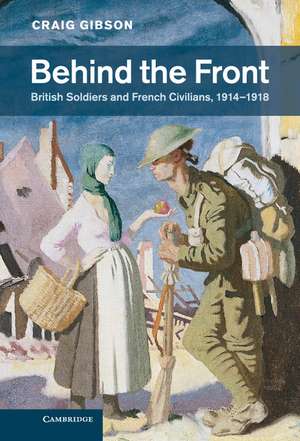
Behind the Front
Autor Craig Gibsonen Limba Engleză Hardback – 7 ian 2015
Recomandăm Behind the Front pentru modul în care reușește să transforme o cercetare istorică riguroasă într-un instrument de înțelegere a logisticii sociale în timp de conflict. Aplicabilitatea practică a acestui volum rezidă în analiza modului în care armatele de ocupație sau aliate gestionează relația cu populația civilă, oferind lecții despre administrare, disciplină și impactul economic local. Ne-a atras atenția faptul că Craig Gibson mută centrul de greutate de la luptele din tranșee către satele și orașele din spatele liniei frontului, acolo unde interacțiunea era inevitabilă, în ciuda directivelor oficiale. Cartea este organizată cronologic și tematic, urmărind evoluția conflictului de la campania inițială din 1914 până la victoria din 1918. Partea a doua, cea mai consistentă, analizează perioada războiului de tranșee prin prisma unor capitole dedicate: cazare, comunicare, fricțiuni sociale, agricultură, disciplină și chiar relații intime. Această segmentare permite o înțelegere granulară a modului în care prezența militară a influențat structura socială franceză. În ceea ce privește contextul istoriografic, lucrarea acoperă aceeași arie ca British, French and American Relations on the Western Front, 1914-1918 de Chris Kempshall, dar cu o abordare mult mai axată pe viața cotidiană a civililor și mai puțin pe diplomația inter-militară. Spre deosebire de Citizen Soldiers de Helen B. McCartney, care se concentrează pe identitatea de civil a soldatului reflectată în scrisori, Gibson analizează simbioza dintre armată și comunitatea gazdă. Apreciem rigurozitatea cu care sunt folosite tabelele și hărțile pentru a ilustra dinamica unei populații aliate vaste care a influențat moralul trupelor britanice mai mult decât se credea anterior.
Preț: 485.65 lei
Preț vechi: 545.68 lei
-11%
Carte tipărită la comandă
Livrare economică 07-21 decembrie
Specificații
ISBN-10: 0521837618
Pagini: 480
Ilustrații: 49 b/w illus. 4 maps 37 tables
Dimensiuni: 157 x 235 x 30 mm
Greutate: 0.84 kg
Ediția:New.
Editura: Cambridge University Press
Locul publicării:Cambridge, United Kingdom
V-ar putea interesa
-
 Ceremony and Civility: Civic Culture in Late Medieval LondonBarbara A. Hanawalt-21%Preț: 250.45 lei315.67 lei
 -
 -17%Preț: 105.51 lei127.63 lei
 -
 Evolution of the BookFrederick G. Kilgour-27%Preț: 466.32 lei641.99 lei
 -
 Early Modern Europe: An Oxford HistoryEuan Cameron-10%Preț: 319.17 lei356.18 lei
 -
 -32%Preț: 543.99 lei800.73 lei
 -
 Preț: 322.73 lei
 -
 The Norman Kingdom of SicilyDonald MatthewPreț: 525.74 lei
 -
 Barbarian Migrations and the Roman West, 376-568Guy HalsallPreț: 320.39 lei
 -
 Reading Medieval LatinKeith SidwellPreț: 263.01 lei
 -
 The Ottoman Empire and Early Modern EuropeDaniel GoffmanPreț: 347.43 lei
 -
 Women, Family, and Gender in Islamic LawJudith E. TuckerPreț: 299.16 lei
 -
 The Byzantine LadyDonald M. NicolPreț: 206.07 lei
 -
 The Formation of Islam 1edJonathan P. BerkeyPreț: 389.06 lei
 -
 Portuguese Oceanic Expansion, 1400-1800Francisco BethencourtPreț: 376.96 lei
 -
 The Byzantine EconomyAngeliki E. LaiouPreț: 318.21 lei
 -
 The Jews of Medieval Western ChristendomRobert ChazanPreț: 334.40 lei
 -
 The Crusades, C.1071 C.1291Jean RichardPreț: 448.10 lei
 -
 Islamic HistoriographyChase RobinsonPreț: 277.60 lei
 -
 Roger II of SicilyHubert HoubenPreț: 337.74 lei
 -
 CharlemagneRosamond MckitterickPreț: 331.20 lei
 -
 German Histories in the Age of Reformations, 1400-1650Thomas A. Brady Jr.Preț: 313.18 lei
 -
 A Social History of England, 1200-1500Rosemary HorroxPreț: 441.75 lei
 -
 Medieval Africa, 1250 1800Roland OliverPreț: 386.58 lei
 -
 The Making of PolitiesJohn WattsPreț: 251.69 lei
 -
 Southeastern Europe in the Middle Ages, 500-1250Florin CurtaPreț: 434.18 lei
 -
 The Cambridge History of ChristianityMargaret M. MitchellPreț: 447.64 lei
 -
 An Economic History of EuropeKarl Gunnar PerssonPreț: 272.80 lei
 -
 Reformation EuropeUlinka RublackPreț: 232.26 lei
 -
 Medieval HeresiesChristine Caldwell AmesPreț: 274.47 lei
 -
 Preț: 501.58 lei
De ce să citești această carte
Recomandăm această carte istoricilor și studenților interesați de Primul Război Mondial dincolo de aspectele pur tactice. Cititorul câștigă o perspectivă nouă asupra modului în care interacțiunile cotidiene — de la închirierea fermelor la gestionarea daunelor — au susținut moralul britanic. Este un studiu esențial despre reziliență și administrare militară într-un context cultural străin, demonstrând că victoria a fost construită și prin relații umane solide în spatele frontului.
Despre autor
Craig Gibson este un cercetător recunoscut pentru studiile sale privind relațiile dintre Aliați în timpul Primului Război Mondial și rolul disciplinei militare în interacțiunile dintre trupe și localnici. Expertiza sa este validată de numeroase premii și distincții primite de la instituții de prestigiu precum Historial de la Grande Guerre (Somme, Franța), Australian War Memorial și Camargo Foundation. Lucrările sale se remarcă prin utilizarea extensivă a arhivelor europene, aducând la lumină detalii neglijate despre viața socială în timpul conflictelor armate de amploare.
Descriere scurtă
Cuprins
Recenzii
'Hellish trench warfare was only one part of World War I soldiers' experiences … Drawing on official archives, letters, diaries, memoirs and even survivors' novels, the book tells of liquor-filled Belgian chocolates that got around alcohol bans; prostitution, within and outside brothels that had official approval, that spread sexually transmitted diseases; civilian thefts of military supplies; and mutual suspicions fueled by language barriers and property damage.' Allan Wallace, triblive.com
'Gibson is to be congratulated for bringing back the French and Belgian character of the British sector of the Western Front.' Jay Winter, The Times Literary Supplement
'… a vivid account of life out of the trenches … Gibson reminds us that the mud, blood and sacrifice of the trenches was just one aspect of the British experience of the Western Front.' Stephen Brumwell, The Wall Street Journal
'Gibson's work incorporates an impressive array of primary and secondary sources and does an excellent job of illuminating the most overlooked side of World War I.' Ellen J. Jenkins, Choice
'… Craig Gibson paints a fascinating picture of the relations of the British and Commonwealth forces with the inhabitants of the towns and villages in whose homes they were billeted, whose land they used for training and sport, and in whose cafes and estaminets they relaxed … densely researched and very readable … [this book] commendably fills a gap.' Martin Bennitt, Great War Forum (1914-1918.invisionzone.com)
'Gibson's portrayal of the complexity of relations between the British Expeditionary Force (BEF) and local populations is excellent, and should appeal to military historians and lay readers alike owing to his accessible language and descriptive writing style. For those seeking to expand their understanding of the operational challenges faced by the BEF regarding the civilian populations of France and Belgium, it is a thorough and important contribution to the Western Front experience.' Christopher Schultz, Journal of Military History
'… this book would be a welcome addition to the reading lists of all civil affairs officers and those military professionals who wish to understand the challenges of operating in the 'human terrain'.' Lt Col Richard S. Faulkner, Military Review
'[An] astounding book.' Yves Tremblay, historian, Department of National Defence, Ottawa
'While there has been considerable new work on how the French and Belgian populations experienced German occupation in the war zone, this is the first scholarly book to examine what Gibson describes as the other 'occupation': that of the British Army in the surreal war hinterland of half-ruined villages, farms, and towns behind the Allied lines … Paying detailed attention to billeting, socializing, trading, farming, and army damage recompense, Gibson succeeds in revealing a more rounded image of the Western Front experience … This study has truly mined a remarkable amount of previously unused French, Belgian, British, Canadian, and Australian archival sources. The accounts by Major Arthur Murray Jarvis and Ralph Hale Mottram are particular finds, as is Gibson's excavation of French postal censorship records.' Heather Jones, The American Historical Review
'In Behind the Front, Canadian historian Craig Gibson invites us to broaden our understanding of British and Dominion soldiers' wartime experience … Gibson explores the multifaceted relationships that developed between … soldiers and civilians, and, far from relegating them to footnote status in the history of the conflict, sees them as an integral part of the Allied war effort and a contributing factor to ultimate victory in 1918.' Anthony J. Minna, Canadian Military Journal
'What emerges is a different picture of war experience, one in which fighting is not the whole part. Gibson goes beyond J. G. Fuller's pioneering study of the army-directed leisure opportunities (Troop Morale and Popular Culture in the British and Dominion Armies, 1914–1918) aimed at sustaining troop morale to consider men's use of other avenues for recreation that had served the local civilian population prior to the war.' Krista Cowman, War in History
'The book showcases the rarely studied military administration of the assistant provost marshals, tasked with troop discipline, and the Claims Commission, established to adjudicate civilian claims for damages.' Margaret H. Darrow, The Journal of Modern History
'By his focus on encounters with civilians as a crucial element of British soldiers' motivation and morale in the Great War, Craig Gibson has shed new light on the willingness of millions of men to endure the war's attritional grind. In so doing, he also persuasively refutes the common notion that only severe discipline and coercion kept soldiers in line. His masterly control of the relevant archival sources and secondary literature makes Behind the Front an excellent starting point for anyone wishing to gain a foothold in the historiography of the British experience of the Western Front.' Sebastian H. Lukasi, Michigan War Studies Review
'I've been waiting for this book for a long time - and so have my students. We haven't been disappointed by Craig Gibson's important and fascinating study. It is the first, and so far the only, major study of a unique phenomenon: the biggest ever experience of 'abroad' by British men, in which nearly 5 million spent time in France, and 600,000 lost their lives on French soil. Gibson shows the hugely varied human side of this encounter between British (and Empire) soldiers and French civilians, in which the latter (mainly women) were outnumbered by the vast influx of men in khaki. Reactions covered the whole gamut of life: love, companionship, sex, money making, food and drink, with much mutual misunderstanding, frequent resentment, but often at the final analysis a human community in circumstances of shared suffering and danger.' Robert Tombs, University of Cambridge