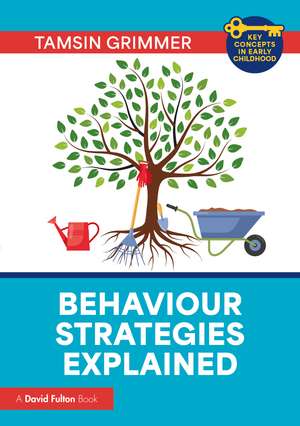
Behaviour Strategies Explained: Key Concepts in Early Childhood
Autor Tamsin Grimmeren Limba Engleză Paperback – 24 noi 2026
Divided into two parts, the first provides a brief overview of the key terms used when talking about behaviour with supporting examples. Part 2 then looks more broadly at the ethos of the setting and considers how we might promote positive behaviour through policy, the environment, the role of the adult and working in partnership with parents.
Part of the Key Concepts in Early Childhood series, this is essential reading for early years practitioners and students wanting to know and understand why children might behave in certain ways and how they can best support them.
Preț: 194.21 lei
Precomandă
Puncte Express: 291
Carte nepublicată încă
Livrare prin curier în România Precomanda se expediază când titlul devine disponibil.
Transport gratuit de la 400.00 lei Plată online sau ramburs, în funcție de opțiunile comenzii.
Retur gratuit în 14 zile Comandă securizată și suport în română.
Doresc să fiu notificat când acest titlu va fi disponibil:
Se trimite...
Specificații
ISBN-13: 9781041138228
ISBN-10: 1041138229
Pagini: 286
Ilustrații: 64
Dimensiuni: 148 x 210 mm
Greutate: 0.35 kg
Ediția:1
Editura: Taylor & Francis
Colecția Routledge
Seria Key Concepts in Early Childhood
Locul publicării:Oxford, United Kingdom
ISBN-10: 1041138229
Pagini: 286
Ilustrații: 64
Dimensiuni: 148 x 210 mm
Greutate: 0.35 kg
Ediția:1
Editura: Taylor & Francis
Colecția Routledge
Seria Key Concepts in Early Childhood
Locul publicării:Oxford, United Kingdom
Public țintă
Professional Practice & Development and Undergraduate CoreCuprins
Introduction Part 1 Explaining terms ABC or STAR analysis Acknowledge and validate feelings Attachment-aware practice Backward chaining Behaviour detective Belonging Body language Calm down time and space ‘Catch’ them being good Change of face/adult Change of place/scene Choices Compassion and forgiveness Conditioning (classical and operant) Conflict resolution Connection before correction Consequences Consistency Control Co-regulation Corporal Punishment De-escalation strategies Discipline Distraction and diversion Emotion coaching Emotionally literate environment Exclusion and suspension Executive function and self-regulation Expectations Explanations Fair and equitable (non-judgemental / not shaming) Gentle parenting Humour Iceberg model Ignore Incentives Instruction Isolation ‘I’ statements Labelled praise Limiting waiting and sedentary times Logical consequences Loving Pedagogy Low demand language Mirroring emotions Natural consequences Naughty step/chair/mat Negative reinforcement Neuro-affirming practice Non-judgemental approach PACE (Playfulness, Acceptance, Curiosity, Empathy) Partial Agreement Physical restraint Positive reinforcement Praise and affirmation Problem solving Punishment Re-directing play Regulation Station Relational approach Releasing feelings Restorative practices Rewards Role modelling Routines Rules and boundaries Sensory Understanding Shouting Social stories Threats Time-In Time-Out Time warnings Total communication approach Touch Transitional objects Trauma-responsive practice Visual Supports Worry Monsters Zero-tolerance approach Zones of regulation™ 5-point scales Further Reading and Resources Part 2 Further unpicking this ethos The rights of the child in relation to behaviour Adopting an ethos that supports children’s behaviour The centrality of relationships in the school or setting The importance of nurturing self-regulation and being proactive not reactive to supporting children’s behaviour How to write a behaviour policy Creating an enabling environment which supports children’s behaviour The impact of children’s behaviour on staff wellbeing Engaging parents and working in partnership with them when supporting their children’s behaviour Staff training and development Conclusion
Notă biografică
Tamsin Grimmer is an experienced consultant and trainer and a principal lecturer at Norland University of Early Childhood. Tamsin has written several early childhood books, including Developing a Loving Pedagogy in the Early Years, Nurturing Self-Regulation in Early Childhood and Supporting Behaviour and Emotions in the Early Years.
Descriere
Part of the Key Concepts in Early Childhood Series, this is essential reading for early years practitioners and students wanting to know why children might behave in certain ways and how they can best support them.