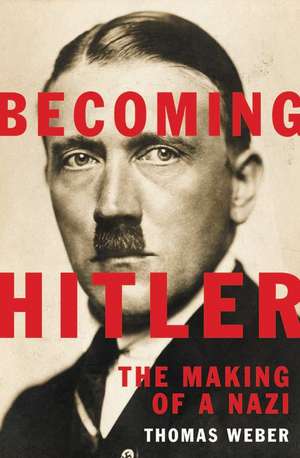
Becoming Hitler: The Making of a Nazi
Autor Thomas Weberen Limba Engleză Hardback – 6 noi 2017
An award-winning historian charts Hitler's radical transformation after World War I from a directionless loner into a powerful National Socialist leader
InBecoming Hitler, award-winning historian Thomas Weber examines Adolf Hitler's time in Munich between 1918 and 1926, the years when Hitler shed his awkward, feckless persona and transformed himself into a savvy opportunistic political operator who saw himself as Germany's messiah. The story of Hitler's transformation is one of a fateful match between man and city. After opportunistically fluctuating between the ideas of the left and the right, Hitler emerged as an astonishingly flexible leader of Munich's right-wing movement. The tragedy for Germany and the world was that Hitler found himself in Munich; had he not been in Bavaria in the wake of the war and the revolution, his transformation into a National Socialist may never have occurred.
InBecoming Hitler, Weber brilliantly charts this tragic metamorphosis, dramatically expanding our knowledge of how Hitler became a lethal demagogue.
| Toate formatele și edițiile | Preț | Express |
|---|---|---|
| Paperback (1) | 88.59 lei 43-48 zile | |
| OUP OXFORD – 28 oct 2021 | 88.59 lei 43-48 zile | |
| Hardback (1) | 242.29 lei 6-8 săpt. | |
| BASIC BOOKS – 6 noi 2017 | 242.29 lei 6-8 săpt. |
Preț: 242.29 lei
Puncte Express: 363
Preț estimativ în valută:
42.83€ • 49.63$ • 37.04£
42.83€ • 49.63$ • 37.04£
Carte tipărită la comandă
Livrare economică 07-21 mai
Specificații
ISBN-13: 9780465032686
ISBN-10: 0465032680
Pagini: 464
Dimensiuni: 165 x 241 x 38 mm
Greutate: 0.7 kg
Editura: BASIC BOOKS
Colecția Basic Books
ISBN-10: 0465032680
Pagini: 464
Dimensiuni: 165 x 241 x 38 mm
Greutate: 0.7 kg
Editura: BASIC BOOKS
Colecția Basic Books
Notă biografică
Thomas Weberis a professor of history and international affairs at the University of Aberdeen, Scotland. The award-winning author of several books, Weber divides his time between Aberdeen, Scotland, and Toronto, Ontario.
Recenzii
"Awell-researched
and
insightful
examination
of
Adolf
Hitler's
politicalawakening
in
the
early
1920s...
extremely
thought
provoking....Becoming
Hitlerofferstimely
lessons,
the
first
and
most
obvious
is
to
underscore
the
strikingparallels
in
political
psychology
between
Hitler
and
Donald
Trump."—Forward
"This comprehensive workshould become the standard text on Hitler and the origins of the Nazi party." —Library Journal
"[An] intensivelyresearched account.... A satisfying, nuts-and-bolts account of the six-year spanduring which an obscure ex-soldier became a demagogue the German establishmentshould have taken more seriously."—HistoryNet
"Carefully tracking[Hitler's] life from 1918 to 1926, Weber documents the transformation thatturned this rudderless opportunist into a fiery orator enjoying the support ofmillions who hailed him as a political genius, even a messiah.... An unflinchinginquiry."—Booklist
"Compelling research andoriginal insights bring a fuller understanding to the mind and motives of thedemagogue."—Kirkus Reviews
"In his brilliantBecoming Hitler, Thomas Weber offers an original, well-documented, and enthralling account of the how and why of Hitler's rapid metamorphosis from zero to self-defined hero in the where of 1919 Munich-a city ripped apart by a short civil war and its vengeful aftermath. Weber's book makes us rethink everything we thought we knew about the emergence of Hitler as a political leader."
—Robert Jan van Pelt, University of Waterloo, Canada
"A splendid account of a vile subject."
—Nicholas Stargardt,author ofThe German War
"Thomas Weber showcases Hitler's terrifying originality as an extremist thinker: committed, from the beginning of his meteoric ascent, to the restoration of German greatness and to the destruction of the Jews. An absolutely compelling and original portrait of a wicked genius in all his grandeur and horror."
—Michael Ignatieff, President, Central European University, Budapest
"Thomas Weber is one of theforemost world authorities on Hitler. He refuted the mantra that there wasnothing more to say about the German dictator and no new sources to be foundwith his path-breaking study of Hitler's First War."—Brendan Simms,author ofEurope: The Struggle for Supremacy, 1453 to the Present
"This is the most importantbook on Hitler and National Socialism since Ian Kershaw's monumental biography.It is amazing how much new information and documentation Thomas Weber has usedto show precisely when, how, and why Hitler's world view was shaped, andprecisely where the intellectual, emotional, and social origins of genocide andof the Holocaust lay."
—Harold James, professor of history, Woodrow Wilson School of Public & International Affairs, Princeton University
"This comprehensive workshould become the standard text on Hitler and the origins of the Nazi party." —Library Journal
"[An] intensivelyresearched account.... A satisfying, nuts-and-bolts account of the six-year spanduring which an obscure ex-soldier became a demagogue the German establishmentshould have taken more seriously."—HistoryNet
"Carefully tracking[Hitler's] life from 1918 to 1926, Weber documents the transformation thatturned this rudderless opportunist into a fiery orator enjoying the support ofmillions who hailed him as a political genius, even a messiah.... An unflinchinginquiry."—Booklist
"Compelling research andoriginal insights bring a fuller understanding to the mind and motives of thedemagogue."—Kirkus Reviews
"In his brilliantBecoming Hitler, Thomas Weber offers an original, well-documented, and enthralling account of the how and why of Hitler's rapid metamorphosis from zero to self-defined hero in the where of 1919 Munich-a city ripped apart by a short civil war and its vengeful aftermath. Weber's book makes us rethink everything we thought we knew about the emergence of Hitler as a political leader."
—Robert Jan van Pelt, University of Waterloo, Canada
"A splendid account of a vile subject."
—Nicholas Stargardt,author ofThe German War
"Thomas Weber showcases Hitler's terrifying originality as an extremist thinker: committed, from the beginning of his meteoric ascent, to the restoration of German greatness and to the destruction of the Jews. An absolutely compelling and original portrait of a wicked genius in all his grandeur and horror."
—Michael Ignatieff, President, Central European University, Budapest
"Thomas Weber is one of theforemost world authorities on Hitler. He refuted the mantra that there wasnothing more to say about the German dictator and no new sources to be foundwith his path-breaking study of Hitler's First War."—Brendan Simms,author ofEurope: The Struggle for Supremacy, 1453 to the Present
"This is the most importantbook on Hitler and National Socialism since Ian Kershaw's monumental biography.It is amazing how much new information and documentation Thomas Weber has usedto show precisely when, how, and why Hitler's world view was shaped, andprecisely where the intellectual, emotional, and social origins of genocide andof the Holocaust lay."
—Harold James, professor of history, Woodrow Wilson School of Public & International Affairs, Princeton University
Descriere
Descriere de la o altă ediție sau format:
The fateful story of Adolf Hitler's transformation from awkward, feckless loner to lethal, charismatic demagogue.The story of the making of Adolf Hitler that we are all familiar with is the one Hitler himself wove in his 1924 trial, and then expanded upon in Mein Kampf. It tells of his rapid emergence as National Socialist leader in 1919, and of how he successfully rallied most of Munich and the majority of Bavaria's establishment to support the famous beer-hall putsch of 1923. It is an account which has largely been taken at face value for over ninety years. Yet, on closer examination, Hitler's account of his experiences in the years immediately following the First World War turns out to be every bit as unreliable as his account of his experiences as a soldier during the war itself.In Becoming Hitler, Thomas Weber continues from where he left off in his previous book, Hitler's First War, stripping away the layers of myth and fabrication in Hitler's own tale to tell the real story of Hitler's politicization and radicalization in post-First World War Munich. It is the gripping account of how an awkward and unemployed loner with virtually no recognizable leadership qualities and fluctuating political ideas turned into the charismatic, self-assured, virulently anti-Semitic leader with an all-or-nothing approach to politics with whom the world was soon to become tragically familiar. As Weber clearly shows, far from the picture of a fully-formed political leader which Hitler wanted to portray in Mein Kampf, his ideas and priorities were still very uncertain and largely undefined in early 1919 — and they continued to shift until 1923. It was the failed Ludendorff putsch of November 1923 - and the subsequent Ludendorff trial — which was to prove the making of Hitler. And he was not slow to spot the opportunity that it offered. As the movers and shakers of Munich's political scene tried to blame everything on him in the course of the trial, Hitler was presented with a golden opportunity to place himself at the centre of attention, turning what had been the 'Ludendorff trial' into the 'Hitler trial'. Henceforth, he would no longer be merely a local Bavarian political leader. From now on, he would present himself as a potential 'national saviour'. In the months after the trial, Hitler cemented this myth by writing Mein Kampf from his comfortable prison cell. His years of metamorphosis were now behind him. His years as Führer were soon to come.
The fateful story of Adolf Hitler's transformation from awkward, feckless loner to lethal, charismatic demagogue.The story of the making of Adolf Hitler that we are all familiar with is the one Hitler himself wove in his 1924 trial, and then expanded upon in Mein Kampf. It tells of his rapid emergence as National Socialist leader in 1919, and of how he successfully rallied most of Munich and the majority of Bavaria's establishment to support the famous beer-hall putsch of 1923. It is an account which has largely been taken at face value for over ninety years. Yet, on closer examination, Hitler's account of his experiences in the years immediately following the First World War turns out to be every bit as unreliable as his account of his experiences as a soldier during the war itself.In Becoming Hitler, Thomas Weber continues from where he left off in his previous book, Hitler's First War, stripping away the layers of myth and fabrication in Hitler's own tale to tell the real story of Hitler's politicization and radicalization in post-First World War Munich. It is the gripping account of how an awkward and unemployed loner with virtually no recognizable leadership qualities and fluctuating political ideas turned into the charismatic, self-assured, virulently anti-Semitic leader with an all-or-nothing approach to politics with whom the world was soon to become tragically familiar. As Weber clearly shows, far from the picture of a fully-formed political leader which Hitler wanted to portray in Mein Kampf, his ideas and priorities were still very uncertain and largely undefined in early 1919 — and they continued to shift until 1923. It was the failed Ludendorff putsch of November 1923 - and the subsequent Ludendorff trial — which was to prove the making of Hitler. And he was not slow to spot the opportunity that it offered. As the movers and shakers of Munich's political scene tried to blame everything on him in the course of the trial, Hitler was presented with a golden opportunity to place himself at the centre of attention, turning what had been the 'Ludendorff trial' into the 'Hitler trial'. Henceforth, he would no longer be merely a local Bavarian political leader. From now on, he would present himself as a potential 'national saviour'. In the months after the trial, Hitler cemented this myth by writing Mein Kampf from his comfortable prison cell. His years of metamorphosis were now behind him. His years as Führer were soon to come.