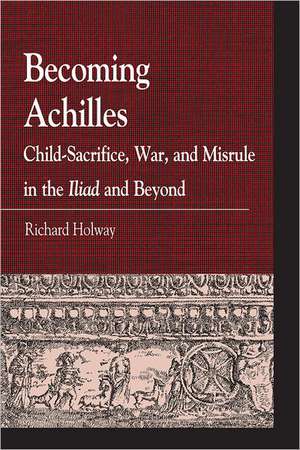
Becoming Achilles: Child-sacrifice, War, and Misrule in the lliad and Beyond: Greek Studies: Interdisciplinary Approaches
Autor Richard Kerr Holwayen Limba Engleză Paperback – 17 noi 2011
Just as Zeus contrives to have threats to his regime play out harmlessly (to him) in the mortal realm, so the Iliad dramatizes threats to Archaic and later Greek cultures in the safe arena of poetic performance. The epic represents in displaced form destructive mother-son and father-daughter liaisons and resulting strife within and between generations.
Holway calls into question the Iliad's (and many scholars') presentation of Achilles as a hero who speaks truth to power, learns through suffering, and exemplifies kingly virtues that Agamemnon lacks. So too the Iliad's cathartic process, whether conceived as purging innate aggression or arriving at moral clarity. Instead, Holway argues, Achilles (and Socrates) try to prove they are not what at bottom they experience themselves to be-needy, defenseless children, who fear to acknowledge, much less speak out against, parents' use of them to meet parents' needs.
What emerges from Holway's analysis is not only a new reading of the Iliad, from its first word to its last, but a revised account of the family dynamics underlying ancient Greek cultures.
Din seria Greek Studies: Interdisciplinary Approaches
- 18%
 Preț: 760.97 lei
 - 31%
 Preț: 331.20 lei
 - 26%
 Preț: 271.62 lei
 - 22%
 Preț: 329.29 lei
 - 22%
 Preț: 294.38 lei
 - 25%
 Preț: 247.73 lei
 - 19%
 Preț: 305.65 lei
 - 28%
 Preț: 355.76 lei
 - 19%
 Preț: 298.77 lei
 - 34%
 Preț: 573.26 lei
 - 22%
 Preț: 329.29 lei
 -
 Preț: 294.68 lei
 -
 Preț: 377.12 lei
 - 28%
 Preț: 399.61 lei
 - 23%
 Preț: 348.00 lei
 - 19%
 Preț: 335.20 lei
 - 31%
 Preț: 345.32 lei
 - 31%
 Preț: 355.58 lei
 - 31%
 Preț: 608.17 lei
 - 34%
 Preț: 708.85 lei
 - 34%
 Preț: 604.11 lei
 - 19%
 Preț: 336.43 lei
 - 34%
 Preț: 566.48 lei
 - 31%
 Preț: 328.50 lei
 - 19%
 Preț: 335.01 lei
 - 28%
 Preț: 420.05 lei
 - 34%
 Preț: 572.18 lei
 - 19%
 Preț: 348.80 lei
 - 23%
 Preț: 304.67 lei
 - 31%
 Preț: 330.17 lei
 - 22%
 Preț: 309.65 lei
 - 28%
 Preț: 419.26 lei
 - 28%
 Preț: 356.47 lei
 - 30%
 Preț: 379.91 lei
 - 28%
 Preț: 357.33 lei
 - 23%
 Preț: 240.45 lei
 - 19%
 Preț: 349.77 lei
 - 19%
 Preț: 351.15 lei
 - 19%
 Preț: 292.53 lei
 - 19%
 Preț: 318.17 lei
 - 34%
 Preț: 535.81 lei
Preț: 322.19 lei
Preț vechi: 369.14 lei
-13%
Puncte Express: 483
Preț estimativ în valută:
57.02€ • 66.64$ • 49.50£
57.02€ • 66.64$ • 49.50£
Carte tipărită la comandă
Livrare economică 19 februarie-05 martie
Preluare comenzi: 021 569.72.76
Specificații
ISBN-13: 9780739146910
ISBN-10: 0739146912
Pagini: 270
Dimensiuni: 154 x 231 x 19 mm
Greutate: 0.41 kg
Ediția:New.
Editura: Bloomsbury Publishing
Colecția Lexington Books
Seria Greek Studies: Interdisciplinary Approaches
Locul publicării:New York, United States
ISBN-10: 0739146912
Pagini: 270
Dimensiuni: 154 x 231 x 19 mm
Greutate: 0.41 kg
Ediția:New.
Editura: Bloomsbury Publishing
Colecția Lexington Books
Seria Greek Studies: Interdisciplinary Approaches
Locul publicării:New York, United States
Cuprins
Chapter 1 Introduction
Chapter 1. The Quarrel
Chapter 2. Heroic Psychology
Chapter 3. Mythobiographies
Chapter 4. Catharsis and Denial
Chapter 5. Fathers and Sons
Chapter 6. Mothers and Sons
Chapter 7. Departures from Maternal Agendas
Chapter 8. Self in Crisis
Epilogue: Achilles and Socrates
Bibliography
Chapter 1. The Quarrel
Chapter 2. Heroic Psychology
Chapter 3. Mythobiographies
Chapter 4. Catharsis and Denial
Chapter 5. Fathers and Sons
Chapter 6. Mothers and Sons
Chapter 7. Departures from Maternal Agendas
Chapter 8. Self in Crisis
Epilogue: Achilles and Socrates
Bibliography
Recenzii
Holway's evaluation of the Iliad in light of attachment theory and Freudian interpretations of family dynamics represents a valuable contribution to a series of interdisciplinary Greek studies edited by Gregory Nagy. Holway (Univ. of Virginia) posits that Achilles' glory-seeking temperament developed because his mother attempted to use him to retaliate against Zeus for rejecting her, providing illuminating insight into the psychological underpinnings of Greek hero-mythology and Greek culture more broadly. Greek hero literature is literally built on such examples of 'parents sacrificing children's needs to their own.' Dysfunctional families abound in the Homeric tradition, and the deleterious effects on people and institutions match up well with the family psychology literature. Holway pursues these connections to explain heroic violence and glory-seeking (chapter 2), patterns of patriarchy and misogyny (chapters 5 and 6), and even Socrates' actions during and after his trial (epilogue). While the analysis relies heavily on a portion of contemporary psychology to explain much about ancient Greek society, the book is an excellent resource for numerous fields of study. Summing Up: Highly recommended.
There exists a view that in order to be truly great you must sacrifice domestic happiness, perhaps even your life, in pursuit of your goal. In this interesting work by Richard Holway it is argued that the Iliad encourages this unhealthy acceptance of self-destruction as the natural pre-requisite of greatness. Using a psychology-based approach, with particular reference to infant attachment theory, Holway dissects the familial patterns in and around the Iliad to explore why its warriors willingly risk death.
Holway offers a reading of the Iliad focused on destructive and dysfunctional kinship relations, and above all those of father-daughter and mother-son. The anxieties of these relations are, Holway argues, ultimately redirected in a cathartic process through Achilles' savage mênis. . . .This is a provocative and interesting book.
Holway's book has many strengths. First among these is the novel reading of the Iliad and its background myths motivated by an interest in attachment theory. . . .Becoming Achilles is a worthy addition to the literature on the pedagogical effects of epic or tragedy. . . .Holway's book is to be recommended for the way it comes at well-worn material with a fresh perspective. More importantly, the book has much to teach us about the connection between familial and cultural violence, and the interpenetration of the micro and macro forces that shape human communities.
By applying the current psychology of attachment theory to the Iliad, this book illuminates Homer and Greek myth. What we see is a culture that depends on and perpetuates child-sacrifice and destructive family dynamics.
A profound and timeless study of the psychological consequences of being raised in a martial society that values the defense of honor-personal and collective-above all else.
This book is not only good to think with: it is also good, very good, to talk about. (From the foreword)
There exists a view that in order to be truly great you must sacrifice domestic happiness, perhaps even your life, in pursuit of your goal. In this interesting work by Richard Holway it is argued that the Iliad encourages this unhealthy acceptance of self-destruction as the natural pre-requisite of greatness. Using a psychology-based approach, with particular reference to infant attachment theory, Holway dissects the familial patterns in and around the Iliad to explore why its warriors willingly risk death.
Holway offers a reading of the Iliad focused on destructive and dysfunctional kinship relations, and above all those of father-daughter and mother-son. The anxieties of these relations are, Holway argues, ultimately redirected in a cathartic process through Achilles' savage mênis. . . .This is a provocative and interesting book.
Holway's book has many strengths. First among these is the novel reading of the Iliad and its background myths motivated by an interest in attachment theory. . . .Becoming Achilles is a worthy addition to the literature on the pedagogical effects of epic or tragedy. . . .Holway's book is to be recommended for the way it comes at well-worn material with a fresh perspective. More importantly, the book has much to teach us about the connection between familial and cultural violence, and the interpenetration of the micro and macro forces that shape human communities.
By applying the current psychology of attachment theory to the Iliad, this book illuminates Homer and Greek myth. What we see is a culture that depends on and perpetuates child-sacrifice and destructive family dynamics.
A profound and timeless study of the psychological consequences of being raised in a martial society that values the defense of honor-personal and collective-above all else.
This book is not only good to think with: it is also good, very good, to talk about. (From the foreword)