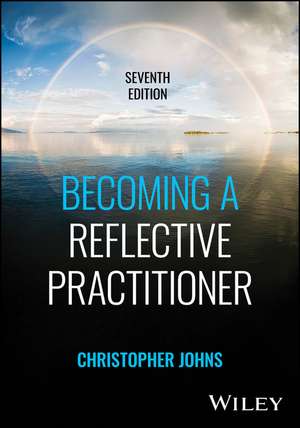
Becoming a Reflective Practitioner
Autor Christopher Johnsen Limba Engleză Paperback – 13 oct 2025
În practica medicală contemporană, simpla acumulare de cunoștințe tehnice nu mai este suficientă pentru a asigura o îngrijire de calitate superioară. Reținem că utilitatea practică a volumului Becoming a Reflective Practitioner, aflat la a șaptea ediție, rezidă în capacitatea sa de a transforma experiențele clinice brute în oportunități de învățare structurată. Clinicianul care parcurge această lucrare va putea să își analizeze critic deciziile cotidiene, trecând de la o execuție rutinată la o practică „dezirabilă”, ancorată în empatie și auto-reflexivitate. Ne-a atras atenția modul în care Christopher Johns își organizează materialul, pornind de la structuri de bază și tipologii ale reflecției, până la aplicarea lor în cadre clinice complexe. Față de edițiile anterioare, se observă o evoluție clară către utilizarea dialogului narativ și a „spiralelor reflexive”. Manualul este comparabil cu Reflective Practice in Nursing de Chris Bulman, însă versiunea de față se distinge prin introducerea modelului specific Johns și prin noile secțiuni dedicate managementului conflictelor și calității îngrijirii, actualizate conform cerințelor actuale din sistemele de sănătate. Spre deosebire de alte lucrări ale autorului care explorează filosofia pură sau politici publice, precum Leibniz's Discourse on Metaphysics, această carte rămâne pilonul central al carierei sale în asistență medicală. Structura progresivă, care include studii de caz precum „Peter și Sam” sau „Tom și Joan”, ghidează cititorul prin patru mișcări dialogice esențiale. Nu este doar un manual teoretic, ci un instrument de lucru care folosește „întreaga activitate cerebrală” pentru a naviga complexitatea relației de îngrijire.
Preț: 319.82 lei
Preț vechi: 336.65 lei
-5%
Carte disponibilă
Livrare economică 14-28 noiembrie
Livrare express 03-07 noiembrie pentru 50.75 lei
Specificații
ISBN-10: 1394343310
Pagini: 368
Dimensiuni: 178 x 253 x 18 mm
Greutate: 0.75 kg
Ediția:7. Auflage
Editura: John Wiley & Sons, Inc.
V-ar putea interesa
-
 Becoming A Nurse:: Making the Transition to PracticeMaria Fedoruk-5%Preț: 260.53 lei274.24 lei
 -
 Nursing Models for Nursing StudentsTeresa Chinn-34%Preț: 185.50 lei278.98 lei
 -
 Successful Studying for Nursing StudentsMelanie Hayward-32%Preț: 193.72 lei286.37 lei
 -
 -30%Preț: 375.24 lei536.65 lei
 -
 -31%Preț: 248.31 lei359.26 lei
 -
 -28%Preț: 296.17 lei413.28 lei
 -
 Successful Clinical Placements in NursingNatalie Elliott-32%Preț: 192.91 lei284.56 lei
 -
 -31%Preț: 224.51 lei324.87 lei
 -
 Contexts of Nursing: An IntroductionDebra Jackson-28%Preț: 319.56 lei445.98 lei
 -
 The Student's Guide to Reflective WritingMartin McMorrow-15%Preț: 125.41 lei147.85 lei
 -
 The Critically Reflective PractitionerNeil Thompson-19%Preț: 204.16 lei252.72 lei
 -
 The Reflective JournalBarbara Bassot-14%Preț: 140.07 lei163.34 lei
 -
 Reflective Teaching in Higher EducationPaul Ashwin-13%Preț: 275.14 lei317.75 lei
 -
 -11%Preț: 122.90 lei137.65 lei
 -
 -19%Preț: 238.10 lei294.43 lei
 -
 -19%Preț: 243.98 lei301.72 lei
 -
 Developing Reflective PracticeNatius OelofsenPreț: 196.61 lei
 -
 Brunner & Suddarth's Textbook of Medical-Surgical NursingJANICE L. HINKLE-17%Preț: 671.19 lei813.09 lei
 -
 (Re)learning as Reflective PractitionersLinley CornishPreț: 395.49 lei
De ce să citești această carte
Această carte este esențială pentru asistenții medicali și profesioniștii din sănătate care doresc să depășească stadiul de simpli executanți. Cititorul câștigă o metodă riguroasă de auto-evaluare prin modelul Johns, reușind să gestioneze mai eficient conflictele de la locul de muncă și să îmbunătățească siguranța pacientului. Este o investiție în dezvoltarea profesională pe termen lung, oferind instrumente concrete pentru a transforma stresul clinic în expertiză.
Despre autor
Christopher Johns este profesor de asistență medicală și un pionier recunoscut la nivel internațional în domeniul practicii reflexive. Cu o carieră dedicată umanizării îngrijirilor medicale, el a dezvoltat modele teoretice care sunt astăzi standard în educația nursingului global. Deși aria sa de interes este vastă, incluzând comentarii filosofice și analize politice, Johns rămâne o figură de referință în asistența medicală prin lucrările sale publicate la John Wiley & Sons, Inc., unde promovează reflecția ca metodă de atingere a excelenței clinice și a echilibrului profesional.
Cuprins
Acknowledgements.
Part 1 Basic structures.
1 Exploring reflection.
The significance of reflective practices for professional life.
Knowing reflection.
Whole–brain stuff.
A typology of reflective practices.
Setting out my stall.
Bimadisiwin.
Prerequisites of reflection.
Energy work.
Being in place.
Developing voice.
Evaluating reflection.
Conclusion.
2 A reflective framework for clinical practice.
Peter and Sam.
The Burford NDU model: caring in practice.
Vision.
From vision to reality.
A structural view of a reflective framework for clinical practice.
Organisational culture.
The Burford model s explicit assumptions.
Conclusion.
3 Becoming reflective.
Tom and Joan.
Narrative.
Dialogue.
The first dialogical movement: doodles in my journal.
The second dialogical movement: surfing the reflective spiral.
Dwelling with the text and gaining insight.
Framing perspectives.
Conclusion.
4 The third and fourth dialogical movements.
The third dialogical movement: the dance with Sophia.
The fourth dialogical movement: dialogue with peers and guides.
The nature of guidance.
Conclusion.
5 The fifth and sixth dialogical movements.
Reflection as art.
Being playful, being disciplined.
Autoethnography.
Conclusion.
6 Being available.
Tony.
Being available.
Holding and intending to realise a vision.
The extent to which the practitioner knows the other.
The extent to which the practitioner is concerned for the other.
The extent to which the practitioner can grasp and interpret the clinical
moment and respond with appropriate skilful action (the aesthetic
response).
Poise the extent to which the practitioner knows and manages self
within relationship.
Conclusion.
7 Creating an environment where being available is possible.
Cathy and the GPs.
Realising our power.
Hank s complaint.
Horizontal violence.
Support.
Debriefing.
Therapeutic benefits of disclosure.
Conclusion.
8 Therapeutic journalling for patients.
Moira Vass living with motor neurone disease.
Reflection.
Listening to the patient s story.
Conclusion.
Part 2 Narratives of being available.
9 Jill Jarvis: reflection on touch and the environment.
Introduction.
Touch (Jill Jarvis).
Environment (Jill Jarvis).
Conclusions.
10 Simon Lee: reflection on caring.
Introduction.
Simon writes.
Involvement.
11 Clare Coward: life begins at 40.
Clare writes.
12 Jim Jones: balancing the wind or a lot of hot air.
Jim writes.
Part 3 Creating the reflective environment.
13 Reflective communication.
Talk.
Confidentiality.
Patient notes.
Narrative.
Reflection.
Conclusion.
14 Ensuring quality.
A narrative of a quality initiative to improve midwifery care to postnatal
women in the community.
Reflection.
Conclusion.
15 Transformational leadership.
Sally writes: a little voice in a big arena.
Susan writes: liberating to care.
Reflection.
Conclusion.
16 Clinical supervision and nurturing the learning organisation.
Bumping heads.
Revealing woozles.
Clinical supervision.
The learning organisation.
Contracting.
Four variables of clinical supervision.
Emancipatory or technical supervision.
Peer–led supervision.
Qualities of the ideal supervisor.
Heron s six–category intervention analysis.
Modes of supervision.
The nine step model.
Trudy s story.
Conclusion.Practitioner
17 Reflection as chaos theory.
Lazell writes.
Reflection.
Conclusion.
18 The reflective curriculum.
Running in place.
Teacher identity.
Tripods.
Frozen stories.
Teaching through reflective practice.
Camp–fire teaching.
Trust.
Judging reflective writing.
Disadvantages.
Conclusion.
19 The performance turn.
Introduction.
The performance turn.
Performance texts.
Musical chairs.
RAW.
Notes.
How might performance be judged as valid? First a warning!
Authenticity/speaking your truth.
Conclusion.
Appendix Clinical supervision evaluation tool.
References.
Index.
Descriere
From Reviews of the second edition:
′Christopher Johns is an internationally recognised pioneer of reflective practice in nursing and health care. The first edition of this book was an excellent resource and this updated version is equally impressive.This is a superb resource for nurses and all those eager to enhance their knowledge and skills in reflective practice. It is well presented, user–friendly and stimulating.′
Nursing Standard
Becoming a Reflective Practitioner is a practical guide to using reflection in every day clinical practice. It explores the value of using models of reflection, with particular reference to Chris Johns′ own model for structured reflection.
Becoming a Reflective Practitioner includes accounts of everyday practice to guide the reader through the stages of reflective practice within the context of care, ′desirable practice′, and the caring relationship. This third edition reflects significant developments in reflective theory and gives greater attention to different approaches to reflection including the use of narrative dialogue. New chapters are included on ensuring quality and managing conflict. Exemplars are included throughout and further references and reflected reading are included at the end of each chapter.
Reflective practice is acknowledged as an effective approach to developing nursing care which evolves as the practitioner develops his or her own practice. This book will therefore be of interest to all nurses involved in developing their clinical practice.
- A practical guide to developing reflective practice
- Reflects significant developments in reflective theory
- Examines Chris Johns own model for structured reflection
- Centred on care and the caring relationship
- Challenges practitioners to question their practice
Reflective Practice in Nursing
Edited by Chris Bulman and Sue Schultz
978–1–4051–7360–5
Transforming Nursing Through Reflective Practice, 2nd edition
Edited by Christopher Johns and Dawn Freshwater
978–1–4051–1457–8
Engaging Reflection in Practice
Christopher Johns
978–1–4051–4973–0