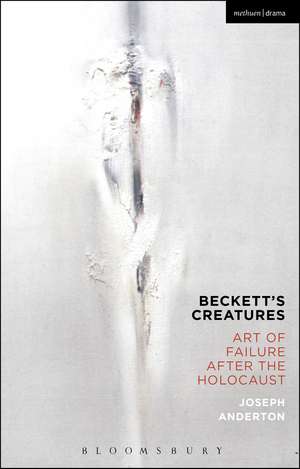
Beckett's Creatures: Art of Failure after the Holocaust
Autor Joseph Andertonen Limba Engleză Hardback – 5 mai 2016
În paginile volumului Beckett's Creatures, descoperim o narațiune vizuală a ruinelor umane, unde textul nu doar descrie, ci și întrupează o „estetică a eșecului” asumată după trauma Holocaustului. Joseph Anderton ne ghidează printr-o galerie de ființe degradate, ordonând lucrările lui Beckett nu cronologic, ci fenomenologic, pentru a ilustra modul în care condiția de „creatură” devine o formă de rezistență în fața istoriei. Găsim aici o analiză profundă a modului în care personajele beckettiene, de la Molloy la Vladimir și Estragon, sunt suspendate într-o existență melancolică, marcând granița fragilă dintre politic și biologic.
Experiența de lectură este una densă și riguroasă, reflectând efortul autorului de a „eșua mai bine” în articularea imposibilului. Structura cărții este echilibrată, capitolul dedicat mărturiei deschizând calea către explorarea relațiilor de putere și a umorului negru, culminând cu tema supraviețuirii ca simplă continuare mecanică. Cei care au studiat Beckett and Animals de Mary Bryden vor regăsi aici aceeași calitate a analizei asupra non-umanului, însă Anderton mută focusul de la zoologie la biopolitică. Dacă în lucrarea sa anterioară, Modernism and the Anthropocene, autorul explora dominația umană asupra naturii, în Beckett's Creatures el investighează momentul în care omul însuși este deposedat de suveranitate și redus la starea de creatură.
Putem afirma că acest volum completează perspectivele oferite de Samuel Beckett and Catastrophe de Michiko Tsushima, oferind un cadru teoretic solid prin dialogul cu filosofia lui Agamben sau Deleuze. Este o lucrare care nu se mulțumește să interpreteze simboluri, ci caută să înțeleagă mecanica degradării limbajului și a corpului în teatrul și proza de după Auschwitz.
Preț: 792.00 lei
Preț vechi: 1167.62 lei
-32%
Carte tipărită la comandă
Livrare economică 07-21 decembrie
Specificații
ISBN-10: 1474234534
Pagini: 264
Dimensiuni: 138 x 216 x 16 mm
Greutate: 0.45 kg
Editura: Bloomsbury Publishing
Colecția Methuen Drama
Locul publicării:London, United Kingdom
V-ar putea interesa
-
 Designs on FilmCathy Whitlock-8%Preț: 404.38 lei439.55 lei
 -
 Theatre and TherapyFintan Walsh-23%Preț: 54.37 lei70.35 lei
 -
 Preț: 312.84 lei
 -
 Preț: 391.79 lei
 -
 Holocaust Public Memory in Postcommunist RomaniaFlorian AlexandruPreț: 242.54 lei
 -
 By Design: Interviews with Film Production DesignersVincent LoBrutto-21%Preț: 258.60 lei327.14 lei
 -
 The Theatre of the Holocaust, Volume 1: Four PlaysRobert SklootPreț: 185.55 lei
 -
 The Theatre of the Holocaust, Volume 2: Six PlaysRobert SklootPreț: 149.06 lei
 -
 -51%Preț: 336.19 lei692.28 lei
 -
 The History of the Holocaust in RomaniaJean AncelPreț: 311.49 lei
 -
 The Holocaust in American FilmJudith DonesonPreț: 155.98 lei
 -
 -11%Preț: 512.76 lei576.13 lei
 -
 -29%Preț: 486.47 lei687.42 lei
 -
 Theatre History and HistoriographyClaire Cochrane-18%Preț: 807.99 lei985.36 lei
 -
 The Ethics of Teaching at Sites of Violence and TraumaNatalie BormannPreț: 431.12 lei
 -
 Preț: 454.28 lei
 -
 Staging Holocaust ResistanceGene A. PlunkaPreț: 308.69 lei
 -
 Applied Theatre: AestheticsGareth White-16%Preț: 199.05 lei236.06 lei
 -
 Anatomy of the Moving Body, Second EditionTheodore Dimon-17%Preț: 137.83 lei166.58 lei
 -
 -15%Preț: 143.23 lei168.03 lei
 -
 The Feldenkrais MethodYochanan RywerantPreț: 113.90 lei
 -
 The Post-traumatic Theatre of Grotowski and KantorMagda RomanskaPreț: 282.88 lei
 -
 Designing for ScreenGeorgina ShorterPreț: 132.05 lei
 -
 Holocaust Education in Primary Schools in the Twenty-First CenturyClaus-Christian W. Szejnmann-18%Preț: 755.49 lei921.32 lei
 -
 -8%Preț: 432.00 lei469.56 lei
 -
 Romania and the Holocaust: Events – Contexts – AftermathSimon Geissbühler-14%Preț: 221.76 lei258.64 lei
 -
 -23%Preț: 173.90 lei225.23 lei
 -
 Preț: 350.09 lei
 -
 Holocaust Education and the Student PerspectiveEvette MelizaPreț: 312.15 lei
De ce să citești această carte
Recomandăm această carte cercetătorilor și studenților de la teatru sau litere care doresc să depășească interpretările nihiliste clasice ale lui Beckett. Cititorul câștigă o înțelegere nuanțată a modului în care trauma istorică a Holocaustului a remodelat reprezentarea corpului uman pe scenă. Este un instrument esențial pentru a descifra legătura dintre etică, politică și estetica eșecului în modernismul târziu, oferind un context academic solid pentru piese precum „Așteptându-l pe Godot”.
Descriere
Through close readings of Beckett's prose and drama, particularly texts from the middle period, including Molloy, Malone Dies, The Unnamable, Waiting for Godot and Endgame, Anderton explicates four arenas of creaturely life in Beckett. Each chapter attends to a particular theme - testimony, power, humour and survival - to analyse a range of pressures and impositions that precipitate the creaturely state of suspension.
Drawing on the writings of Adorno, Agamben, Benjamin, Deleuze and Derrida to explore the overlaps between artistic and political structures of creation, the creature emerges as an in-between figure that bespeaks the provisional nature of the human. The result is a provocative examination of the indirect relationship between art and history through Beckett's treatment of testimony, power, humour and survival, which each attest to the destabilisation of meaning after Auschwitz.
Cuprins
What is a Beckettian Creature?
Last Human and Becoming-Animal
Concepts of the Creature and Creaturely Life
Beckett After 1945
Chapter 1: Testimony: Bearing Witness to the Event and Self
'Impossibility of Expressing': Art of Failure and Lacuna of Testimony
Fallibility and Dissociation
(In)sovereign Author-Narrators
Obligation to Testify: Mechanics, Enunciation, Ruins
Testimony of Fiction
Chapter 2: Power: Master-Servant Relationships
Exercising Writing: Fascist Regime Against Liberal Art
Watt the Fungible and Knott There: Objectified Servant and Absent Master
'A vague supplication': Melancholy in Waiting for Godot
Master-Servant Context: The Holocaust and the Jewish Creature
Biopolitical Struggles: Territory and Custody
Chapter 3: Humour: Failure and Degradation
Humour in Failure
Textual Performances
Words and Flesh in Endgame
Metanarrative Tragicomedy
'turd waiting for the flush': Gallows Humour
Chapter 4: Survival: Incompleteness and Continuation
'oh all to end': Beckettian Stirrings Still
Creaturely 'Undeadness'
Repetition and Performance
Forms of Activity and Stasis in Molloy
'finish dying': Death Without Death in Molloy
6. Epilogue
Endnotes
Bibliography
Index