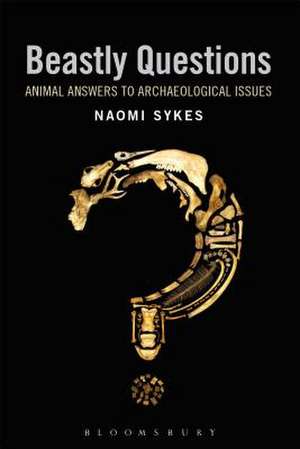
Beastly Questions: Animal Answers to Archaeological Issues
Autor Naomi Sykesen Limba Engleză Paperback – 24 sep 2015
By integrating knowledge from archaeological remains with evidence from texts, iconography, social anthropology and cultural geography, Beastly Questions: Animal Answers to Archaeological Issues seeks to encourage archaeological students, researchers and those working in the commercial sector to offer more engaging interpretations of the evidence at their disposal. Going beyond the simple confines of 'what people ate', this accessible but in-depth study covers a variety of high-profile topics in European archaeology and provides novel interpretations of mainstream archaeological questions. This includes cultural responses to wild animals, the domestication of animals and its implications on human daily practice, experience and ideology, the transportation of species and the value of incorporating animals into landscape research, the importance of the study of foodways for understanding past societies and how animal studies can help us to comprehend issues of human identity and ideology: past, present and future.
Preț: 254.18 lei
Puncte Express: 381
Carte tipărită la comandă
Livrare economică 26 noiembrie-10 decembrie
Livrare prin curier în România Termenul estimat este afișat lângă disponibilitate.
Transport gratuit de la 400.00 lei Plată online sau ramburs, în funcție de opțiunile comenzii.
Retur gratuit în 14 zile Comandă securizată și suport în română.
Specificații
ISBN-13: 9781474260695
ISBN-10: 1474260691
Pagini: 240
Ilustrații: 34 bw illus
Dimensiuni: 152 x 232 x 10 mm
Greutate: 0.38 kg
Editura: Bloomsbury Publishing
Colecția Bloomsbury Academic
Locul publicării:London, United Kingdom
ISBN-10: 1474260691
Pagini: 240
Ilustrații: 34 bw illus
Dimensiuni: 152 x 232 x 10 mm
Greutate: 0.38 kg
Editura: Bloomsbury Publishing
Colecția Bloomsbury Academic
Locul publicării:London, United Kingdom
V-ar putea interesa
-
 The Holy Land: An Oxford Archaeological Guide from Earliest Times to 1700Jerome Murphy O'Connor-23%Preț: 172.74 lei224.45 lei
 -
 AftermathJohn SchofieldPreț: 388.91 lei
 -
 Objects: Reluctant Witnesses to the PastChris CaplePreț: 382.81 lei
 -
 Uses of HeritageLaurajane SmithPreț: 384.86 lei
 -
 Archaeology For DummiesNancy Marie WhitePreț: 141.09 lei
 -
 Quantitative PaleozoologyR. Lee LymanPreț: 361.36 lei
 -
 Preț: 73.94 lei
 -
 Digging Up the PastJohn Collis-16%Preț: 116.36 lei138.14 lei
 -
 Environmental ArchaeologyTerry O'Connor-24%Preț: 148.53 lei194.81 lei
 -
 -26%Preț: 80.11 lei108.20 lei
 -
 -25%Preț: 173.62 lei230.79 lei
 -
 -27%Preț: 172.45 lei235.45 lei
 -
 The World of Ancient Egypt: "Essays in Honor of Ahmed Abd El-Qader El-Sawi Cahier"KHALED ABDALLA DAOUDPreț: 169.93 lei
Cuprins
Preface
Chapter 1: Animals and People: Mirrors and Windows
Chapter 2: Animal 'Revolutions'
Chapter 3: Wild Animals and Human Societies
Chapter 4: Animal Diaspora and Culture Change
Chapter 5: Ideas of Landscape
Chapter 6: The Chapter about Ritual
Chapter 7: Friends, Confidants and Lovers
Chapter 8: Meat
References
Chapter 1: Animals and People: Mirrors and Windows
Chapter 2: Animal 'Revolutions'
Chapter 3: Wild Animals and Human Societies
Chapter 4: Animal Diaspora and Culture Change
Chapter 5: Ideas of Landscape
Chapter 6: The Chapter about Ritual
Chapter 7: Friends, Confidants and Lovers
Chapter 8: Meat
References
Recenzii
A typically sideways, very personal, look at the study of animal remains from archaeological deposits, offering a new approach centred upon understanding the full, complex relations between people and the animals around them. Students will appreciate this as a source of information and ideas, academics will welcome a gust of fresh air through a dusty subject, and the general reader will enjoy a lively, often irreverent, book on a fascinating topic.
This volume provides an important and provocative contribution to the zooarchaeological literature. Naomi Sykes demonstrates that zooarchaeology can do much more than simply provide appendices to archaeological site reports. She shows that faunal remains can answer a range of interesting questions about human-animal relationships in the past.
Naomi Sykes begins Beastly Questions thus, 'Zooarchaeology has begun to bore me.' That is not really true. What troubles her greatly is the sterility of a certain kind of zoöarchaeology which identifies, measures, orders and quantifies animal remains but fails to interrogate them as traces of the co-constituted social and cultural relations between humans and other animals in the past. Beastly Questions is a feisty, imaginative, academically thorough and extremely readable exploration of the potentials and possibilities of a new social zooarchaeology. From mere bones Sykes fleshes out the animals and reconnects them to human worlds. Bored? Not at all! This is a powerful reanimation.
Anybody who cares for animals will enjoy this book just as much as specialists involved in the study of the past. It will be a great companion volume for scholars and students in archaeology and history as well as those who would like to understand why we need animals around us not only for meat and milk, but also for company and as metaphors for life and living even in the most modernized urban society. The 770 scholarly works listed in the book's reference list lend weight to the author's educated arguments on these exciting questions.
This volume provides an important and provocative contribution to the zooarchaeological literature. Naomi Sykes demonstrates that zooarchaeology can do much more than simply provide appendices to archaeological site reports. She shows that faunal remains can answer a range of interesting questions about human-animal relationships in the past.
Naomi Sykes begins Beastly Questions thus, 'Zooarchaeology has begun to bore me.' That is not really true. What troubles her greatly is the sterility of a certain kind of zoöarchaeology which identifies, measures, orders and quantifies animal remains but fails to interrogate them as traces of the co-constituted social and cultural relations between humans and other animals in the past. Beastly Questions is a feisty, imaginative, academically thorough and extremely readable exploration of the potentials and possibilities of a new social zooarchaeology. From mere bones Sykes fleshes out the animals and reconnects them to human worlds. Bored? Not at all! This is a powerful reanimation.
Anybody who cares for animals will enjoy this book just as much as specialists involved in the study of the past. It will be a great companion volume for scholars and students in archaeology and history as well as those who would like to understand why we need animals around us not only for meat and milk, but also for company and as metaphors for life and living even in the most modernized urban society. The 770 scholarly works listed in the book's reference list lend weight to the author's educated arguments on these exciting questions.