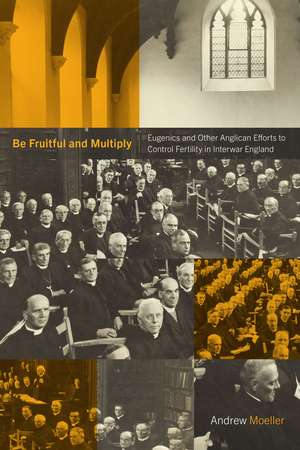
Be Fruitful and Multiply: Eugenics and Other Anglican Efforts to Control Fertility in Interwar England
Autor Andrew Moelleren Limba Engleză Paperback – 8 dec 2026 – vârsta ani
Preț: 237.47 lei
Precomandă
Puncte Express: 356
Carte nepublicată încă
Livrare prin curier în România Precomanda se expediază când titlul devine disponibil.
Transport gratuit de la 400.00 lei Plată online sau ramburs, în funcție de opțiunile comenzii.
Retur gratuit în 14 zile Comandă securizată și suport în română.
Doresc să fiu notificat când acest titlu va fi disponibil:
Se trimite...
Specificații
ISBN-13: 9781978845688
ISBN-10: 1978845685
Pagini: 230
Ilustrații: 1 B-W image
Dimensiuni: 152 x 229 mm
Greutate: 0.45 kg
Editura: Rutgers University Press
Colecția Rutgers University Press
ISBN-10: 1978845685
Pagini: 230
Ilustrații: 1 B-W image
Dimensiuni: 152 x 229 mm
Greutate: 0.45 kg
Editura: Rutgers University Press
Colecția Rutgers University Press
Notă biografică
ANDREW MOELLER is a hosted research fellow at the Uehiro Oxford Institute and an associate member of the History Faculty at The University of Oxford, England. He is also the leader of a research project entitled “Biotechnology and the Humanities,” based within the Medical Humanities Research Hub at Oxford.
Cuprins
List of Abbreviations
Introduction
1: Shepherds of Sexual Morals, Family Life, and National Interests, 1916-1920
2: Declining Birthrates and a Declining Church, 1920-1930
3: Birth Control as Charity: Fertility, Class, and Flourishing at the 1930 Lambeth Conference
4: A Divine Narrative of Exclusion: The "Will of God" and the Eradication of the "Mentally Unfit," 1929-1935
5: Parenthood as Penitence: Depopulation Panic and a "Broken" Social Order, 1936-1941
Conclusion
Acknowledgments
Notes
Bibliography
Index
Introduction
1: Shepherds of Sexual Morals, Family Life, and National Interests, 1916-1920
2: Declining Birthrates and a Declining Church, 1920-1930
3: Birth Control as Charity: Fertility, Class, and Flourishing at the 1930 Lambeth Conference
4: A Divine Narrative of Exclusion: The "Will of God" and the Eradication of the "Mentally Unfit," 1929-1935
5: Parenthood as Penitence: Depopulation Panic and a "Broken" Social Order, 1936-1941
Conclusion
Acknowledgments
Notes
Bibliography
Index
Recenzii
"Moeller’s examination of the theologically-driven interests of Anglican leaders in birth rates and reproduction is an original and persuasive analysis of the moral backdrop that fueled the varied positions adopted by Church leaders in the mid-twentieth century. It’s an intriguing and thoughtful contribution that deserves a wide audience."
"This is the authoritative treatment of how the leaders of the Anglican Church in England expressed concerns about fertility, reproduction, family size, and demographic decline during the interwar period. Many of them also entertained eugenic and racial ideas. With the current resurgence of pronatalist eugenics across the Western world, understanding these interwar debates on population and their legacy is more relevant today than ever before."
"This book provides the first full-length account of the prominent role played by Church of England leaders in national debates about fertility and the birthrate in interwar Britain. Driven by anxieties about the future of the British Empire, the middle classes, and the national church, some senior Anglicans led eugenic and pronatalist campaigns. At the same time, the Church broke with tradition by sanctioning the use of contraception for married couples. This fascinating volume will be invaluable for historians of science, sexuality, race, and religion."
"This is the authoritative treatment of how the leaders of the Anglican Church in England expressed concerns about fertility, reproduction, family size, and demographic decline during the interwar period. Many of them also entertained eugenic and racial ideas. With the current resurgence of pronatalist eugenics across the Western world, understanding these interwar debates on population and their legacy is more relevant today than ever before."
"This book provides the first full-length account of the prominent role played by Church of England leaders in national debates about fertility and the birthrate in interwar Britain. Driven by anxieties about the future of the British Empire, the middle classes, and the national church, some senior Anglicans led eugenic and pronatalist campaigns. At the same time, the Church broke with tradition by sanctioning the use of contraception for married couples. This fascinating volume will be invaluable for historians of science, sexuality, race, and religion."
Descriere
Be Fruitful and Multiply explores how Anglican leaders justified support for eugenic, pronatalist, and neo-Malthusian schemes between the world wars. It explores how population concerns contributed to the liberalization of church views on marriage and sexuality, and how Anglican leaders responded to a perceived decline in their own moral authority.