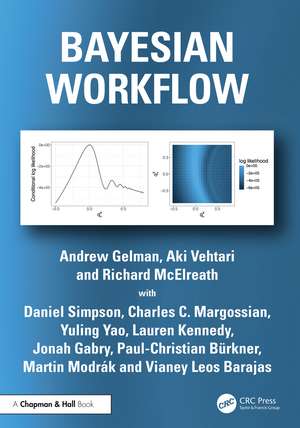
Bayesian Workflow
Autor Andrew Gelman, Aki Vehtari, Richard McElreath, Daniel Simpson, Charles C. Margossian, Yuling Yao, Lauren Kennedy, Jonah Gabry, Paul-Christian Bürkner, Martin Modrák, Vianey Leos Barajasen Limba Engleză Paperback – 25 iun 2026
Through detailed examples and practical guidance, the book bridges the gap between theory and application, empowering practitioners and researchers to navigate the complexities of Bayesian inference. It is not a checklist or cookbook but a flexible framework for understanding and resolving challenges in statistical modeling and decision-making under uncertainty.
Features
- Covers all aspects of Bayesian statistical workflow, including model building, inference, validation, troubleshooting, and understanding
- Demonstrates iterative model development and computational problem-solving through real-world case studies
- Explores computational challenges, calibration checking, and connections between modeling and computation
- Highlights the importance of checking models under diverse conditions to understand their limitations and improve their robustness
- Discusses how Bayesian principles apply to non-Bayesian methods in statistics and machine learning
- Includes code snippets, exercises, and links to full datasets and code in R and Stan, with applicability to other programming environments like Python and Julia
Preț: 346.61 lei
Preț vechi: 433.27 lei
-20%
Puncte Express: 520
Carte disponibilă
Livrare economică 06-20 noiembrie
Livrare express 22-28 octombrie pentru 57.27 lei
Livrare prin curier în România Termenul estimat este afișat lângă disponibilitate.
Transport gratuit de la 400.00 lei Plată online sau ramburs, în funcție de opțiunile comenzii.
Retur gratuit în 14 zile Comandă securizată și suport în română.
Specificații
ISBN-13: 9780367490140
ISBN-10: 0367490145
Pagini: 552
Ilustrații: 486
Dimensiuni: 178 x 254 mm
Greutate: 1.14 kg
Ediția:1
Editura: CRC Press
Colecția Chapman and Hall/CRC
ISBN-10: 0367490145
Pagini: 552
Ilustrații: 486
Dimensiuni: 178 x 254 mm
Greutate: 1.14 kg
Ediția:1
Editura: CRC Press
Colecția Chapman and Hall/CRC
V-ar putea interesa
-
 Inside the FirmHarvey LeibensteinPreț: 502.24 lei
 -
 Dealing with DownturnsCorinne Michaela FlickPreț: 67.11 lei
 -
 Lead Me Out to the BallgameHoward C. FeroPreț: 106.36 lei
 -
 Éléphants VertsSimon ChapleauPreț: 114.63 lei
 -
 HochschulmanagementWerner HeinrichsPreț: 331.77 lei
 -
 Internationale MarketingforschungErich Bauer-8%Preț: 489.20 lei531.73 lei
 -
 Sales Coaching by BenedictKarl HerndlPreț: 424.05 lei
 -
 The Concept of the Firm in the Network EconomyKateryna Bondar-8%Preț: 489.99 lei532.60 lei
 -
 Détermination du prix ou Formation de la valeur économique ?Diego Boilengar Nodjirim-23%Preț: 912.74 lei1185.38 lei
 -
 -23%Preț: 745.39 lei968.04 lei
 -
 Comportement de l'exposant de HurstImen Zgueb Rejichi-23%Preț: 654.27 lei849.69 lei
 -
 Preț: 379.93 lei
 -
 Mobile CRM - Nutzung mobiler Technologien im Customer Relationship ManagementFabian HeidensteckerPreț: 421.52 lei
 -
 Preț: 415.57 lei
 -
 Veränderungsmanagement: Werkzeuge zur Umsetzung für KMUSasha PetschnigPreț: 420.87 lei
 -
 Preț: 397.07 lei
 -
 Preț: 247.23 lei
 -
 Immobilienprojektentwicklung am Beispiel eines HotelsChristian BlankensteinPreț: 293.38 lei
 -
 Preț: 264.71 lei
 -
 Mindful LeadershipWibo KoolePreț: 154.23 lei
 -
 PROJECT MANAGEMENT FOR ENGINEERSBennett J MichaelPreț: 416.85 lei
Public țintă
Academic, Postgraduate, and Professional Practice & DevelopmentCuprins
Part 1: From Bayesian inference to Bayesian workflow. 1 Bayesian theory and Bayesian practice. 2 Statistical modeling and workflow. 3 Computational tools. 4 Introduction to workflow: Modeling performance on a multiple choice exam. Part 2: Statistical workflow. 5 Building statistical models. 6 Using simulations to capture uncertainty. 7 Prediction, generalization, and causal inference/ 8 Visualizing and checking fitted models. 9 Comparing and improving models. 10 Statistical inference and scientific inference. Part 3: Computational workflow. 11 Fitting statistical models. 12 Diagnosing and fixing problems with fitting. 13 Approximate algorithms and approximate models. 14 Simulation-based calibration checking. 15 Statistical modeling as software development. Part 4: Case studies. 16 Coding a series of models: Simulated data of movie ratings. 17 Prior specification for regression models: Reanalysis of a sleep study.18 Predictive model checking and comparison: Clinical trial. 19 Building up to a hierarchical model: Coronavirus testing. 20 Using a fitted model for decision analysis: Mixture model for time series competition. 21 Posterior predictive checking: Stochastic learning in dogs. 22 Incremental development and testing: Black cat adoptions. 23 Debugging a model: World Cup football. 24 Leave-one-out cross validation model checking and comparison: Roaches. 25 Model building and expansion: Golf putting. 26 Model building with latent variables: Markov models for animal movement. 27 Model building: Time-series decomposition for birthdays. 28 Models for regression coefficients and variable selection: Student grades. 29 Funnel problem with latent variables: No vehicles in the park. 30 Computational challenge of multimodality: Differential equation for planetary motion. 31 Simulation-based calibration checking in model development workflow.
Notă biografică
Andrew Gelman is a professor of statistics and political science at Columbia University
Aki Vehtari is a professor of computer science at Aalto University
Richard McElreath is the director of the Max Planck Institute for Evolutionary Anthropology
Daniel Simpson is a machine learning engineer at dottxt
Charles Margossian is an assistant professor of statistics at the University of British Columbia
Yuling Yao is an assistant professor of statistics at the University of Texas
Lauren Kennedy is a senior lecturer in mathematical science at the University of Adelaide
Jonah Gabry is an applied statistics researcher at Columbia University
Paul-Christian Bürkner is a professor of statistics at TU Dortmund University
Martin Modrák is a researcher in bioinformatics at Charles University
Vianey Leos Barajas is an assistant professor of statistical sciences at the University of Toronto
Aki Vehtari is a professor of computer science at Aalto University
Richard McElreath is the director of the Max Planck Institute for Evolutionary Anthropology
Daniel Simpson is a machine learning engineer at dottxt
Charles Margossian is an assistant professor of statistics at the University of British Columbia
Yuling Yao is an assistant professor of statistics at the University of Texas
Lauren Kennedy is a senior lecturer in mathematical science at the University of Adelaide
Jonah Gabry is an applied statistics researcher at Columbia University
Paul-Christian Bürkner is a professor of statistics at TU Dortmund University
Martin Modrák is a researcher in bioinformatics at Charles University
Vianey Leos Barajas is an assistant professor of statistical sciences at the University of Toronto
Recenzii
“This is an important book…The text magnificently achieves its aim of leading the reader through this workflow, which involves iterative model building, model checking, validation and troubleshooting of computational problems, as well as model understanding and model comparison. These aspects of the workflow are considered in the context of several, diverse examples…Despite its length, the book is beautifully structured, as a series of 31 chapters, each a relatively short and carefully crafted essay on some aspect of the Bayesian workflow. Each chapter includes a set of quite open-ended exercises, so the text would serve as an excellent basis for an extensive advanced course on contemporary applied Bayesian data analysis…The book is ‘not a checklist, not a cookbook’ but fully achieves its aim of presenting a flexible framework for understanding and analysing challenges in Bayesian statistical modelling and decision-making under uncertainty…The authors have produced a tour-de-force. By elegantly systematizing the processes of Bayesian model development and criticism, they have provided a work which provides a road map for improved applied Bayesian data analysis. It is certain to influence developments in applied statistical analysis, as well as inspire future innovations in Bayesian theory, methodology and computational software.”
~Alastair Young, Imperial College, UK, published in International Statistical Review, July 2026
“An outstanding, protocol-driven guide for Bayesian data analysis, Bayesian Workflow by Gelman, Vehtari, McElreath and co-authors delivers a practical and comprehensive framework for iterative modeling, emphasizing simulation, diagnostic checks, and rigorous empirical validation, and with a long and impressive list of case studies. By treating data analysis as a structured, verifiable workflow, it provides an indispensable toolkit for diagnosing model failures, refining priors, and building reliable data analysis systems for reproducible conclusions, useful for beginning and veteran data analysts alike.”
~Bin Yu, CDSS Chancellor’s Distinguished Professor of Statistics, Electrical Engineering and Computer Sciences, and Center for Computational Biology, UC Berkeley, USA
“This is not a typical methods textbook, but instead it guides the reader through the whole process of fitting, critiquing and adapting statistical models to real-world problems. It is full of the accumulated wisdom of skilled practitioners, teaching through demonstration rather than theory, with both basic and highly sophisticated examples. I strongly recommend this book to statisticians who really want to understand what they can learn from their data.”
~Sir David Spiegelhalter, University of Cambridge, UK
"A bravura performance...Gelman, Vehtari, McElreath and friends develop in detail a practical Bayesian data analysis workflow, from acquisition to final report, including full computational guidance.”
~Brad Efron, Stanford University, USA
"This original, thought-provoking, and transformative book is much much more than an implementation manual for Bayesian Data Analysis, even though it shares almost the same perspective. (The first sentence of the book states that the authors' "conceptions of statistical practice, and of Bayesian statistics, have changed over the years".) By providing a modus vivendi for undertaking Bayesian modelling from scratch in realistic settings where models are not magicked out of the blue, the authors explicit and rationalise the many steps required by such a bottom-up modelling protocol ("not a checklist, not a cookbook", and not a flowchart!) in real situations. The contents read very well and very smoothly, with a seamless conjunction of intuition, modelling advices, computational details, and comparison tools. While unsurprisingly Bayesian, the perspective adopted therein remains both open and inclusive, with a welcome humility about the limitations and challenges of Bayesian workflows. This book should thus appeal to and profit a wide variety of readers, as providing guidance through an extensive collection of highly detailed examples, with shared code and exercises.”
~Christian P. Robert, Université Paris Dauphine PSL, Paris, France
“Some statistics books show you how to beat an egg, others are recipe books: if this, then that style. This book teaches you how to cook. Written by authors who established so much of how we do Bayesian statistics, this new book is an indispensable guide for analyzing data in a trustworthy way. It walks you through the actual steps involved in building models to explore and understand datasets. Part 4 is particularly excellent – the authors provide many end-to-end case studies that will be useful for both practitioners and students. It highlights the value of their workflow-based approach. Filled with chatty asides, the book introduces the Bayesian workflow to a broad audience. It embraces the frustrations and complexities of actually doing Bayesian statistics and provides specific guidance throughout. Each chapter contains exercises and it could be the basis of an upper-year undergraduate course, or a first-year grad course, in applied statistics. It will be used for many years to come.”
~Rohan Alexander, University of Toronto, Canada
“What makes Bayesian Workflow so exceptional is how it seamlessly pairs profound ideas about modeling with the adoption of modern computational practice. By centering the messy, iterative process of modeling through real-world case studies, the authors reject rigid cookbooks and checklists in favor of building deep situational awareness. Because the ideas are so clearly articulated and deeply applied, this book serves as an invaluable pedagogical resource. With its practical exercises, individual chapters or the text as a whole can easily be integrated into upper-level undergraduate or graduate courses, while also remaining accessible for self-guided readers. It is an indispensable read for anyone with foundational knowledge in Bayesian methods, regardless of whether they are applied practitioners, software developers, or methodologists.”
~Mine Doğucu, Senior Lecturer on Statistics, Harvard University, USA
~Alastair Young, Imperial College, UK, published in International Statistical Review, July 2026
“An outstanding, protocol-driven guide for Bayesian data analysis, Bayesian Workflow by Gelman, Vehtari, McElreath and co-authors delivers a practical and comprehensive framework for iterative modeling, emphasizing simulation, diagnostic checks, and rigorous empirical validation, and with a long and impressive list of case studies. By treating data analysis as a structured, verifiable workflow, it provides an indispensable toolkit for diagnosing model failures, refining priors, and building reliable data analysis systems for reproducible conclusions, useful for beginning and veteran data analysts alike.”
~Bin Yu, CDSS Chancellor’s Distinguished Professor of Statistics, Electrical Engineering and Computer Sciences, and Center for Computational Biology, UC Berkeley, USA
“This is not a typical methods textbook, but instead it guides the reader through the whole process of fitting, critiquing and adapting statistical models to real-world problems. It is full of the accumulated wisdom of skilled practitioners, teaching through demonstration rather than theory, with both basic and highly sophisticated examples. I strongly recommend this book to statisticians who really want to understand what they can learn from their data.”
~Sir David Spiegelhalter, University of Cambridge, UK
"A bravura performance...Gelman, Vehtari, McElreath and friends develop in detail a practical Bayesian data analysis workflow, from acquisition to final report, including full computational guidance.”
~Brad Efron, Stanford University, USA
"This original, thought-provoking, and transformative book is much much more than an implementation manual for Bayesian Data Analysis, even though it shares almost the same perspective. (The first sentence of the book states that the authors' "conceptions of statistical practice, and of Bayesian statistics, have changed over the years".) By providing a modus vivendi for undertaking Bayesian modelling from scratch in realistic settings where models are not magicked out of the blue, the authors explicit and rationalise the many steps required by such a bottom-up modelling protocol ("not a checklist, not a cookbook", and not a flowchart!) in real situations. The contents read very well and very smoothly, with a seamless conjunction of intuition, modelling advices, computational details, and comparison tools. While unsurprisingly Bayesian, the perspective adopted therein remains both open and inclusive, with a welcome humility about the limitations and challenges of Bayesian workflows. This book should thus appeal to and profit a wide variety of readers, as providing guidance through an extensive collection of highly detailed examples, with shared code and exercises.”
~Christian P. Robert, Université Paris Dauphine PSL, Paris, France
“Some statistics books show you how to beat an egg, others are recipe books: if this, then that style. This book teaches you how to cook. Written by authors who established so much of how we do Bayesian statistics, this new book is an indispensable guide for analyzing data in a trustworthy way. It walks you through the actual steps involved in building models to explore and understand datasets. Part 4 is particularly excellent – the authors provide many end-to-end case studies that will be useful for both practitioners and students. It highlights the value of their workflow-based approach. Filled with chatty asides, the book introduces the Bayesian workflow to a broad audience. It embraces the frustrations and complexities of actually doing Bayesian statistics and provides specific guidance throughout. Each chapter contains exercises and it could be the basis of an upper-year undergraduate course, or a first-year grad course, in applied statistics. It will be used for many years to come.”
~Rohan Alexander, University of Toronto, Canada
“What makes Bayesian Workflow so exceptional is how it seamlessly pairs profound ideas about modeling with the adoption of modern computational practice. By centering the messy, iterative process of modeling through real-world case studies, the authors reject rigid cookbooks and checklists in favor of building deep situational awareness. Because the ideas are so clearly articulated and deeply applied, this book serves as an invaluable pedagogical resource. With its practical exercises, individual chapters or the text as a whole can easily be integrated into upper-level undergraduate or graduate courses, while also remaining accessible for self-guided readers. It is an indispensable read for anyone with foundational knowledge in Bayesian methods, regardless of whether they are applied practitioners, software developers, or methodologists.”
~Mine Doğucu, Senior Lecturer on Statistics, Harvard University, USA
Descriere
Explores the intricate workflows of applied Bayesian statistics, aiming to uncover the tacit knowledge often overlooked in published papers and textbooks. By systematizing the process of Bayesian model development, the book seeks to improve applied analyses and inspire future innovations in theory, methods, and software.