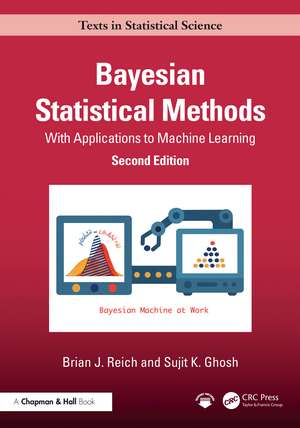
Bayesian Statistical Methods: With Applications to Machine Learning: Chapman & Hall/CRC Texts in Statistical Science
Autor Brian J. Reich, Sujit K. Ghoshen Limba Engleză Hardback – feb 2026
Readers familiar with only introductory statistics will find this book accessible, as it includes many worked examples with complete R code, and comparisons are presented with analogous frequentist procedures. The book can be used as a one-semester course for advanced undergraduate and graduate students and can be used in courses comprising undergraduate statistics majors, as well as non-statistics graduate students from other disciplines such as engineering, ecology and psychology. In addition to thorough treatment of the basic concepts of Bayesian inferential methods, the book covers many general topics:
- Advice on selecting prior distributions
- Computational methods including Markov chain Monte Carlo (MCMC) sampling
- Model-comparison and goodness-of-fit measures, including sensitivity to priors.
- Handling of missing and censored data
- Priors for high-dimensional regression models
- Machine learning models including Bayesian adaptive regression trees and deep learning
- Computational techniques for large datasets
- Frequentist properties of Bayesian methods.
Din seria Chapman & Hall/CRC Texts in Statistical Science
- 8%
 Preț: 591.72 lei
 - 14%
 Preț: 675.87 lei
 - 11%
 Preț: 715.27 lei
 - 20%
 Preț: 659.27 lei
 - 9%
 Preț: 812.56 lei
 - 9%
 Preț: 826.08 lei
 - 9%
 Preț: 756.15 lei
 - 8%
 Preț: 438.66 lei
 - 18%
 Preț: 1072.86 lei
 - 15%
 Preț: 530.47 lei
 - 18%
 Preț: 941.48 lei
 - 15%
 Preț: 560.19 lei
 - 18%
 Preț: 734.98 lei
 - 18%
 Preț: 752.30 lei
 -
 Preț: 444.29 lei
 - 18%
 Preț: 709.93 lei
 - 9%
 Preț: 816.65 lei
 - 9%
 Preț: 640.24 lei
 - 18%
 Preț: 1280.63 lei
 - 15%
 Preț: 533.53 lei
 - 18%
 Preț: 777.27 lei
 -
 Preț: 447.53 lei
 - 18%
 Preț: 796.60 lei
 - 18%
 Preț: 1091.13 lei
 - 8%
 Preț: 615.44 lei
 - 15%
 Preț: 652.65 lei
 - 18%
 Preț: 695.93 lei
 - 15%
 Preț: 530.47 lei
 - 18%
 Preț: 939.05 lei
 - 18%
 Preț: 726.61 lei
 - 15%
 Preț: 528.08 lei
 - 5%
 Preț: 775.20 lei
 - 15%
 Preț: 465.33 lei
 - 18%
 Preț: 717.88 lei
 - 15%
 Preț: 489.45 lei
 - 18%
 Preț: 812.99 lei
 - 18%
 Preț: 945.32 lei
 - 18%
 Preț: 1367.70 lei
 - 18%
 Preț: 753.17 lei
 - 20%
 Preț: 418.40 lei
 - 18%
 Preț: 1077.45 lei
 - 18%
 Preț: 1467.42 lei
 - 9%
 Preț: 644.47 lei
 - 8%
 Preț: 558.93 lei
 - 9%
 Preț: 742.48 lei
 - 18%
 Preț: 799.03 lei
 - 18%
 Preț: 964.16 lei
 - 18%
 Preț: 737.55 lei
Preț: 726.95 lei
Preț vechi: 886.52 lei
-18%
Puncte Express: 1090
Carte tipărită la comandă
Livrare economică 21 noiembrie-05 decembrie
Livrare express 17-23 octombrie pentru 131.08 lei
Livrare prin curier în România Termenul estimat este afișat lângă disponibilitate.
Transport gratuit pentru acest produs Plată online sau ramburs, în funcție de opțiunile comenzii.
Retur gratuit în 14 zile Comandă securizată și suport în română.
Specificații
ISBN-13: 9781032486321
ISBN-10: 1032486325
Pagini: 360
Ilustrații: 232
Dimensiuni: 178 x 254 mm
Greutate: 0.83 kg
Ediția:2. Auflage
Editura: CRC Press
Colecția Chapman and Hall/CRC
Seria Chapman & Hall/CRC Texts in Statistical Science
ISBN-10: 1032486325
Pagini: 360
Ilustrații: 232
Dimensiuni: 178 x 254 mm
Greutate: 0.83 kg
Ediția:2. Auflage
Editura: CRC Press
Colecția Chapman and Hall/CRC
Seria Chapman & Hall/CRC Texts in Statistical Science
V-ar putea interesa
-
 -31%Preț: 1103.30 lei1592.23 lei
 -
 Social Accounting SystemsM. YanovskyPreț: 461.37 lei
 -
 Time Series: A Data Analysis Approach Using RRobert H. Shumway-15%Preț: 603.22 lei709.67 lei
 -
 -15%Preț: 552.88 lei650.45 lei
 -
 Data, Statistics, and Decision Models with ExcelDonald L. Harnett-27%Preț: 1589.82 lei2177.84 lei
 -
 Research and Evaluation for BusinessMarilyn K. Pelosi-11%Preț: 1523.19 lei1711.44 lei
 -
 Foundations Dynamic Economic AnlyMichael R. Caputo-19%Preț: 558.65 lei689.70 lei
 -
 -27%Preț: 353.97 lei484.55 lei
 -
 Cognition and Chance: The Psychology of Probabilistic ReasoningRaymond S. Nickerson-15%Preț: 664.93 lei782.27 lei
 -
 The Power of Survey DesignGiuseppe IarossiPreț: 252.41 lei
 -
 -20%Preț: 524.16 lei655.20 lei
 -
 Technical Analysis of Stock TrendsRobert D. Edwards-18%Preț: 819.55 lei999.44 lei
 -
 The Banking Crisis HandbookGreg N Gregoriou-15%Preț: 641.31 lei754.49 lei
 -
 Introduction to Functional Data AnalysisPiotr Kokoszka-18%Preț: 1072.86 lei1308.37 lei
 -
 Health, Safety, and Environmental Data Analysis: A Business ApproachAnthony J. Joseph-18%Preț: 1110.11 lei1353.79 lei
 -
 -8%Preț: 488.52 lei531.00 lei
 -
 Statistik verstehen und sinnvoll nutzenJörg-D. Meißner-9%Preț: 890.68 lei978.76 lei
Public țintă
Undergraduate Advanced and Undergraduate CoreCuprins
Preface 1 Basics of Bayesian inference 2 From prior information to posterior inference 3 Computational approaches 4 Linear models 5 Hypothesis testing 6 Model selection and diagnostics 7 Case studies using hierarchical modeling 8 Machine learning 9 Statistical properties of Bayesian methods Appendices Bibliography Index
Notă biografică
Brian J. Reich, Gertrude M. Cox Distinguished Professor of Statistics at North Carolina State University, applies Bayesian statistical methods in a variety of fields including environmental epidemiology, engineering, weather and climate. He is a Fellow of the American Statistical Association, former Editor-in-Chief of the Journal of Agricultural, Biological, and Environmental Statistics and recipient of the LeRoy & Elva Martin Teaching Award at NC State University.
Sujit K. Ghosh, Professor of Statistics at North Carolina State University, has worked in advanced research fields such as Bayesian inference, spatial statistics, survival analysis and shape-constrained inference, addressing complex inferential challenges in biomedical and environmental sciences, econometrics, and engineering. At NC State, he has been honored with the D.D. Mason Faculty Award and the Cavell Brownie Mentoring Award, reflecting his excellence in research, mentoring and teaching. His leadership includes impactful service as Program Director at NSF’s Division of Mathematical Sciences, Deputy Director at SAMSI and President of the IISA.
Sujit K. Ghosh, Professor of Statistics at North Carolina State University, has worked in advanced research fields such as Bayesian inference, spatial statistics, survival analysis and shape-constrained inference, addressing complex inferential challenges in biomedical and environmental sciences, econometrics, and engineering. At NC State, he has been honored with the D.D. Mason Faculty Award and the Cavell Brownie Mentoring Award, reflecting his excellence in research, mentoring and teaching. His leadership includes impactful service as Program Director at NSF’s Division of Mathematical Sciences, Deputy Director at SAMSI and President of the IISA.
Descriere
This book provides data scientists with the foundational and computational tools needed to carry out a Bayesian analysis. Compared to others, it is more focused on Bayesian methods applied routinely in practice including multiple linear regression, mixed effects models and generalized linear models.
Recenzii
"A book that gives a comprehensive coverage of Bayesian inference for a diverse background of scientific practitioners is needed. The book Bayesian Statistical Methods seems to be a good candidate for this purpose, which aims at a balanced treatment between theory and computation. The authors are leading researchers and experts in Bayesian statistics. I believe this book is likely to be an excellent text book for an introductory course targeting at first-year graduate students or undergraduate statistics majors…This new book is more focused on the most fundamental components of Bayesian methods. Moreover, this book contains many simulated examples and real-data applications, with computer code provided to demonstrate the implementations."
~Qing Zhou, UCLA"The book gives an overview of Bayesian statistical modeling with a focus on the building blocks for fitting and analyzing hierarchical models. The book uses a number of interesting and realistic examples to illustrate the methods. The computational focus is in the use of JAGS, as a tool to perform Bayesian inference using Markov chain Monte Carlo methods…It can be targeted as a textbook for upper-division undergraduate students in statistics and some areas of science, engineering and social sciences with an interest in a reasonably formal development of data analytic methods and uncertainty quantification. It could also be used for a Master’s class in statistical modeling."
~Bruno Sansó, University of California Santa Cruz
"The given manuscript sample is technically correct, clearly written, and at an appropriate level of difficulty… I enjoyed the real-life problems in the Chapter 1 exercises. I especially like the problem on the Federalist Papers, because the students can revisit this problem and perform more powerful inferences using the advanced Bayesian methods that they will learn later in the textbook… I would seriously consider adopting the book as a required textbook. This text provides more details, R codes, and illuminating visualizations compared to competing books, and more quickly introduces a broad scope of regression models that are important in practical applications."
~Arman Sabbaghi, Purdue University
"The authors are leading researchers and experts in Bayesian statistics. I believe this book is likely to be an excellent textbook for an introductory course targeting at first-year graduate students or
undergraduate statistics majors..." (Qing Zhou, UCLA)
"I would seriously consider adopting the book as a required textbook. This text provides more details, R codes, and illuminating visualizations compared to competing books, and more quickly introduces a broad scope of regression models that are important in practical applications…" (Arman Sabbaghi, Purdue University)
"The book gives an overview of Bayesian statistical modeling with a focus on the building blocks for fitting and analyzing hierarchical models. The book uses a number of interesting and realistic examples to illustrate the methods. The computational focus is in the use of JAGS, as a tool to perform Bayesian inference using Markov chain Monte Carlo methods…It can be targeted as a textbook for upper-division undergraduate students in statistics and some areas of science, engineering and social sciences with an interest in a reasonably formal development of data analytic methods and uncertainty quantification. It could also be used for a Master’s class in statistical modeling." (Bruno Sansó, University of California Santa Cruz)
~Qing Zhou, UCLA"The book gives an overview of Bayesian statistical modeling with a focus on the building blocks for fitting and analyzing hierarchical models. The book uses a number of interesting and realistic examples to illustrate the methods. The computational focus is in the use of JAGS, as a tool to perform Bayesian inference using Markov chain Monte Carlo methods…It can be targeted as a textbook for upper-division undergraduate students in statistics and some areas of science, engineering and social sciences with an interest in a reasonably formal development of data analytic methods and uncertainty quantification. It could also be used for a Master’s class in statistical modeling."
~Bruno Sansó, University of California Santa Cruz
"The given manuscript sample is technically correct, clearly written, and at an appropriate level of difficulty… I enjoyed the real-life problems in the Chapter 1 exercises. I especially like the problem on the Federalist Papers, because the students can revisit this problem and perform more powerful inferences using the advanced Bayesian methods that they will learn later in the textbook… I would seriously consider adopting the book as a required textbook. This text provides more details, R codes, and illuminating visualizations compared to competing books, and more quickly introduces a broad scope of regression models that are important in practical applications."
~Arman Sabbaghi, Purdue University
"The authors are leading researchers and experts in Bayesian statistics. I believe this book is likely to be an excellent textbook for an introductory course targeting at first-year graduate students or
undergraduate statistics majors..." (Qing Zhou, UCLA)
"I would seriously consider adopting the book as a required textbook. This text provides more details, R codes, and illuminating visualizations compared to competing books, and more quickly introduces a broad scope of regression models that are important in practical applications…" (Arman Sabbaghi, Purdue University)
"The book gives an overview of Bayesian statistical modeling with a focus on the building blocks for fitting and analyzing hierarchical models. The book uses a number of interesting and realistic examples to illustrate the methods. The computational focus is in the use of JAGS, as a tool to perform Bayesian inference using Markov chain Monte Carlo methods…It can be targeted as a textbook for upper-division undergraduate students in statistics and some areas of science, engineering and social sciences with an interest in a reasonably formal development of data analytic methods and uncertainty quantification. It could also be used for a Master’s class in statistical modeling." (Bruno Sansó, University of California Santa Cruz)