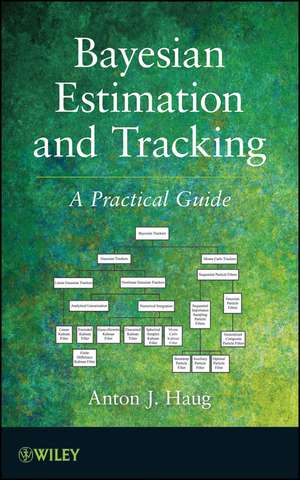
Bayesian Estimation
Autor Anton J Haugen Limba Engleză Hardback – 19 iun 2012
Preț: 848.94 lei
Preț vechi: 932.90 lei
-9%
Puncte Express: 1273
Carte tipărită la comandă
Livrare economică 28 noiembrie-12 decembrie
Livrare prin curier în România Termenul estimat este afișat lângă disponibilitate.
Transport gratuit pentru acest produs Plată online sau ramburs, în funcție de opțiunile comenzii.
Retur gratuit în 14 zile Comandă securizată și suport în română.
Specificații
ISBN-13: 9780470621707
ISBN-10: 0470621702
Pagini: 400
Dimensiuni: 161 x 240 x 26 mm
Greutate: 0.76 kg
Editura: Wiley
Locul publicării:Hoboken, United States
ISBN-10: 0470621702
Pagini: 400
Dimensiuni: 161 x 240 x 26 mm
Greutate: 0.76 kg
Editura: Wiley
Locul publicării:Hoboken, United States
V-ar putea interesa
-
 -8%Preț: 487.81 lei530.22 lei
 -
 Sensitivity Analysis in PracticeSaltelli-20%Preț: 654.10 lei817.63 lei
 -
 Topics in AlgebraI. N. Herstein-27%Preț: 1520.26 lei2082.54 lei
 -
 -27%Preț: 1080.66 lei1480.36 lei
 -
 -27%Preț: 1785.31 lei2445.64 lei
 -
 Biostatistics - A Methodology for the Health Sciences 2eGerald Van Belle-5%Preț: 1361.68 lei1433.35 lei
 -
 The Elements of Real AnalysisRobert Gardner Bartle-27%Preț: 1420.72 lei1946.20 lei
 -
 Preț: 132.21 lei
 -
 Preț: 85.33 lei
 -
 Elementary CalculusWilliam F. OsgoodPreț: 128.42 lei
 -
 Preț: 141.84 lei
 -
 Preț: 169.85 lei
 -
 Preț: 155.08 lei
 -
 Preț: 81.60 lei
 -
 Preț: 126.20 lei
 -
 Oral Lessons in Number: A Manual for TeachersE. E. WhitePreț: 122.57 lei
 -
 Preț: 93.85 lei
 -
 Geometrical OpticsW. B. HopkinsPreț: 94.55 lei
 -
 Answers to the New School AlgebraGeorge Albert WentworthPreț: 94.95 lei
 -
 An Elementary Treatise on Partial Differential EquationsSir George Biddell AiryPreț: 96.37 lei
 -
 The Logica Yearbook 2017Pavel ArazimPreț: 155.53 lei
 -
 -11%Preț: 493.88 lei554.92 lei
 -
 -11%Preț: 493.46 lei554.46 lei
 -
 Preț: 263.08 lei
Public țintă
As a textbook for a one semester graduate course on estimation and tracking methods; as a reference for professionals (mathematicians and engineers) requiring a deeper understanding of the topics; and academic libraries. Prerequisites include a graduate level understanding of probability theory as well as familiarity with matrix linear algebra and numerical methods including finite differences as well as a working knowledge of Matlab.Notă biografică
ANTON J. HAUG, PhD, is member of the technical staff at the Applied Physics Laboratory at The Johns Hopkins University, where he develops advanced target tracking methods in support of the Air and Missile Defense Department. Throughout his career, Dr. Haug has worked across diverse areas such as target tracking; signal and array processing and processor design; active and passive radar and sonar design; digital communications and coding theory; and time- frequency analysis.
Cuprins
Preface xv
Acknowledgments xvii
List of Figures Xix
List of Tables xxv
PART I PRELIMINARIES
1 Introduction 3
1.1 Bayesian Inference 4
1.2 Bayesian Hierarchy of Estimation Methods 5
1.3 Scope of This Text 6
1.4 Modeling and Simulation with MATLAB® 8
References 9
2 Preliminary Mathematical Concepts 11
2.1 A Very Brief Overview of Matrix Linear Algebra 11
2.2 Vector Point Generators 16
2.3 Approximating Nonlinear Multidimensional Functions with Multidimensional Arguments 19
2.4 Overview of Multivariate Statistics 29
References 40
3 General Concepts of Bayesian Estimation 42
3.1 Bayesian Estimation 43
3.2 Point Estimators 43
3.3 Introduction to Recursive Bayesian Filtering of Probability Density Functions 46
3.4 Introduction to Recursive Bayesian Estimation of the State Mean and Covariance 49
3.5 Discussion of General Estimation Methods 55
References 55
4 Case Studies: Preliminary Discussions 56
4.1 The Overall Simulation/Estimation/Evaluation Process 57
4.2 A Scenario Simulator for Tracking a Constant Velocity Target Through a DIFAR Buoy Field 58
4.3 DIFAR Buoy Signal Processing 62
4.4 The DIFAR Likelihood Function 67
References 69
PART II THE GAUSSIAN ASSUMPTION: A FAMILY OF KALMAN FILTER ESTIMATORS
5 The Gaussian Noise Case: Multidimensional Integration of Gaussian-Weighted Distributions 73
5.1 Summary of Important Results From Chapter 3 74
5.2 Derivation of the Kalman Filter Correction (Update) Equations Revisited 76
5.3 The General Bayesian Point Prediction Integrals for Gaussian Densities 78
References 85
6 The Linear Class of Kalman Filters 86
6.1 Linear Dynamic Models 86
6.2 Linear Observation Models 87
6.3 The Linear Kalman Filter 88
6.4 Application of the LKF to DIFAR Buoy Bearing Estimation 88
References 92
7 The Analytical Linearization Class of Kalman Filters: The Extended Kalman Filter 93
7.1 One-Dimensional Consideration 93
7.2 Multidimensional Consideration 98
7.3 An Alternate Derivation of the Multidimensional Covariance Prediction Equations 107
7.4 Application of the EKF to the DIFAR Ship Tracking Case Study 108
References 114
8 The Sigma Point Class: The Finite Difference Kalman Filter 115
8.1 One-Dimensional Finite Difference Kalman Filter 116
8.2 Multidimensional Finite Difference Kalman Filters 120
8.3 An Alternate Derivation of the Multidimensional Finite Difference Covariance Prediction Equations 125
References 127
9 The Sigma Point Class: The Unscented Kalman Filter 128
9.1 Introduction to Monomial Cubature Integration Rules 128
9.2 The Unscented Kalman Filter 130
9.3 Application of the UKF to the DIFAR Ship Tracking Case Study 137
References 138
10 The Sigma Point Class: The Spherical Simplex Kalman Filter 140
10.1 One-Dimensional Spherical Simplex Sigma Points 141
10.2 Two-Dimensional Spherical Simplex Sigma Points 142
10.3 Higher Dimensional Spherical Simplex Sigma Points 144
10.4 The Spherical Simplex Kalman Filter 144
10.5 The Spherical Simplex Kalman Filter Process 145
10.6 Application of the SSKF to the DIFAR Ship Tracking Case Study 146
Reference 147
11 The Sigma Point Class: The Gauss-Hermite Kalman Filter 148
11.1 One-Dimensional Gauss-Hermite Quadrature 149
11.2 One-Dimensional Gauss-Hermite Kalman Filter 153
11.3 Multidimensional Gauss-Hermite Kalman Filter 155
11.4 Sparse Grid Approximation for High Dimension/High Polynomial Order 160
11.5 Application of the GHKF to the DIFAR Ship Tracking Case Study 163
References 163
12 The Monte Carlo Kalman Filter 164
12.1 The Monte Carlo Kalman Filter 167
Reference 167
13 Summary of Gaussian Kalman Filters 168
13.1 Analytical Kalman Filters 168
13.2 Sigma Point Kalman Filters 170
13.3 A More Practical Approach to Utilizing the Family of Kalman Filters 174
References 175
14 Performance Measures for the Family of Kalman Filters 176
14.1 Error Ellipses 176
14.2 Root Mean Squared Errors 182
14.3 Divergent Tracks 183
14.4 Cramer-Rao Lower Bound 184
14.5 Performance of Kalman Class DIFAR Track Estimators 192
References 198
PART III MONTE CARLO METHODS
15 Introduction to Monte Carlo Methods 201
15.1 Approximating a Density From a Set of Monte Carlo Samples 202
15.2 General Concepts Importance Sampling 210
15.3 Summary 215
References 216
16 Sequential Importance Sampling Particle Filters 218
16.1 General Concept of Sequential Importance Sampling 218
16.2 Resampling and Regularization (Move) for SIS Particle Filters 222
16.3 The Bootstrap Particle Filter 230
16.4 The Optimal SIS Particle Filter 233
16.5 The SIS Auxiliary Particle Filter 238
16.6 Approximations to the SIS Auxiliary Particle Filter 243
16.7 Reducing the Computational Load Through Rao-Blackwellization 245
References 245
17 The Generalized Monte Carlo Particle Filter 247
17.1 The Gaussian Particle Filter 248
17.2 The Combination Particle Filter 250
17.3 Performance Comparison of All DIFAR Tracking Filters 253
References 255
PART IV ADDITIONAL CASE STUDIES
18 A Spherical Constant Velocity Model for Target Tracking in Three Dimensions 259
18.1 Tracking a Target in Cartesian Coordinates 261
18.2 Tracking a Target in Spherical Coordinates 265
18.3 Implementation of Cartesian and Spherical Tracking Filters 273
18.4 Performance Comparison for Various Estimation Methods 278
18.5 Some Observations and Future Considerations 293
APPENDIX 18.A Three-Dimensional Constant Turn Rate Kinematics 294
18.A.1 General Velocity Components for Constant Turn Rate Motion 294
18.A.2 General Position Components for Constant Turn Rate Motion 297
18.A.3 Combined Trajectory Transition Equation 299
18.A.4 Turn Rate Setting Based on a Desired Turn Acceleration 299
APPENDIX 18.B Three-Dimensional Coordinate Transformations 301
18.B.1 Cartesian-to-Spherical Transformation 302
18.B.2 Spherical-to-Cartesian Transformation 305
References 306
19 Tracking a Falling Rigid Body Using Photogrammetry 308
19.1 Introduction 308
19.2 The Process (Dynamic) Model for Rigid Body Motion 311
19.3 Components of the Observation Model 318
19.4 Estimation Methods 321
19.5 The Generation of Synthetic Data 328
19.6 Performance Comparison Analysis 334
APPENDIX 19.A Quaternions Axis-Angle Vectors and Rotations 342
19.A.1 Conversions Between Rotation Representations 342
19.A.2 Representation of Orientation and Rotation 343
19.A.3 Point Rotations and Frame Rotations 344
References 345
20 Sensor Fusion Using Photogrammetric and Inertial Measurements 346
20.1 Introduction 346
20.2 The Process (Dynamic) Model for Rigid Body Motion 347
20.3 The Sensor Fusion Observational Model 348
20.4 The Generation of Synthetic Data 352
20.5 Estimation Methods 354
20.6 Performance Comparison Analysis 357
20.7 Conclusions 361
20.8 Future Work 362
References 364
Index 367
Acknowledgments xvii
List of Figures Xix
List of Tables xxv
PART I PRELIMINARIES
1 Introduction 3
1.1 Bayesian Inference 4
1.2 Bayesian Hierarchy of Estimation Methods 5
1.3 Scope of This Text 6
1.4 Modeling and Simulation with MATLAB® 8
References 9
2 Preliminary Mathematical Concepts 11
2.1 A Very Brief Overview of Matrix Linear Algebra 11
2.2 Vector Point Generators 16
2.3 Approximating Nonlinear Multidimensional Functions with Multidimensional Arguments 19
2.4 Overview of Multivariate Statistics 29
References 40
3 General Concepts of Bayesian Estimation 42
3.1 Bayesian Estimation 43
3.2 Point Estimators 43
3.3 Introduction to Recursive Bayesian Filtering of Probability Density Functions 46
3.4 Introduction to Recursive Bayesian Estimation of the State Mean and Covariance 49
3.5 Discussion of General Estimation Methods 55
References 55
4 Case Studies: Preliminary Discussions 56
4.1 The Overall Simulation/Estimation/Evaluation Process 57
4.2 A Scenario Simulator for Tracking a Constant Velocity Target Through a DIFAR Buoy Field 58
4.3 DIFAR Buoy Signal Processing 62
4.4 The DIFAR Likelihood Function 67
References 69
PART II THE GAUSSIAN ASSUMPTION: A FAMILY OF KALMAN FILTER ESTIMATORS
5 The Gaussian Noise Case: Multidimensional Integration of Gaussian-Weighted Distributions 73
5.1 Summary of Important Results From Chapter 3 74
5.2 Derivation of the Kalman Filter Correction (Update) Equations Revisited 76
5.3 The General Bayesian Point Prediction Integrals for Gaussian Densities 78
References 85
6 The Linear Class of Kalman Filters 86
6.1 Linear Dynamic Models 86
6.2 Linear Observation Models 87
6.3 The Linear Kalman Filter 88
6.4 Application of the LKF to DIFAR Buoy Bearing Estimation 88
References 92
7 The Analytical Linearization Class of Kalman Filters: The Extended Kalman Filter 93
7.1 One-Dimensional Consideration 93
7.2 Multidimensional Consideration 98
7.3 An Alternate Derivation of the Multidimensional Covariance Prediction Equations 107
7.4 Application of the EKF to the DIFAR Ship Tracking Case Study 108
References 114
8 The Sigma Point Class: The Finite Difference Kalman Filter 115
8.1 One-Dimensional Finite Difference Kalman Filter 116
8.2 Multidimensional Finite Difference Kalman Filters 120
8.3 An Alternate Derivation of the Multidimensional Finite Difference Covariance Prediction Equations 125
References 127
9 The Sigma Point Class: The Unscented Kalman Filter 128
9.1 Introduction to Monomial Cubature Integration Rules 128
9.2 The Unscented Kalman Filter 130
9.3 Application of the UKF to the DIFAR Ship Tracking Case Study 137
References 138
10 The Sigma Point Class: The Spherical Simplex Kalman Filter 140
10.1 One-Dimensional Spherical Simplex Sigma Points 141
10.2 Two-Dimensional Spherical Simplex Sigma Points 142
10.3 Higher Dimensional Spherical Simplex Sigma Points 144
10.4 The Spherical Simplex Kalman Filter 144
10.5 The Spherical Simplex Kalman Filter Process 145
10.6 Application of the SSKF to the DIFAR Ship Tracking Case Study 146
Reference 147
11 The Sigma Point Class: The Gauss-Hermite Kalman Filter 148
11.1 One-Dimensional Gauss-Hermite Quadrature 149
11.2 One-Dimensional Gauss-Hermite Kalman Filter 153
11.3 Multidimensional Gauss-Hermite Kalman Filter 155
11.4 Sparse Grid Approximation for High Dimension/High Polynomial Order 160
11.5 Application of the GHKF to the DIFAR Ship Tracking Case Study 163
References 163
12 The Monte Carlo Kalman Filter 164
12.1 The Monte Carlo Kalman Filter 167
Reference 167
13 Summary of Gaussian Kalman Filters 168
13.1 Analytical Kalman Filters 168
13.2 Sigma Point Kalman Filters 170
13.3 A More Practical Approach to Utilizing the Family of Kalman Filters 174
References 175
14 Performance Measures for the Family of Kalman Filters 176
14.1 Error Ellipses 176
14.2 Root Mean Squared Errors 182
14.3 Divergent Tracks 183
14.4 Cramer-Rao Lower Bound 184
14.5 Performance of Kalman Class DIFAR Track Estimators 192
References 198
PART III MONTE CARLO METHODS
15 Introduction to Monte Carlo Methods 201
15.1 Approximating a Density From a Set of Monte Carlo Samples 202
15.2 General Concepts Importance Sampling 210
15.3 Summary 215
References 216
16 Sequential Importance Sampling Particle Filters 218
16.1 General Concept of Sequential Importance Sampling 218
16.2 Resampling and Regularization (Move) for SIS Particle Filters 222
16.3 The Bootstrap Particle Filter 230
16.4 The Optimal SIS Particle Filter 233
16.5 The SIS Auxiliary Particle Filter 238
16.6 Approximations to the SIS Auxiliary Particle Filter 243
16.7 Reducing the Computational Load Through Rao-Blackwellization 245
References 245
17 The Generalized Monte Carlo Particle Filter 247
17.1 The Gaussian Particle Filter 248
17.2 The Combination Particle Filter 250
17.3 Performance Comparison of All DIFAR Tracking Filters 253
References 255
PART IV ADDITIONAL CASE STUDIES
18 A Spherical Constant Velocity Model for Target Tracking in Three Dimensions 259
18.1 Tracking a Target in Cartesian Coordinates 261
18.2 Tracking a Target in Spherical Coordinates 265
18.3 Implementation of Cartesian and Spherical Tracking Filters 273
18.4 Performance Comparison for Various Estimation Methods 278
18.5 Some Observations and Future Considerations 293
APPENDIX 18.A Three-Dimensional Constant Turn Rate Kinematics 294
18.A.1 General Velocity Components for Constant Turn Rate Motion 294
18.A.2 General Position Components for Constant Turn Rate Motion 297
18.A.3 Combined Trajectory Transition Equation 299
18.A.4 Turn Rate Setting Based on a Desired Turn Acceleration 299
APPENDIX 18.B Three-Dimensional Coordinate Transformations 301
18.B.1 Cartesian-to-Spherical Transformation 302
18.B.2 Spherical-to-Cartesian Transformation 305
References 306
19 Tracking a Falling Rigid Body Using Photogrammetry 308
19.1 Introduction 308
19.2 The Process (Dynamic) Model for Rigid Body Motion 311
19.3 Components of the Observation Model 318
19.4 Estimation Methods 321
19.5 The Generation of Synthetic Data 328
19.6 Performance Comparison Analysis 334
APPENDIX 19.A Quaternions Axis-Angle Vectors and Rotations 342
19.A.1 Conversions Between Rotation Representations 342
19.A.2 Representation of Orientation and Rotation 343
19.A.3 Point Rotations and Frame Rotations 344
References 345
20 Sensor Fusion Using Photogrammetric and Inertial Measurements 346
20.1 Introduction 346
20.2 The Process (Dynamic) Model for Rigid Body Motion 347
20.3 The Sensor Fusion Observational Model 348
20.4 The Generation of Synthetic Data 352
20.5 Estimation Methods 354
20.6 Performance Comparison Analysis 357
20.7 Conclusions 361
20.8 Future Work 362
References 364
Index 367