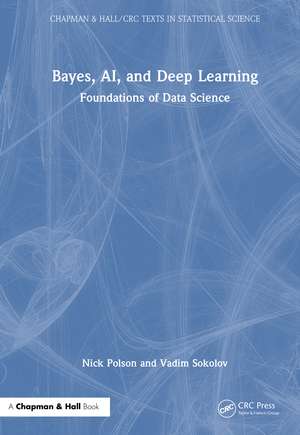
Bayes, AI, and Deep Learning: Foundations of Data Science: Chapman & Hall/CRC Texts in Statistical Science
Autor Nick Polson, Vadim Sokoloven Limba Engleză Hardback – 5 mai 2027
Key Features:
- Builds Bayesian reasoning from first principles through historical examples like submarine search and WWII code-breaking
- Bridges classical statistics and deep learning, connecting linear regression to transformers
- Covers the complete AI stack: probability, decision theory, Gaussian processes, neural networks, CNNs, NLP, and LLMs
- Emphasizes uncertainty quantification—building systems that know what they don't know
- Practical applications across finance, healthcare, operations, and autonomous systems
- Emerging topics: AI agents, RLHF, and retrieval-augmented generation
Din seria Chapman & Hall/CRC Texts in Statistical Science
- 14%
 Preț: 675.87 lei
 - 20%
 Preț: 713.42 lei
 - 9%
 Preț: 826.96 lei
 - 8%
 Preț: 602.18 lei
 - 14%
 Preț: 1504.46 lei
 - 14%
 Preț: 753.82 lei
 - 9%
 Preț: 826.08 lei
 - 9%
 Preț: 824.13 lei
 - 8%
 Preț: 446.40 lei
 - 18%
 Preț: 1101.44 lei
 - 15%
 Preț: 560.19 lei
 - 18%
 Preț: 734.98 lei
 -
 Preț: 444.29 lei
 - 18%
 Preț: 752.30 lei
 - 15%
 Preț: 530.47 lei
 - 18%
 Preț: 941.48 lei
 - 18%
 Preț: 709.93 lei
 - 9%
 Preț: 816.65 lei
 - 9%
 Preț: 640.24 lei
 - 18%
 Preț: 1280.63 lei
 - 15%
 Preț: 533.53 lei
 - 18%
 Preț: 777.27 lei
 -
 Preț: 447.53 lei
 - 18%
 Preț: 796.60 lei
 - 18%
 Preț: 1091.13 lei
 - 18%
 Preț: 695.93 lei
 - 15%
 Preț: 530.47 lei
 - 18%
 Preț: 939.05 lei
 - 18%
 Preț: 726.61 lei
 - 15%
 Preț: 528.08 lei
 - 5%
 Preț: 877.00 lei
 - 15%
 Preț: 465.33 lei
 - 18%
 Preț: 717.88 lei
 - 15%
 Preț: 489.45 lei
 - 18%
 Preț: 812.99 lei
 - 18%
 Preț: 945.32 lei
 - 9%
 Preț: 674.08 lei
 - 15%
 Preț: 652.65 lei
 - 18%
 Preț: 1367.70 lei
 - 18%
 Preț: 757.82 lei
 - 20%
 Preț: 418.40 lei
 - 18%
 Preț: 1467.42 lei
 - 15%
 Preț: 652.56 lei
 - 18%
 Preț: 1077.45 lei
 - 8%
 Preț: 558.93 lei
 - 9%
 Preț: 742.48 lei
 - 18%
 Preț: 799.03 lei
 - 18%
 Preț: 964.16 lei
Preț: 1229.39 lei
Preț vechi: 1621.64 lei
-24% Precomandă
Puncte Express: 1844
Carte nepublicată încă
Livrare prin curier în România Precomanda se expediază când titlul devine disponibil.
Transport gratuit pentru acest produs Plată online sau ramburs, în funcție de opțiunile comenzii.
Retur gratuit în 14 zile Comandă securizată și suport în română.
Doresc să fiu notificat când acest titlu va fi disponibil:
Se trimite...
Specificații
ISBN-13: 9781032471228
ISBN-10: 1032471220
Pagini: 818
Ilustrații: 370
Dimensiuni: 178 x 254 mm
Greutate: 0.45 kg
Ediția:1
Editura: CRC Press
Colecția Chapman and Hall/CRC
Seria Chapman & Hall/CRC Texts in Statistical Science
ISBN-10: 1032471220
Pagini: 818
Ilustrații: 370
Dimensiuni: 178 x 254 mm
Greutate: 0.45 kg
Ediția:1
Editura: CRC Press
Colecția Chapman and Hall/CRC
Seria Chapman & Hall/CRC Texts in Statistical Science
Public țintă
Academic, Postgraduate, Undergraduate Advanced, and Undergraduate CoreCuprins
1 Probability and Uncertainty. 2 Bayes Rule. 3 Bayesian Learning. 4 Utility, Risk and Decisions. 5 A/B Testing. 6 Bayesian Hypothesis Testing. 7 Stochastic Processes. 8 Gaussian Processes. 9 Reinforcement Learning. 10 Unreasonable Effectiveness of Data. 11 Pattern Matching. 12 Linear Regression. 13 Logistic Regression and Generalized Linear Models. 14 Tree Models. 15 Forecasting. 16 Model Selection. 17 Statistical Learning Theory and Regularization. 18 Neural Networks. 19 Theory of Deep Learning. 20 Gradient Descent. 21 Quantile Neural Networks. 22 Convolutional Neural Networks. 23 Natural Language Processing. 24 Large Language Models. 25 AI Agents.
Notă biografică
Vadim Sokolov is Associate Professor in the Department of Systems Engineering and Operations Research at George Mason University, where he develops Bayesian methods, machine learning algorithms, and deep learning architectures for complex systems. His research spans statistical learning theory, probabilistic modeling, and intelligent transportation systems, with publications in leading journals including Bayesian Analysis, Transportation Research, and IEEE Transactions on Intelligent Transportation Systems.
Before joining Mason in 2016, Sokolov served as Visiting Assistant Professor of Statistics at the University of Chicago Booth School of Business and Principal Computational Scientist at Argonne National Laboratory, where he led the development of POLARIS, a large-scale agent-based transportation simulation framework, and the GREET life-cycle analysis model used by over 800 organizations worldwide.
Sokolov earned his Ph.D. in Computational Mathematics from Northern Illinois University and holds a diploma in Applied Mathematics with High Honors from Rostov State University, Russia. His work bridges rigorous statistical foundations with practical applications in energy systems, urban analytics, and data-driven decision-making. He is a member of INFORMS, the International Society for Bayesian Analysis, and the American Statistical Association.
Nicholas Polson is the Robert Law, Jr. Professor of Econometrics and Statistics at the University of Chicago Booth School of Business, where he has shaped modern Bayesian statistics and machine learning since 1991. A leading authority on probabilistic modeling, his research encompasses Markov chain Monte Carlo methods, particle learning, financial econometrics, and deep learning theory, with foundational contributions to stochastic volatility modeling, sparse Bayesian estimation, and high-dimensional inference.
Polson's influential work includes developing particle filtering algorithms for sequential learning and Bayesian regularization methods ranging from Tikhonov to horseshoe priors. His article "Bayesian Analysis of Stochastic Volatility Models" was recognized as one of the most influential papers in the 20th anniversary issue of the Journal of Business and Economic Statistics. He co-authored AIQ: How People and Machines Are Smarter Together (2018), exploring the synergy between human intelligence and artificial intelligence.
Polson earned his master's degree with First Class Honours from Worcester College, Oxford University, and his Ph.D. from the University of Nottingham. His work bridges theoretical foundations in probability and statistics with practical applications in finance, forecasting, and data science, establishing him as a pioneer in connecting classical Bayesian methods to modern deep learning.
Before joining Mason in 2016, Sokolov served as Visiting Assistant Professor of Statistics at the University of Chicago Booth School of Business and Principal Computational Scientist at Argonne National Laboratory, where he led the development of POLARIS, a large-scale agent-based transportation simulation framework, and the GREET life-cycle analysis model used by over 800 organizations worldwide.
Sokolov earned his Ph.D. in Computational Mathematics from Northern Illinois University and holds a diploma in Applied Mathematics with High Honors from Rostov State University, Russia. His work bridges rigorous statistical foundations with practical applications in energy systems, urban analytics, and data-driven decision-making. He is a member of INFORMS, the International Society for Bayesian Analysis, and the American Statistical Association.
Nicholas Polson is the Robert Law, Jr. Professor of Econometrics and Statistics at the University of Chicago Booth School of Business, where he has shaped modern Bayesian statistics and machine learning since 1991. A leading authority on probabilistic modeling, his research encompasses Markov chain Monte Carlo methods, particle learning, financial econometrics, and deep learning theory, with foundational contributions to stochastic volatility modeling, sparse Bayesian estimation, and high-dimensional inference.
Polson's influential work includes developing particle filtering algorithms for sequential learning and Bayesian regularization methods ranging from Tikhonov to horseshoe priors. His article "Bayesian Analysis of Stochastic Volatility Models" was recognized as one of the most influential papers in the 20th anniversary issue of the Journal of Business and Economic Statistics. He co-authored AIQ: How People and Machines Are Smarter Together (2018), exploring the synergy between human intelligence and artificial intelligence.
Polson earned his master's degree with First Class Honours from Worcester College, Oxford University, and his Ph.D. from the University of Nottingham. His work bridges theoretical foundations in probability and statistics with practical applications in finance, forecasting, and data science, establishing him as a pioneer in connecting classical Bayesian methods to modern deep learning.
Descriere
This book is based on a course taught at Chicago Booth to MBA and PhD students on Bayesian Statistics, Artificial Intelligence, and Deep Learning. It pulls together these three related topics into a unified framework of study, building up from the basics of probability and Bayesian inference, through AI and deep learning.