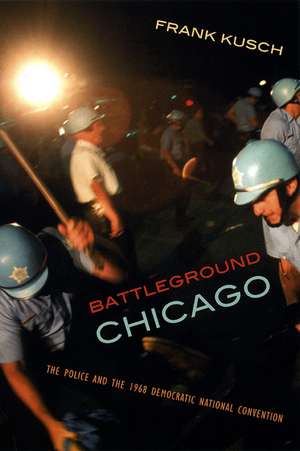
Battleground Chicago: The Police and the 1968 Democratic National Convention
Autor Frank Kuschen Limba Engleză Paperback – mai 2008
The 1968 Democratic Convention, best known for police brutality against demonstrators, has been relegated to a dark place in American historical memory. Battleground Chicago ventures beyond the stereotypical image of rioting protestors and violent cops to reevaluate exactly how—and why—the police attacked antiwar activists at the convention.
Working from interviews with eighty former Chicago police officers who were on the scene, Frank Kusch uncovers the other side of the story of ’68, deepening our understanding of a turbulent decade.
“Frank Kusch’s compelling account of the clash between Mayor Richard Daley’s men in blue and anti-war rebels reveals why the 1960s was such a painful era for many Americans. . . . to his great credit, [Kusch] allows ‘the pigs’ to speak up for themselves.”—Michael Kazin
“Kusch’s history of white Chicago policemen and the 1968 Democratic National Convention is a solid addition to a growing literature on the cultural sensibility and political perspective of the conservative white working class in the last third of the twentieth century.”—David Farber, Journal of American History
Working from interviews with eighty former Chicago police officers who were on the scene, Frank Kusch uncovers the other side of the story of ’68, deepening our understanding of a turbulent decade.
“Frank Kusch’s compelling account of the clash between Mayor Richard Daley’s men in blue and anti-war rebels reveals why the 1960s was such a painful era for many Americans. . . . to his great credit, [Kusch] allows ‘the pigs’ to speak up for themselves.”—Michael Kazin
“Kusch’s history of white Chicago policemen and the 1968 Democratic National Convention is a solid addition to a growing literature on the cultural sensibility and political perspective of the conservative white working class in the last third of the twentieth century.”—David Farber, Journal of American History
| Toate formatele și edițiile | Preț | Express |
|---|---|---|
| Paperback (1) | 201.90 lei 6-8 săpt. | |
| University of Chicago Press – mai 2008 | 201.90 lei 6-8 săpt. | |
| Hardback (1) | 366.60 lei 6-8 săpt. | |
| Bloomsbury Publishing – 30 sep 2004 | 366.60 lei 6-8 săpt. |
Preț: 201.90 lei
Puncte Express: 303
Preț estimativ în valută:
35.74€ • 41.51$ • 30.96£
35.74€ • 41.51$ • 30.96£
Carte tipărită la comandă
Livrare economică 02-16 martie
Preluare comenzi: 021 569.72.76
Specificații
ISBN-13: 9780226465036
ISBN-10: 0226465039
Pagini: 224
Ilustrații: 11 halftones, 3 maps
Dimensiuni: 152 x 229 x 15 mm
Greutate: 0.33 kg
Ediția:Univ of Chicago.
Editura: University of Chicago Press
Colecția University of Chicago Press
ISBN-10: 0226465039
Pagini: 224
Ilustrații: 11 halftones, 3 maps
Dimensiuni: 152 x 229 x 15 mm
Greutate: 0.33 kg
Ediția:Univ of Chicago.
Editura: University of Chicago Press
Colecția University of Chicago Press
V-ar putea interesa
-
 Chicago: City on the Make: Sixtieth Anniversary EditionNelson AlgrenPreț: 109.59 lei
 -
 Lost Prophet: The Life and Times of Bayard RustinJohn D'EmilioPreț: 155.81 lei
 -
 Heat Wave: A Social Autopsy of Disaster in ChicagoEric KlinenbergPreț: 121.06 lei
 -
 Preț: 286.51 lei
 -
 Fierce PatriotRobert L. O'ConnellPreț: 149.06 lei
 -
 Preț: 197.21 lei
 -
 Gila Country Legend: The Life and Times of Quentin HulseNancy CoggeshallPreț: 194.81 lei
 -
 ArgentinaJill Hedges-18%Preț: 176.23 lei215.23 lei
Notă biografică
Frank Kusch has worked as a freelance editor, a communications consultant, and a political speechwriter. He is the author of All American Boys: Draft Dodgers in Canada from the Vietnam War.
Cuprins
Preface to the Paperback Edition
Preface
Timeline
1. "An American City": The Roots of a Creed
2. "Freaks, Cowards, and Bastards": The War at Home
3. "What's America Coming To?": January--June 1968
4. "On to Chicago": Countdown to August
5. "A Perfect Mess": Convention Week
6. "Terrorists from Out of Town": Fallout in the Second City
7. "Half the Power of God": Chicago in '68 Revisited
Conclusion
Notes
Bibliography
Index
Photo essay follows chapter 5.
Preface
Timeline
1. "An American City": The Roots of a Creed
2. "Freaks, Cowards, and Bastards": The War at Home
3. "What's America Coming To?": January--June 1968
4. "On to Chicago": Countdown to August
5. "A Perfect Mess": Convention Week
6. "Terrorists from Out of Town": Fallout in the Second City
7. "Half the Power of God": Chicago in '68 Revisited
Conclusion
Notes
Bibliography
Index
Photo essay follows chapter 5.
Recenzii
“This retelling of a well-known story is significant partly for its detail and objectivity, but mostly because the author focuses on telling the story from the perspective of the police rather than the protesters. . . . Highly recommended.”
“Kusch’s history of white Chicago policemen and the 1968 Democratic National Convention is a solid addition to a growing literature on the cultural sensibility and political perspective of the conservative white working class in the last third of the twentieth century.”
“A fascinating story unfolds, of family-oriented cops recruited from white ethnic communities confronting middle-class ‘longhairs’; of both the police and the activists able to perceive one another only as stereotypes . . . of the cumulative and destructive mutual antipathy between police and press.”
“Masterful. . . . Kusch’s interviews contribute invaluable material to one wishing to decipher and make theoretical sense of what happened in Chicago during the 1968 Convention.”
"Battleground Chicago is especially valuable because it lets the police officers involved in the riots in Lincoln and Grant Parks have their say."
Descriere
Descriere de la o altă ediție sau format:
Did the police lose control of themselves in dealing with demonstrators during the 1968 Democratic National Convention? Or were they simply men who saw themselves as protecting their city from the forces of revolution? Kusch contends that Chicago's police were more than unthinking thugs, that they had, in effect, become a counterculture, even more so than the people they ended up attacking. From Polish and Irish working class backgrounds, these men felt they represented a time gone by, a different way of life. The world they found themselves in during August of 1968 was an almost alien environment. Analyzing interviews of men who were on the streets and examining in-depth their actions and the reasons behind them, Kusch challenges traditional thinking on this pivotal event.
As television cameras rolled, and flash bulbs popped, young middle-class college kids were attacked by Chicago's finest. For four days, police chased, bludgeoned, and kicked, not only the protesters, but innocent onlookers and dozens of media representatives. Going beyond stereotypes and addressing what went on behind the cameras, Kusch challenges the assumptions that the police rioted and that the violence was limited to a handful of individuals. These officers are revealed as real men, with families, lives, and fears. It was these fears-as much as their hatred of the antiwar movement and the people in it-that led to the violent showdown. This work tackles a turbulent period when presentation was key for all the major players: the protesters, the media, and the police themselves.
Did the police lose control of themselves in dealing with demonstrators during the 1968 Democratic National Convention? Or were they simply men who saw themselves as protecting their city from the forces of revolution? Kusch contends that Chicago's police were more than unthinking thugs, that they had, in effect, become a counterculture, even more so than the people they ended up attacking. From Polish and Irish working class backgrounds, these men felt they represented a time gone by, a different way of life. The world they found themselves in during August of 1968 was an almost alien environment. Analyzing interviews of men who were on the streets and examining in-depth their actions and the reasons behind them, Kusch challenges traditional thinking on this pivotal event.
As television cameras rolled, and flash bulbs popped, young middle-class college kids were attacked by Chicago's finest. For four days, police chased, bludgeoned, and kicked, not only the protesters, but innocent onlookers and dozens of media representatives. Going beyond stereotypes and addressing what went on behind the cameras, Kusch challenges the assumptions that the police rioted and that the violence was limited to a handful of individuals. These officers are revealed as real men, with families, lives, and fears. It was these fears-as much as their hatred of the antiwar movement and the people in it-that led to the violent showdown. This work tackles a turbulent period when presentation was key for all the major players: the protesters, the media, and the police themselves.