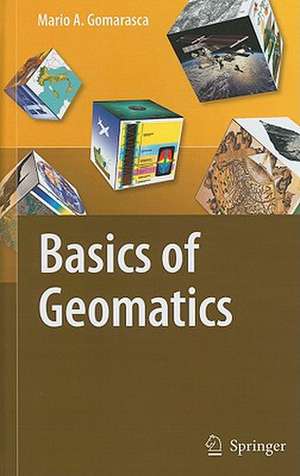
Basics of Geomatics
Autor Mario A. Gomarascaen Limba Engleză Hardback – 14 oct 2009
Observăm că această ediție a volumului Basics of Geomatics marchează o tranziție necesară de la metodele clasice de măsurare către conceptul integrat de Geo-Informație. Remarcăm faptul că autorul Mario A. Gomarasca reușește să unifice sub umbrela „geomaticii” domenii care anterior erau tratate separat, introducând capitole noi sau extinse despre tehnici de scanare laser, WebGIS și sisteme de suport pentru decizii. Această abordare elimină fragmentarea dintre topografia instrumentală și analiza modernă a datelor.
Structura volumului este concepută pentru a ghida cititorul printr-o progresie logică: se pornește de la bazele cartografiei și fotogrammetriei, se trece prin informatică și sistemele de achiziție, culminând cu procesarea imaginilor digitale și clasificarea utilizării terenurilor. Cu un total de 700 de pagini, lucrarea oferă un echilibru între rigoarea științifică și accesibilitate, fiind un instrument esențial pentru cei care studiază suprafața terestră prin prisma tehnologiei satelitare.
Comparabil cu Geo-information de Mathias Lemmens în rigurozitate, volumul de față este însă actualizat pentru integrarea masivă a informaticii în prelucrarea datelor geospațiale. În timp ce alte texte se concentrează pe o singură metodologie, Basics of Geomatics subliniază interdependența dintre GPS, teledetecție și GIS. Considerăm că această lucrare publicată de Springer reprezintă un fundament teoretic solid pentru contextul complex al cercetării actuale, oferind precizie în descrierea instrumentelor electronice și a metodelor de compensare a rețelelor.
Preț: 1349.58 lei
Preț vechi: 1645.83 lei
-18%
Carte tipărită la comandă
Livrare economică 13-27 noiembrie
Specificații
ISBN-10: 1402090137
Pagini: 700
Ilustrații: XLI, 656 p.
Dimensiuni: 155 x 235 x 48 mm
Greutate: 1.11 kg
Ediția:2009
Editura: SPRINGER NETHERLANDS
Colecția Springer
Locul publicării:Dordrecht, Netherlands
V-ar putea interesa
-
 Remote Sensing and GISBasudeb Bhatta-23%Preț: 710.26 lei922.41 lei
 -
 -9%Preț: 550.34 lei604.77 lei
 -
 Preț: 340.09 lei
 -
 -20%Preț: 330.03 lei412.53 lei
 -
 Remote Sensing and Image InterpretationThomas Lillesand-18%Preț: 1345.99 lei1641.45 lei
 -
 -23%Preț: 720.97 lei936.32 lei
 -
 GIS For DummiesJami DennisPreț: 163.90 lei
 -
 Introduction to Geographic Information SystemsFalguni Mukherjee-17%Preț: 349.98 lei420.22 lei
 -
 A to Z GISTasha WadePreț: 233.07 lei
 -
 Unmanned Vehicle Systems for GeomaticsCostas Armenakis-23%Preț: 604.66 lei785.27 lei
 -
 Springer Handbook of Geographic InformationWolfgang Kresse-18%Preț: 2182.06 lei2661.05 lei
 -
 Web and Wireless Geographical Information SystemsMiguel Félix Mata-Rivera-20%Preț: 758.24 lei947.80 lei
 -
 GeodesyWolfgang TorgePreț: 460.33 lei
 -
 -15%Preț: 498.81 lei586.83 lei
 -
 Springer Handbook of Geographic InformationWolfgang Kresse-18%Preț: 2006.55 lei2447.01 lei
 -
 Geoinformatics in Theory and PracticeNorbert De Lange-15%Preț: 516.64 lei607.81 lei
 -
 Geospatial Techniques for Managing Environmental ResourcesJay Krishna Thakur-15%Preț: 624.77 lei735.03 lei
 -
 Geoinformatics for Hilly RegionsVishal Chettry-18%Preț: 896.40 lei1093.17 lei
 -
 Handling of Geospatial Data with QGISKo Ko Lwin-19%Preț: 635.38 lei784.41 lei
Public țintă
ResearchDe ce să citești această carte
Recomandăm această lucrare cercetătorilor care au nevoie de o viziune de ansamblu asupra științelor geospațiale. Cititorul câștigă o înțelegere clară a modului în care informatica transformă topografia tradițională în geomatică modernă. Este un manual de referință care explică sintetic tehnologii complexe precum fotogrammetria digitală și sistemele de poziționare globală, fiind ideal pentru fundamentarea proiectelor de analiză spațială.
Descriere scurtă
Cuprins
Recenzii
"The book is rigorous and synthetic, describing with precision the main instruments and methods connected to the multiple techniques today available. The objective pursued is to publish an integrated text, containing simple and comprehensible concepts relevant to experts in Geo-spatial Information."
S. Dequal, Professor of Topography and Photogrammetry, DITAG, Polytechnic of Turin, Italy
"This book fills a void of telling and showing the reader how remote sensing as a part of geomatics really works. With a clearly presented historical review up to the present time, the author illustrates the basic theories and use of the different remote sensing sensors and how to analyze the data from them for their application. The author has had many years of experience in the analysis of remote sensing data and one can feel the confidence that he has as in presenting the material. This book would be a complement to the standard remote sensing books and I would highly recommend it for all land oriented professionals and especially graduate students who need a clear explanation of how remote sensing works. For anyone who uses remote sensing data as related to land analysis and survey, this book should be part of their library."
Chris J. Johannsen, Professor Emeritus of Agronomy, Department of Agronomy,
Purdue University, West Lafayette, Indiana, USA
"Basics of Geomatics is structured in a clear and effective way into
thematic chapters that provide a fundamental, yet comprehensive coverage
of each of the major disciplines making up the field of Geomatics.
Thanks to its clarity and completeness, the text, supplemented by many
useful tables and illustrations will serve as a basic reference work for
both beginners and experienced readers."
J.L.van Genderen, ITC, Enschede, The Netherlands
“This work, translated from Italian, is unique in that itaddresses a particular gap in the remote sensing literature … aimed at a broader group of readers who may be using geospatial information in their work. … The text is supported with numerous illustrations and well-explicated formula. … color plates are included at the end of the volume. The comprehensive index greatly contributes to this book’s effectiveness as a reference tool for both students and professionals. Summing Up: Recommended. Upper-division undergraduate through professional collections.” (W. Weston, Choice, Vol. 47 (11), August, 2010)
Textul de pe ultima copertă
As such, it will serve as a working tool not only to geoscientists and geographers but also to engineers, architects, computer scientists, urban planners, specialists in GIS, remote sensing, forestry, agricultural science, soil science geometry, environmental scientists and managers.
Applications can be found in security, risk management, monitoring, info-mobility, geo-positioning, food traceability, etc.
From the reviews:
"The book is rigorous and synthetic, describing with precision the main instruments and methods connected to the multiple techniques today available. The objective pursued is to publish an integrated text, containing simple and comprehensible concepts relevant to experts in Geo-spatial Information."
S. Dequal, Professor of Topography and Photogrammetry, DITAG, Polytechnic of Turin, Italy
"This book fills a void of telling and showing the reader how remote sensing as a part of geomatics really works. With a clearly presented historical review up to the present time, the author illustrates the basic theories and use of the different remote sensing sensors and how to analyze the data from them for their application. This book would be a complement to the standard remote sensing books and I would highly recommend it for all land oriented professionals and especially graduate students who need a clear explanation of how remote sensing works".
Chris J. Johannsen, Professor Emeritus of Agronomy, Department of Agronomy, Purdue University, West Lafayette, Indiana, USA
"Basics of Geomatics" is structured in a clear and effective way into thematic chapters that provide a fundamental, yet comprehensive coverage of each of the major disciplines making up the field of Geomatics. Thanks to its clarity and completeness, the text, supplemented by many useful tables and illustrations will serve as a basic reference work for both beginners and experienced readers".
John L. van Genderen, Professor, International Institute for Geoinformation Science and Earth Observation (ITC), Department of Earth Observation Science, Enschede, The Netherlands.