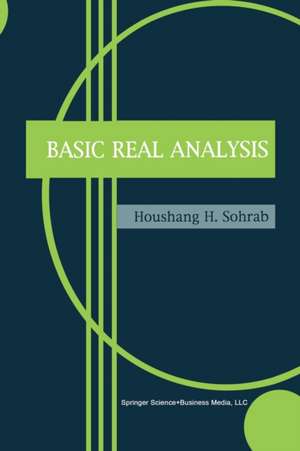
Basic Real Analysis
Autor Houshang H. Sohraben Limba Engleză Paperback – 28 sep 2012
În cadrul curriculumului de matematică pură și aplicată, analiza reală reprezintă pilonul fundamental pe care se sprijină înțelegerea riguroasă a calculului diferențial și integral. Basic Real Analysis de Houshang H. Sohrab se poziționează ca un text de tranziție esențial, facilitând trecerea de la calculul computațional la demonstrația formală. Găsim în această lucrare o abordare care prioritizează rigoarea, fără a sacrifica însă accesibilitatea pentru cititorul aflat la prima interacțiune cu limbajul matematic avansat.
Notăm cu interes structura progresivă a volumului, care debutează cu bazele teoriei mulțimilor și cardinalitatea numerelor, trecând prin studiul secvențelor și seriilor, pentru a ajunge la topologia spațiilor metrice. Această ediție extinde cadrul propus de Analysis de Richard Beals prin includerea unor versiuni mai detaliate ale teoremelor fundamentale și prin rescrierea completă a secțiunilor despre măsura Lebesgue. Dacă Analysis se concentrează pe o perspectivă largă ce include ecuațiile diferențiale, volumul de față alege să aprofundeze analiza reală pură, oferind demonstrații optimizate pentru a fi parcurse facil.
Elementul distinctiv al cărții publicate de Birkhäuser Boston este densitatea aplicațiilor practice: cele peste 650 de exerciții integrate și problemele de la finalul capitolelor transformă textul dintr-o expunere teoretică într-un instrument de lucru activ. Față de alte titluri clasice menționate în recenziile de specialitate, precum cele ale lui Rudin sau Lang, abordarea lui Sohrab este mai puțin abruptă, oferind context motivațional și exemple lucrate pas cu pas care ajută la fixarea conceptelor de continuitate uniformă sau aproximare funcțională.
Preț: 405.53 lei
Carte disponibilă
Livrare economică 05-19 noiembrie
Specificații
ISBN-10: 1461265037
Pagini: 576
Ilustrații: XIII, 559 p.
Dimensiuni: 155 x 235 x 30 mm
Greutate: 0.79 kg
Ediția:Softcover reprint of the original 1st ed. 2003
Editura: Birkhäuser Boston
Colecția Birkhäuser
Locul publicării:Boston, MA, United States
V-ar putea interesa
-
 -25%Preț: 721.29 lei967.93 lei
 -
 Introduction to Metric and Topological SpacesWilson A Sutherland-11%Preț: 374.36 lei420.86 lei
 -
 The Real Numbers and Real AnalysisEthan D Bloch-15%Preț: 568.54 lei668.87 lei
 -
 Advanced Data Analysis and Modelling in Chemical EngineeringDenis Constales-25%Preț: 590.09 lei789.14 lei
 -
 AnalysisRichard Beals-19%Preț: 596.27 lei736.14 lei
 -
 -16%Preț: 656.32 lei781.33 lei
 -
 Closer and Closer: Introducing Real AnalysisCarol Schumacher-19%Preț: 765.49 lei945.86 lei
 -
 Elements of Real AnalysisCharles Denlinger-27%Preț: 764.97 lei1047.90 lei
 -
 Derivatives and Integrals of Multivariable FunctionsAlberto GuzmánPreț: 374.86 lei
 -
 -15%Preț: 612.05 lei720.07 lei
 -
 Complex Analysis in One VariableRaghavan Narasimhan-15%Preț: 592.55 lei697.11 lei
 -
 Proofs and FundamentalsEthan D. BlochPreț: 431.78 lei
 -
 Real Analysis for the UndergraduateMatthew A. PonsPreț: 520.77 lei
 -
 -18%Preț: 964.16 lei1175.80 lei
 -
 Introduction to Mathematical AnalysisIgor Kriz-15%Preț: 546.00 lei642.35 lei
 -
 A Course on Integration TheoryNicolas Lerner-15%Preț: 541.88 lei637.51 lei
 -
 Real AnalysisPeter A. LoebPreț: 476.93 lei
 -
 MVT: A Most Valuable TheoremCraig Smoryński-15%Preț: 678.17 lei797.85 lei
 -
 Number Systems: Constructions and PropertiesInder K. Rana-15%Preț: 442.37 lei520.43 lei
 -
 INTRODUCTION TO ANALYSIS, ANMikusinski Piotr-15%Preț: 529.24 lei622.63 lei
Public țintă
GraduateDe ce să citești această carte
Această carte este recomandată studenților care doresc să stăpânească fundamentele analizei reale printr-un parcurs riguros, dar ghidat. Cititorul câștigă acces la o bază solidă de probleme rezolvate și la o expunere clară a integralei Lebesgue, esențială pentru cercetarea avansată. Este o resursă valoroasă pentru auto-studiu, datorită apendicelor tehnice și a stilului pedagogic care demistifică demonstrațiile complexe.
Despre autor
Houshang H. Sohrab este un matematician cu o vastă experiență academică, recunoscut pentru contribuțiile sale pedagogice în domeniul analizei matematice. Lucrarea sa, publicată sub egida Birkhäuser, reflectă o înțelegere profundă a dificultăților pe care studenții le întâmpină la nivel postuniversitar. Autorul pune accent pe claritatea expunerii și pe selecția judicioasă a referințelor bibliografice, transformând Basic Real Analysis într-un titlu de referință în bibliografia de specialitate pentru cursurile de analiză reală și teoria măsurii.
Descriere scurtă
Key features include:
* A broad view of mathematics throughout the book
* Treatment of all concepts for real numbers first, with extensions to metric spaces later, in a separate chapter
* Elegant proofs
* Excellent choice of topics
* Numerous examples and exercises to enforce methodology; exercises integrated into the main text, as well as at the end of each chapter
* Emphasis on monotone functions throughout
* Good development of integration theory
* Special topics on Banach and Hilbert spaces and Fourier series, often not included in many courses on real analysis
* Solid preparation for deeper study of functional analysis
* Chapter on elementary probability
* Comprehensive bibliography and index
* Solutions manual available to instructors upon request
By covering all the basics and developing rigor simultaneously, this introduction to real analysis is ideal for senior undergraduates and beginning graduate students, both as a classroom text or for self-study. With its wide range of topics and its view of real analysis in a larger context, the book will be appropriate for more advanced readers as well.
Cuprins
Recenzii
—CHOICE
"This book is intended as a text for a one-year course for senior undergraduates or beginning graduate students, though it seems to the reviewer that it contains more than enough material for one year's study. . . . The quality of the exposition is good: strong and complete versions of theorems are preferred, and the material is organised so that all the proofs are of easily manageable length; motivational comments are helpful, and there are plenty of illustrative examples. The reader is strongly encouraged to learn by doing: exercises are sprinkled liberally throughout the text and each chapter ends with a set of problems, about 650 in all, some of which are of considerable intrinsic interest."
—MATHEMATICAL REVIEWS
"The book is a clear and well structured introduction to real analysis aimed at senior undergraduate and beginning graduate students. . . . The author managed to confine within a reasonable size book, all the basic concepts in real analysis and also some developed topics . . . The text contains carefully worked out examples which contribute motivating and helping to understand the theory. There is also an excellent selection of exercises within the text and problem sections at the end of each chapter. In fact this textbook can serve as a source of examples and exercises in real analysis. . . . This book can behighly recommended as a good reference on real analysis."
—ZENTRALBLATT MATH
Caracteristici
Notă biografică
Textul de pe ultima copertă
The text is a comprehensive and largely self-contained introduction to the theory of real-valued functions of a real variable. The chapters on Lebesgue measure and integral have been rewritten entirely and greatly improved. They now contain Lebesgue’s differentiation theorem as well as his versions of the Fundamental Theorem(s) of Calculus.
With expanded chapters, additional problems, and an expansive solutions manual, Basic Real Analysis, Second Edition, is ideal for senior undergraduates and first-year graduate students, both as a classroom text and a self-study guide.
Reviews of first edition:
The book is a clear and well-structured introduction to real analysis aimed at senior undergraduate and beginning graduate students. The prerequisites are few, but a certain mathematical sophistication is required. ... The text contains carefully worked out examples which contribute motivating and helping to understand the theory. There is also an excellent selection of exercises within the text and problem sections at the end of each chapter. In fact, this textbook can serve as a source of examples and exercises in real analysis.
—Zentralblatt MATH
The quality of the exposition is good: strong and complete versions of theorems are preferred, and the material is organised so that all the proofs are of easily manageable length; motivational comments are helpful, and there are plenty of illustrative examples. The reader is strongly encouraged to learn by doing: exercises are sprinkled liberally throughout the text and each chapter ends with a set of problems, about 650 in all, some of which are of considerable intrinsic interest.
—Mathematical Reviews
[This text] introduces upper-division undergraduate or first-year graduate students to real analysis.... Problems and exercises abound; an appendix constructs the reals as the Cauchy (sequential) completion of the rationals; references are copious and judiciously chosen; and a detailed index brings up the rear.
—CHOICE Reviews