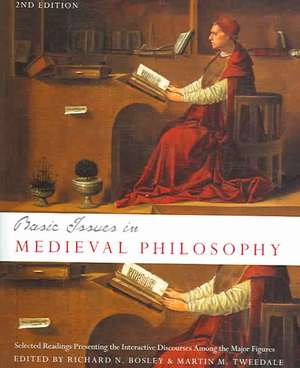
Basic Issues in Medieval Philosophy - Second Edition: Selected Readings Presenting Interactive Discourse Among the Major Figures
Editat de Richard N. Bosley, Martin M. Tweedaleen Limba Engleză Paperback – 9 mai 2006
This edition, updated throughout, contains a substantial new chapter on medieval psychology and philosophy of mind, with texts from authors not previously represented such as John Buridan and Peter John Olivi.
Preț: 513.73 lei
Preț vechi: 676.90 lei
-24%
Puncte Express: 771
Carte disponibilă
Livrare economică 29 octombrie-12 noiembrie
Livrare express 15-21 octombrie pentru 127.42 lei
Livrare prin curier în România Termenul estimat este afișat lângă disponibilitate.
Transport gratuit pentru acest produs Plată online sau ramburs, în funcție de opțiunile comenzii.
Retur gratuit în 14 zile Comandă securizată și suport în română.
Specificații
ISBN-13: 9781551117157
ISBN-10: 1551117150
Pagini: 852
Dimensiuni: 191 x 229 x 41 mm
Greutate: 1.22 kg
Ediția:Revised
Editura: BROADVIEW PR
Colecția Broadview Press
Locul publicării:Peterborough, Canada
ISBN-10: 1551117150
Pagini: 852
Dimensiuni: 191 x 229 x 41 mm
Greutate: 1.22 kg
Ediția:Revised
Editura: BROADVIEW PR
Colecția Broadview Press
Locul publicării:Peterborough, Canada
V-ar putea interesa
-
 Oxford Studies in Medieval Philosophy, Volume 2Robert Pasnau-21%Preț: 264.06 lei333.30 lei
 -
 -21%Preț: 285.75 lei360.88 lei
 -
 Approaches to IntentionalityWilliam Lyons-19%Preț: 329.29 lei407.86 lei
 -
 -29%Preț: 490.11 lei686.27 lei
 -
 Aspects of ReasonPaul Grice-29%Preț: 368.89 lei517.50 lei
 -
 Aquinas on BeingAnthony Kenny-29%Preț: 389.30 lei545.74 lei
 -
 -31%Preț: 626.56 lei909.36 lei
 -
 Essays on Spinoza's Ethical TheoryMatthew J. Kisner-31%Preț: 742.76 lei1077.58 lei
 -
 Thomas Aquinas: A PortraitDenys TurnerPreț: 131.96 lei
 -
 On HumourSimon CritchleyPreț: 218.94 lei
 -
 On HabitClare CarlislePreț: 285.76 lei
 -
 IrrationalityLisa BortolottiPreț: 186.57 lei
 -
 On the World and OurselvesZygmunt BaumanPreț: 151.90 lei
 -
 Aping MankindRaymond TallisPreț: 194.29 lei
 -
 The Political Philosophy of Niccolò MachiavelliFilippo Del Lucchese-17%Preț: 172.52 lei208.64 lei
 -
 Spinoza and PoliticsÉtienne BalibarPreț: 112.55 lei
 -
 Key Philosophical WritingsRene DescartesPreț: 44.28 lei
Recenzii
In this important collection, the editors argue that medieval philosophy is best studied as an interactive discussion between thinkers working on very much the same problems despite being often widely separated in time or place. Each section opens with at least one selection from a classical philosopher, and there are many points at which the readings chosen refer to other works that the reader will also find in this collection. There is a considerable amount of material from central figures such as Augustine, Abelard, Duns Scotus, and William of Ockham, as well as extensive texts from thinkers in the medieval Islamic world. Each selection is prefaced by a brief introduction by the editors, providing a philosophical and religious background to help make the material more accessible to the reader.
This edition, updated throughout, contains a substantial new chapter on medieval psychology and philosophy of mind, with texts from authors not previously represented such as John Buridan and Peter John Olivi.
“Basic Issues in Medieval Philosophy is currently the best textbook on medieval philosophy in any modern language. It is outstanding in its area because the topical approach underlines both the relationship medieval philosophers have with ancient philosophers and the specific debates in which they were engaged among themselves. The selection of texts, some of which have never before been translated, is excellent. Bosley and Tweedale provide us with a decisively philosophical access to philosophy in the Middle Ages that allows the reader to discover a variety of competing views. I can only recommend this fine volume.” — Martin Pickave, University of Toronto
Comments on the First Edition:
“Basic Issues in Medieval Philosophy is unquestionably the best available textbook in the field.” — Norman Kretzmann, Cornell University
This edition, updated throughout, contains a substantial new chapter on medieval psychology and philosophy of mind, with texts from authors not previously represented such as John Buridan and Peter John Olivi.
“Basic Issues in Medieval Philosophy is currently the best textbook on medieval philosophy in any modern language. It is outstanding in its area because the topical approach underlines both the relationship medieval philosophers have with ancient philosophers and the specific debates in which they were engaged among themselves. The selection of texts, some of which have never before been translated, is excellent. Bosley and Tweedale provide us with a decisively philosophical access to philosophy in the Middle Ages that allows the reader to discover a variety of competing views. I can only recommend this fine volume.” — Martin Pickave, University of Toronto
Comments on the First Edition:
“Basic Issues in Medieval Philosophy is unquestionably the best available textbook in the field.” — Norman Kretzmann, Cornell University
Cuprins
Preface
Introduction
TOPIC I : NECESSITY, CONTINGENCY, AND CAUSATION
Introduction
I.1. Aristotle
Introduction
II.1. Aristotle
Introduction
III.1. Aristotle
Introduction
IV.1. Aristotle
Introduction
V.1. Aristotle
Introduction
VI.1. Plato
Introduction
VII.1. St. Augustine
Introduction
VIII.1. Aristotle
Introduction
IX.1. Plotinus
Introduction
X.1. Aristotle
GLOSSARY
SOURCES
BIBLIOGRAPHY
Introduction
TOPIC I : NECESSITY, CONTINGENCY, AND CAUSATION
Introduction
I.1. Aristotle
- The four Causes
- Senses of the Necessary
- Causation, Chance, and Spontaneity
- Science and the Accidental
- Two Kinds of Existents
- Proof of the Necessary of Existence
- What is Possible of Existence is Necessary of Existence from something else
- Characteristics of the Necessary of Existence
- That God can only do what He does do
- Whether the First Cause is simple
- About the Natural Sciences
- How absolute Necessity can exist in Created Things
- That God does not will other things in a necessary way
- Difficulties in the Concept of Will
- Commentary on Necessity
- Extending God’s Power
- The Finiteness of the World’s Past
- Proof of a First Cause
- The First Cause causes contingently
- The Omnipotence of God
- Impossibility
- Could God make things better than He does?
- Essentially ordered Causes
- Can it be proved that there exists a first productive Cause?
- Can it be proved that there exists a first conserving Cause?
- Is God able to do Everything that it is possible for a Creature to do?
- Can God do things which He neither does do nor will do?
- Does not being able to do the Impossible belong to God before not being able to be done by Godbelongs to the Impossible?
- Can God make a better world than this one?
Introduction
II.1. Aristotle
- Why there must be an eternal Mover that is not itself in Motion
- The first Mover has no Size
- The Principle on which depend the Heavens and Nature
- The Being “a greater than which cannot be thought”
- Can we prove that the First Being is incorporeal?
- God’s Existence is not self-evident to us
- The five Ways
- A Being which just is its own Existence
- The first efficient Cause has infinite Power
- The Infinity of the most excellent Being
- Why the first efficient Cause cannot be proved to have infinite Power
- Why it cannot be proven that the most perfect Being is infinite in Perfection
- Aristotle did not intend to prove the Infinity of the First Cause
Introduction
III.1. Aristotle
- Did Motion ever have a Beginning? Will it ever end?
- What is Time?
- How Creatures have always been but are not co-eternal with God
- Is the Doctrine of the “Philosophers” as regards the Production of the World coherent?
- Arguments of the Mutakallemim purporting to show that the Universe was created out of nothing
- Different views on the Eternity of the Universe among those who believe God exists
- That the Universe is eternal has not been proven
- The view that God has produced the Universe from all Eternity and how it is to be evaluated
- That it is not necessary for Creatures to have existed always
- That God could have created an eternal World
- That a created thing cannot have existed from Eternity
- Contradictions involved in the view that God makes eternal things
- Arguments on both sides and their Refutations
- Could God make a World that has existed from Eternity?
Introduction
IV.1. Aristotle
- Determinism and the Truth of future contingent Statements
- How can God know everything about the Future?
- The Harmony of Foreknowledge and Free Will
- Does God’s Knowledge extend to Future Contingents?
- How Contingency arises in the World
- How God can know Future Contingents by knowing His own Will
- Why Scotus’s Solution will not work
- Propositions in the Present tense but about the Future
Introduction
V.1. Aristotle
- Senses of ‘same’
- Senses of ‘One’
- How the Motion of the Agent is the same as the Motion in the Recipient, yet different
- Sameness and Difference in the Trinity
- How to have many Persons in one God
- Qualified and unqualified Distinctions
- No formal Distinction without Real Distinction
Introduction
VI.1. Plato
- A World based on Archetypes
- Categories and the things there are
- Universals and Particulars
- The Problem of Universals
- Are first Principles Universals?
- Substance and Universals
- The five “Predicables”
- The “deeper Questions”
- The Predicables are just Utterances
- The Existence and the Nature of Universals
- Universals and Signification
- What Propositions signify
- The Nature of Universals
- The Essences of things
- Natures are not of themselves individuated
- What makes a Substance individual
- Is a Universal something in things?
- Universals and Distinction
- The Distinction of First and Second Intentions
- The Synonymy of Concrete and Abstract Nouns
- Is a Universal a Singular?
- Is every Universal a Quality of the Mind?
- Is a Category made up of things outside the Mind or of Concepts of Things?
Introduction
VII.1. St. Augustine
- Arguments against Academic Skepticism
- Internal Knowledge
- Can we know there is something above Human Reason?
- Knowledge requires Divine Illumination of the Mind
- Some Judgments are to be trusted
- Refutation of Henry and of Skepticism generally
- Certainty and the Principle of Non-Contradiction
Introduction
VIII.1. Aristotle
- Excellence (Virtue) and the Mean
- Ethics and Deliberation
- What is the Supreme Good for Human Beings?
- The Ultimate Good is not to be found in this Life
- How Order pervades everything
- The Works of Reason
- Why Adultery is evil
- Lust, a Penalty for the Original Sin
- Hope
- Fear
- What Sin and Vice consist in
- Goodness and Badness in outward Acts
- Is Pleasure bad?
- Is Enjoyment in the Thought of Fornication a Sin?
- Why Lechery is a Sin
- Sex in the Garden of Eden
Introduction
IX.1. Plotinus
- The One that is the Source of Being
- The Intelligence and its Relation to the Soul
- The Transcendent Good
- How God can be called Wisdom
- The Mystical Theology
- The Divine Darkness
- Things that are and things that are not
- God as Hyper-being
- God’s Diffusion into all things
- The Return of the Many to the One
- The three Motions of the Soul
- The Indefinability of God
- The Self-creation of the Divine Darkness
- Man contains all Creatures
- The Return of all things to God
- The Experience of total Self-annihilation
- On the Names of God
- “God is One”
- The Intellect perceives God bare of Goodness and Being
- The “Negation of Negation”
- The Attraction of the Soul to the One
- “On Detachment”
Introduction
X.1. Aristotle
- What sort of accounts should we give in psychology?
- Is there movement in the soul?
- What type of entity is the soul?
- What accounts for thinking and knowledge?
- Is the intellect formed in the process of fetal generation?
- On the Intellect
- How to understand the potential and active intellects
- What does Aristotle’s definition of the soul tell us?
- Is the soul a substance?
- How do there come to be many individual human souls?
- Can the soul exist after the body has been destroyed?
- How does the human intellect come to know abstract essences?
- How does the intellect think?
- How does the soul relate to its powers?
- The nature of the material intellect
- The role of the agent intellect
- How does the intellect unite with the body?
- Why the intellectual soul must be the form of the body
- Why the Averroists are wrong
- How Albert and Thomas go wrong
- Why the human soul cannot be the form of the body
- In what way is the soul an actuality?
- How many souls does an individual have?
- Is the soul just its powers?
- How many powers does the soul have?
- Can the soul be spread throughout the body?
- Is the intellect passive as regards its objects?
- Can what knows something have the character of what it knows?
- Three theories about the intellect
GLOSSARY
SOURCES
BIBLIOGRAPHY