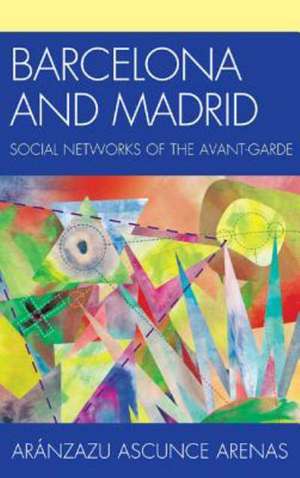
Barcelona and Madrid: Social Networks of the Avant-Garde
Autor Aránzazu Ascunce Arenasen Limba Engleză Hardback – 15 mar 2012
| Toate formatele și edițiile | Preț | Express |
|---|---|---|
| Paperback (1) | 336.45 lei 6-8 săpt. | |
| Bloomsbury Publishing – 12 iun 2014 | 336.45 lei 6-8 săpt. | |
| Hardback (1) | 538.93 lei 6-8 săpt. | |
| Bloomsbury Publishing – 15 mar 2012 | 538.93 lei 6-8 săpt. |
Preț: 538.93 lei
Preț vechi: 773.54 lei
-30%
Puncte Express: 808
Preț estimativ în valută:
95.22€ • 109.42$ • 82.48£
95.22€ • 109.42$ • 82.48£
Carte tipărită la comandă
Livrare economică 06-20 mai
Specificații
ISBN-13: 9781611484243
ISBN-10: 1611484243
Pagini: 254
Dimensiuni: 162 x 240 x 24 mm
Greutate: 0.45 kg
Ediția:New.
Editura: Bloomsbury Publishing
Colecția Bucknell University Press
Locul publicării:New York, United States
ISBN-10: 1611484243
Pagini: 254
Dimensiuni: 162 x 240 x 24 mm
Greutate: 0.45 kg
Ediția:New.
Editura: Bloomsbury Publishing
Colecția Bucknell University Press
Locul publicării:New York, United States
Cuprins
List of Illustrations
Acknowledgments
Introduction
Chapter 1: Introduction to the Avant-Garde
Chapter 2: The Avant-Garde as Network
Introduction to Network Studies
Other Considerations and Critical Nodes
Chapter 3: The Crisis of Modernity
The Modernization of Spain and The Rebirth of Catalan Culture
The Perpetuation of Violence at the Birth of a New Century
The Avant-Garde Revolution
Chapter 4: One Hundred Little Magazines
Stage One: Consensus
Stage Two: Revolution
Stage Three: Retreat
Chapter 5: The Art of Seeing. To See and Be Seen in Spain's Avant-Garde Art Scene
Master Bridge-Builder: Rafael Barradas, the Outsider
Dissonances and Resonances of Avant-Garde Art in Spain Prior and During World War I
The Iberians: The First Major Modern Art Show in Madrid, but without the Catalans
The Last Modern Art Show of the Decade in Madrid and the Yellow Manifesto
Chapter 6: The Quixotic Quest of Ernesto Giménez Caballero
Before La Gaceta Literaria
Negotiating a New Iberian Identity
After the Dictatorship
Conclusion
Appendixes
Chronology
Bibliography
Acknowledgments
Introduction
Chapter 1: Introduction to the Avant-Garde
Chapter 2: The Avant-Garde as Network
Introduction to Network Studies
Other Considerations and Critical Nodes
Chapter 3: The Crisis of Modernity
The Modernization of Spain and The Rebirth of Catalan Culture
The Perpetuation of Violence at the Birth of a New Century
The Avant-Garde Revolution
Chapter 4: One Hundred Little Magazines
Stage One: Consensus
Stage Two: Revolution
Stage Three: Retreat
Chapter 5: The Art of Seeing. To See and Be Seen in Spain's Avant-Garde Art Scene
Master Bridge-Builder: Rafael Barradas, the Outsider
Dissonances and Resonances of Avant-Garde Art in Spain Prior and During World War I
The Iberians: The First Major Modern Art Show in Madrid, but without the Catalans
The Last Modern Art Show of the Decade in Madrid and the Yellow Manifesto
Chapter 6: The Quixotic Quest of Ernesto Giménez Caballero
Before La Gaceta Literaria
Negotiating a New Iberian Identity
After the Dictatorship
Conclusion
Appendixes
Chronology
Bibliography
Recenzii
This is a book about friendships and connections, the "networks" of the Spanish avant-garde that played through an exciting political transformation in the cultural history of the peninsula during the early 20th century. As a harbinger of modernity, the avant-garde movement brought with it new opportunities for Spaniards to learn about one another. The rivalry between Barcelona and Madrid is the center of the narrative: Arenas's thesis is that the tension between the two cities opened new spaces for artists from the periphery to participate. Some, like Ernesto Giménez Caballero of the journal La Gaceta Literaria, were intensely aware of the momentous opportunity, but behind all exhibits and little magazines lay the intention to shake traditional culture by allowing more participation and new expressions. Social networks were the means to connect with groups in different geographical locations. Arenas (Spanish, Univ. of Hawai'i) shows that by destroying old prejudices vanguardia artists and writers, acting together, engaged in new ways of imagining Spain. The international context is not ignored, as all movements are mentioned, always according to their reception in the Hispanic world. Appendixes provide lists of magazines and participants in different seminal events. Summing Up: Recommended.
Did the Avant-Garde movements of Barcelona and Madrid know about one another? This is the essential question at the heart of Ara´ nzazu Ascunce Arenas's ambitious new book. ... [T]he book is highly commendable. Ascunce carefully and thoughtfully analyses a rich variety of sources, avoids burdensome academic jargon, provides an extensive bibliography, and does not unnecessarily favour one city over the other. Overall, this is an important contribution to the complex story of Spain's development in the early twentieth century, and should be welcomed by graduate students and scholars across a variety of disciplines: cultural studies, art history, history and network studies.
Did the Avant-Garde movements of Barcelona and Madrid know about one another? This is the essential question at the heart of Ara´ nzazu Ascunce Arenas's ambitious new book. ... [T]he book is highly commendable. Ascunce carefully and thoughtfully analyses a rich variety of sources, avoids burdensome academic jargon, provides an extensive bibliography, and does not unnecessarily favour one city over the other. Overall, this is an important contribution to the complex story of Spain's development in the early twentieth century, and should be welcomed by graduate students and scholars across a variety of disciplines: cultural studies, art history, history and network studies.