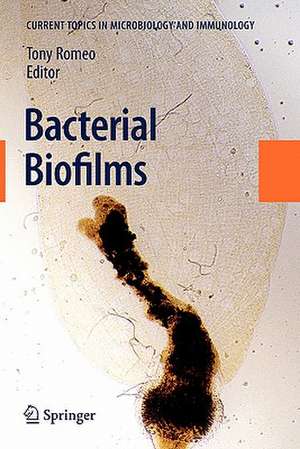
Bacterial Biofilms: Current Topics in Microbiology and Immunology, cartea 322
Editat de Tony Romeoen Limba Engleză Paperback – 23 noi 2010
Din seria Current Topics in Microbiology and Immunology
- 18%
 Preț: 992.99 lei
 - 5%
 Preț: 1158.11 lei
 - 18%
 Preț: 1159.79 lei
 - 5%
 Preț: 720.82 lei
 - 5%
 Preț: 716.26 lei
 - 5%
 Preț: 685.78 lei
 - 5%
 Preț: 685.78 lei
 - 5%
 Preț: 693.36 lei
 - 5%
 Preț: 348.28 lei
 - 5%
 Preț: 715.78 lei
 - 5%
 Preț: 778.19 lei
 - 15%
 Preț: 643.28 lei
 - 5%
 Preț: 348.78 lei
 - 5%
 Preț: 680.40 lei
 - 5%
 Preț: 694.07 lei
 - 5%
 Preț: 688.64 lei
 - 5%
 Preț: 693.53 lei
 - 5%
 Preț: 687.58 lei
 - 5%
 Preț: 688.11 lei
 - 5%
 Preț: 694.85 lei
 - 5%
 Preț: 713.24 lei
 - 5%
 Preț: 358.62 lei
 - 5%
 Preț: 688.62 lei
 - 5%
 Preț: 693.02 lei
 - 5%
 Preț: 709.55 lei
 - 5%
 Preț: 687.86 lei
 - 5%
 Preț: 717.64 lei
 - 5%
 Preț: 692.66 lei
 - 5%
 Preț: 730.00 lei
 - 5%
 Preț: 711.17 lei
 - 5%
 Preț: 717.36 lei
 - 5%
 Preț: 708.74 lei
 - 5%
 Preț: 714.68 lei
 - 5%
 Preț: 728.98 lei
 - 5%
 Preț: 710.63 lei
 - 5%
 Preț: 718.96 lei
 - 5%
 Preț: 713.64 lei
 - 5%
 Preț: 360.99 lei
 - 5%
 Preț: 377.44 lei
 - 15%
 Preț: 638.22 lei
 - 5%
 Preț: 710.88 lei
 - 5%
 Preț: 726.79 lei
 - 15%
 Preț: 635.51 lei
 - 15%
 Preț: 634.56 lei
 - 15%
 Preț: 646.25 lei
 - 5%
 Preț: 681.77 lei
 - 5%
 Preț: 719.55 lei
 - 5%
 Preț: 714.85 lei
 - 5%
 Preț: 711.90 lei
Preț: 1454.00 lei
Preț vechi: 1530.52 lei
-5%
Puncte Express: 2181
Carte tipărită la comandă
Livrare economică 30 noiembrie-05 decembrie
Livrare prin curier în România Termenul estimat este afișat lângă disponibilitate.
Transport gratuit pentru acest produs Plată online sau ramburs, în funcție de opțiunile comenzii.
Retur gratuit în 14 zile Comandă securizată și suport în română.
Specificații
ISBN-13: 9783642094699
ISBN-10: 3642094694
Pagini: 308
Ilustrații: XII, 294 p. 36 illus., 21 illus. in color.
Dimensiuni: 155 x 235 x 17 mm
Greutate: 0.47 kg
Ediția:Softcover reprint of hardcover 1st ed. 2008
Editura: Springer
Colecția Current Topics in Microbiology and Immunology
Seria Current Topics in Microbiology and Immunology
Locul publicării:Berlin, Heidelberg, Germany
ISBN-10: 3642094694
Pagini: 308
Ilustrații: XII, 294 p. 36 illus., 21 illus. in color.
Dimensiuni: 155 x 235 x 17 mm
Greutate: 0.47 kg
Ediția:Softcover reprint of hardcover 1st ed. 2008
Editura: Springer
Colecția Current Topics in Microbiology and Immunology
Seria Current Topics in Microbiology and Immunology
Locul publicării:Berlin, Heidelberg, Germany
V-ar putea interesa
-
 Microbiology: A Very Short IntroductionNicholas P. Money-24%Preț: 57.24 lei75.24 lei
 -
 -5%Preț: 334.32 lei351.91 lei
 -
 Introduction to Modern VirologyAndrew J. Easton-5%Preț: 532.93 lei560.98 lei
 -
 Principles and Practice of Travel MedicineJane N Zuckerman-5%Preț: 2198.50 lei2314.21 lei
 -
 -27%Preț: 997.90 lei1361.36 lei
 -
 Preț: 96.71 lei
 -
 Ökosystem Darm Special: Updates on Clostridium difficileJean-Claude Rambaud-5%Preț: 347.53 lei365.82 lei
 -
 -5%Preț: 1427.05 lei1502.15 lei
 -
 -5%Preț: 1059.67 lei1115.44 lei
 -
 DNA Methods in Clinical MicrobiologyP. Singleton-5%Preț: 1050.03 lei1105.29 lei
Public țintă
ResearchCuprins
Biofilm Development with an Emphasis on Bacillus subtilis.- Physiology of Microbes in Biofilms.- Environmental Influences on Biofilm Development.- Quorum Sensing and Microbial Biofilms.- Innate and Induced Resistance Mechanisms of Bacterial Biofilms.- Multidrug Tolerance of Biofilms and Persister Cells.- Biofilms on Central Venous Catheters: Is Eradication Possible?.- Role of Bacterial Biofilms in Urinary Tract Infections.- Shifting Paradigms in Pseudomonas aeruginosa Biofilm Research.- Staphylococcal Biofilms.- Yersinia pestis Biofilm in the Flea Vector and Its Role in the Transmission of Plague.- Escherichia coli Biofilms.
Textul de pe ultima copertă
Throughout the biological world, bacteria thrive predominantly in surface attached, matrix enclosed, multicellular communities or biofilms, as opposed to isolated planktonic cells. This choice of lifestyle is not trivial, as it involves major shifts in the use of genetic information and cellular energy, and has profound consequences for bacterial physiology and survival. Growth within a biofilm can thwart immune function and antibiotic therapy and thereby complicate the treatment of infectious diseases, especially chronic and foreign device-associated infections. Modern studies of many important biofilms have advanced well beyond the descriptive stage, and have begun to provide molecular details of the structural, biochemical and genetic processes that drive biofilm formation and its dispersion. There is much diversity in the details of biofilm development among various species, but there are also commonalities. In most species, environmental and nutritional conditions greatly influence biofilm development. Similar kinds of adhesive molecules often promote biofilm formation in diverse species. Signaling and regulatory processes that drive biofilm development are often conserved, especially among related bacteria. Knowledge of such processes holds great promise for efforts to control biofilm growth and combat biofilm-associated infections.
This volume tends to focus on the biology of biofilms that affect human disease. It opens with chapters that provide the reader with current perspectives on biofilm development, physiology, environmental and regulatory effects, the role of quorum sensing, and resistance/phenotypic persistence to antimicrobial agents during biofilm growth. The next chapters are devoted to common problematic biofilms, those that colonize venous and urinary catheters. The final series of chapters examines biofilm formation by four species that are important pathogens and well studied models, one of which, Yersinia pestis, cleverly adopts abiofilm state of growth within its insect vector to promote disease transmission to mammalian hosts.
This volume tends to focus on the biology of biofilms that affect human disease. It opens with chapters that provide the reader with current perspectives on biofilm development, physiology, environmental and regulatory effects, the role of quorum sensing, and resistance/phenotypic persistence to antimicrobial agents during biofilm growth. The next chapters are devoted to common problematic biofilms, those that colonize venous and urinary catheters. The final series of chapters examines biofilm formation by four species that are important pathogens and well studied models, one of which, Yersinia pestis, cleverly adopts abiofilm state of growth within its insect vector to promote disease transmission to mammalian hosts.