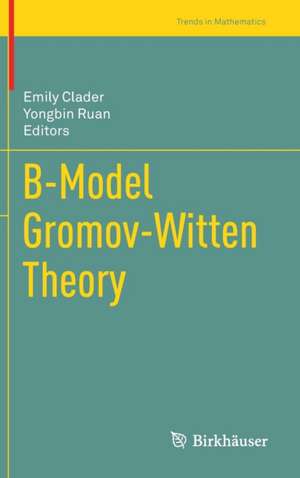
B-Model Gromov-Witten Theory: Trends in Mathematics
Editat de Emily Clader, Yongbin Ruanen Limba Engleză Hardback – 18 apr 2019
În cadrul programelor de studii avansate în geometrie algebrică și fizică teoretică, studiul simetriei oglindă reprezintă un punct de intersecție fundamental. Observăm că, deși modelul A este riguros documentat, modelul B a rămas adesea într-o zonă de umbră pentru comunitatea matematică. Lucrarea B-Model Gromov-Witten Theory, editată de Emily Clader și Yongbin Ruan, vine să corecteze acest dezechilibru, oferind o sinteză amplă între viziunea fizicienilor și rigoarea matematicienilor. Remarcăm o structură echilibrată, care debutează cu o trecere în revistă a metodelor de construcție a oglinzilor, explorând ulterior teoria BCOV și conexiunile sale surprinzătoare cu teoria numerelor prin modularitate. Progresia editorială continuă spre latura formală, abordând cuantificarea geometrică, potențialul ancestral al lui Givental și sistemele integrabile. Această ediție se prezintă ca o alternativă tehnică la Classical Mirror Symmetry pentru cursurile de geometrie algebrică de nivel master sau doctorat, cu avantajul de a integra fenomene fizice precum anomalia olomorfă într-un limbaj accesibil cercetătorilor matematicieni. Față de volumul Calabi-Yau Varieties: Arithmetic, Geometry and Physics, care oferă o privire de ansamblu asupra varietăților Calabi-Yau, textul de față se concentrează strict pe mecanismele modelului B, oferind instrumente de calcul specifice pentru invarianții Gromov-Witten. Editorul Yongbin Ruan și-a demonstrat anterior capacitatea de a sintetiza concepte complexe în Beginning in Algebraic Geometry, însă aici părăsește zona introductivă pentru a coordona o explorare de frontieră a simetriei oglindă.
Din seria Trends in Mathematics
- 18%
 Preț: 913.11 lei
 - 18%
 Preț: 1175.96 lei
 - 18%
 Preț: 1336.52 lei
 - 15%
 Preț: 628.24 lei
 -
 Preț: 367.12 lei
 -
 Preț: 374.86 lei
 -
 Preț: 365.86 lei
 - 18%
 Preț: 911.64 lei
 - 18%
 Preț: 915.73 lei
 - 15%
 Preț: 622.73 lei
 - 15%
 Preț: 621.67 lei
 -
 Preț: 368.79 lei
 - 18%
 Preț: 930.60 lei
 - 15%
 Preț: 620.38 lei
 - 15%
 Preț: 622.29 lei
 - 15%
 Preț: 630.46 lei
 - 15%
 Preț: 619.26 lei
 - 18%
 Preț: 905.13 lei
 - 15%
 Preț: 622.70 lei
 - 15%
 Preț: 613.80 lei
 -
 Preț: 369.74 lei
 -
 Preț: 382.87 lei
 - 20%
 Preț: 631.45 lei
 - 15%
 Preț: 615.84 lei
 -
 Preț: 382.10 lei
 - 18%
 Preț: 706.75 lei
 - 20%
 Preț: 633.70 lei
 - 18%
 Preț: 922.85 lei
 - 15%
 Preț: 615.52 lei
 -
 Preț: 371.37 lei
 -
 Preț: 374.91 lei
 -
 Preț: 380.04 lei
 - 15%
 Preț: 617.39 lei
 - 15%
 Preț: 565.19 lei
 - 15%
 Preț: 625.09 lei
 - 18%
 Preț: 968.22 lei
 -
 Preț: 375.79 lei
 -
 Preț: 379.11 lei
 -
 Preț: 390.61 lei
Preț: 987.31 lei
Preț vechi: 1204.04 lei
-18%
Carte tipărită la comandă
Livrare economică 08-22 iunie
Specificații
ISBN-10: 3319942190
Pagini: 640
Ilustrații: XIII, 625 p. 65 illus., 6 illus. in color.
Dimensiuni: 160 x 241 x 40 mm
Greutate: 1.12 kg
Ediția:1st ed. 2018
Editura: birkhäuser
Colecția Trends in Mathematics
Seria Trends in Mathematics
Locul publicării:Cham, Switzerland
De ce să citești această carte
Recomandăm această lucrare cercetătorilor și studenților la doctorat care doresc să stăpânească modelul B în simetria oglindă, un domeniu unde resursele matematice riguroase sunt rare. Cititorul câștigă o înțelegere profundă a legăturii dintre teoria corzilor topologice și geometria formelor primitive, beneficiind de un aparat matematic care unifică perspectivele din fizică cu structurile bihamiltoniene și teoria singularităților.
Despre autor
Emily Clader și Yongbin Ruan sunt personalități proeminente în comunitatea matematică internațională, cu o expertiză vastă în geometrie algebrică și topologie simplectică. Yongbin Ruan este recunoscut pentru contribuțiile sale fundamentale la teoria Chen-Ruan și pentru capacitatea de a scrie texte educaționale de referință, precum Beginning in Algebraic Geometry, care facilitează tranziția studenților către cercetarea avansată. În acest volum publicat de Birkhäuser, cei doi editori reunesc o comunitate globală de experți pentru a formaliza un domeniu aflat la intersecția dintre matematica pură și fizica teoretică.