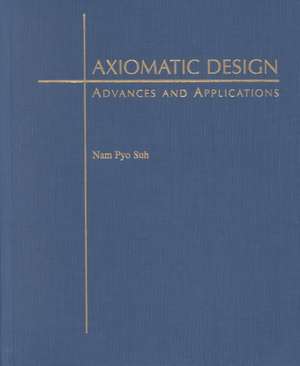
Axiomatic Design: Advances and Applications: MIT-Pappalardo Series in Mechanical Engineering
Autor Nam P. Suhen Limba Engleză Hardback – 28 iun 2001



Preț: 1705.15 lei
Preț vechi: 2265.61 lei
-25%
Puncte Express: 2558
Carte tipărită la comandă
Livrare economică 27 noiembrie-08 decembrie
Livrare prin curier în România Termenul estimat este afișat lângă disponibilitate.
Transport gratuit pentru acest produs Plată online sau ramburs, în funcție de opțiunile comenzii.
Retur gratuit în 14 zile Comandă securizată și suport în română.
Specificații
ISBN-13: 9780195134667
ISBN-10: 0195134664
Pagini: 528
Ilustrații: numerous tables, figures and halftones
Dimensiuni: 234 x 191 x 31 mm
Greutate: 1.07 kg
Editura: Oxford University Press
Colecția OUP USA
Seria MIT-Pappalardo Series in Mechanical Engineering
Locul publicării:New York, United States
ISBN-10: 0195134664
Pagini: 528
Ilustrații: numerous tables, figures and halftones
Dimensiuni: 234 x 191 x 31 mm
Greutate: 1.07 kg
Editura: Oxford University Press
Colecția OUP USA
Seria MIT-Pappalardo Series in Mechanical Engineering
Locul publicării:New York, United States
V-ar putea interesa
-
 Materials: Engineering, Science, Processing and DesignMichael F. Ashby-30%Preț: 421.47 lei600.65 lei
 -
 Introduction to Optimum DesignJasbir Singh Arora-32%Preț: 721.59 lei1059.00 lei
 -
 Introduction to Human-Computer InteractionKasper Hornbæk-27%Preț: 423.05 lei579.30 lei
 -
 Software Design DecodedAndre van der Hoek-20%Preț: 85.23 lei106.54 lei
 -
 -39%Preț: 483.04 lei798.37 lei
 -
 -31%Preț: 526.00 lei759.22 lei
 -
 Materials Selection in Mechanical DesignMichael F. Ashby-30%Preț: 455.56 lei654.07 lei
 -
 Systems EngineeringDerek K Hitchins-23%Preț: 778.18 lei1010.62 lei
 -
 MechanicsJ. P. Den HartogPreț: 104.74 lei
 -
 Notes on the Synthesis of FormChristopher AlexanderPreț: 235.55 lei
 -
 Design-Tech: Building Science for ArchitectsJason Alread-8%Preț: 496.29 lei539.45 leiRecomandat
 -
 -23%Preț: 813.65 lei1056.69 lei
 -
 -18%Preț: 945.22 lei1152.70 lei
 -
 Electrical and Mechanical Engineering 101David BakerPreț: 97.67 lei
 -
 -23%Preț: 412.01 lei535.90 lei
 -
 -23%Preț: 683.70 lei887.92 lei
 -
 -15%Preț: 649.15 lei763.70 lei
 -
 Springer Handbook of Mechanical EngineeringKarl-Heinrich Grote-18%Preț: 2092.64 lei2552.00 lei
 -
 Engineering Mechanics 1Dietmar GrossPreț: 274.96 lei
 -
 Delft Design Guide (revised edition): Perspectives - Models - Approaches - MethodsAnnemiek van Boeijen-20%Preț: 208.96 lei260.00 lei
Cuprins
- Preface
- Acknowledgement
- On the MIT-Pappalardo Series of Mechanical Engineering Books
- On CIRP Design Book Series
- 1: Introduction to Axiomatic Design
- 1.1: Introduction
- 1.2: Current State of Design Practice
- 1.3: Who Are the Designers? How Do We Design? What Is Design?
- 1.4: What Is the Ultimate Goal of Axiomatic Design?
- 1.5: Role of Axioms in Development of Science and Technology -- A Technological Perspective
- 1.6: Axiomatic Approach vs. Algorithmic Approach
- 1.7: Axiomatic Design Framework
- 1.8: Common Mistakes Made by Designers
- 1.9: Comparison of Axiomatic Design with Other Methodologies
- 1.10: Summary
- References
- Appendix 1-A Corollaries and Theorems
- Homework
- 2: One-FR Design, the Information Axiom, and Robust Design
- 2.1: Introduction
- 2.2: Introduction to One-FR Design
- 2.3: Design Issues for the One-FR Design
- 2.4: One-FR Design and Information Content
- 2.5: Elimination of Bias and Reduction of Variance
- 2.6: Robust Design
- 2.7: Design Process
- 2.8: Summary
- References
- Appendices
- 2-A: Pressure in Thick Wall Tube
- 2-B: Discrete Random Variables: Expected Value, Variance, and Standard Deviation
- 2-C: Continuous Random Variables: Expected Value, Variance, Standard Deviation, and Multivariate Random Variables
- Homework
- 3: Multi-FR Design
- 3.1: Introduction
- 3.2: Brief Review of Axiomatic Theory for Multi-FR Design
- 3.3: The Independence Axiom and the Information Axiom -- Their Implications for a Multi-FR Design Task
- 3.4: On Ideal Multi-FR Design
- 3.5: Uncoupled and Decoupled Multi-FR Designs
- 3.6: Information Content and Complexity of Multi-FR Design
- 3.7: Integration of DPs to Minimize the Information Content
- 3.8: Nonlinear Multi-FR Design
- 3.9: Design of Dispatching and Schedules: Avoiding Traffic Congestion
- 3.10: Conclusions
- References
- Appendix 3-A: Independence of the Two Design Axioms
- Appendix 3-B: Corollaries and Theorems Related to Information and Complexity
- Homework
- 4: Design of Systems
- 4.1: Introduction
- 4.2: Issues Related to System Design
- 4.3: Classification of Systems
- 4.4: Axiomatic Design Thoery for Fixed Systems
- 4.5: Design and Operation of Large Systems
- 4.6: Representation of the System Architecture of Fixed Systems
- 4.7: Mathematical Modeling, Simulation, and Optimization of Systems
- 4.8: Application of the System Architecture
- 4.9: On human-machine Interface
- 4.10: Generation of System Architecture using Computer Science
- 4.11: Conclusions
- References
- Homework
- 5: Axiomatic Design of Software
- 5.1: Introduction
- 5.2: Axiomatic Design
- 5.3: Design of a Software System for a Library: An Example
- 5.4: Software for Design of a Rib in Injection Molding of Plastic Parts: an Example (Adapted from Kim, et al., 1991)
- 5.5: Axiomatic Design of Object-Oriented Software System
- 5.6: Case Study: Acclaro Software -- Axiomatic Design of Object-Oriented Software System (ADo-oSS) for Designers
- 5.7: Case Study: Software Design for Real Time Control of Hardware/Software System
- 5.8: Software Development for Design Automation for Glass-Bulb Design
- 5.9: An Ideal Software System
- 5.10: Other Issues Related to Software Design
- 5.11: Conclusions
- References
- Homework
- 6: Axiomatic Design of Manufacturing Systems
- 6.1: Introduction
- 6.2: Basic Requirements of a Manufacturing System
- 6.3: Elements of Manufacturing Systems
- 6.4: Axiomatic Design of Fixed Manufacturing Systems for Identical Parts
- 6.5: Axiomatic Design of a Flexible Manufacturing System for Different Part
- 6.6: Mathematical Modeling and Optimization of Design
- 6.7: Representation of Manufacturing System Architecture
- 6.8: Conculsions
- References
- Homework
- 7: Axiomatic Design of Materals and Materials Processing Techniques
- Summary of Chapter 7
- 7.1: Introduction
- 7.2: Mixalloys
- 7.3: Microcellular Plastics
- 7.4: Layered Manufacturing Process
- 7.5: Conclusions
- References
- Homework
- 8: Product Development
- Summary of Chapter 8
- 8.1: Introduction
- 8.2: Mapping from the Customer Domain to the Functional Domain
- 8.3: Mapping from FRs to DPs
- 8.4: Application of the Information Axiom
- 8.5: Case Study -- Depth Charge
- 8.6: Concurrent Engineering -- Mapping from FR to DP to PV
- 8.7: Product Service
- 8.8: System Architecture
- 8.9: Conclusions
- References
- Homework
- 9: A Theory of Complexity -- The Design Axioms, Information, Complexity, and Periodicity
- Summary of Chapter 9
- 9.1: Introduction
- 9.2: Complexity, Uncertainty, Information, and Periodicity
- 9.3: Reduction of Uncertainity -- Conversion of a Design with Time-Dependent Combinatorial Complexity to a Design with Time-Dependent Periodic Complexity
- 9.4: Distinction between Time-Independent and Time-Dependent Complexity
- 9.5: Other Implications of Periodic Complexity -- A Speculation
- 9.6: Conclusion Remarks
- References
- Homework
- Index