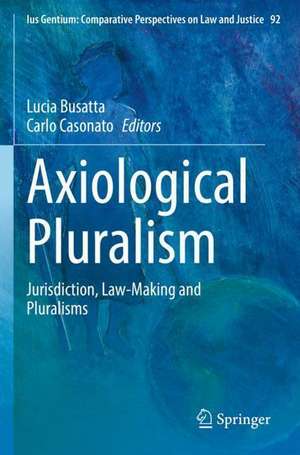
Axiological Pluralism: Ius Gentium: Comparative Perspectives on Law and Justice, cartea 92
Editat de Lucia Busatta, Carlo Casonatoen Limba Engleză Paperback – 4 sep 2022
The book outlines a model that makes it possible to focus on and address these issues in a sustainable manner, that is, to respond to individual requests and technological advances in the field of biolaw by consistently and effectively applying suitable legal instruments and jurisdictional interpretation.
Din seria Ius Gentium: Comparative Perspectives on Law and Justice
- 15%
 Preț: 706.15 lei
 - 18%
 Preț: 790.43 lei
 - 18%
 Preț: 1120.07 lei
 - 18%
 Preț: 870.23 lei
 - 18%
 Preț: 962.90 lei
 - 18%
 Preț: 1071.93 lei
 - 18%
 Preț: 924.52 lei
 - 18%
 Preț: 757.01 lei
 - 15%
 Preț: 612.82 lei
 - 24%
 Preț: 888.10 lei
 -
 Preț: 446.32 lei
 - 18%
 Preț: 1122.20 lei
 - 18%
 Preț: 1393.38 lei
 - 18%
 Preț: 788.62 lei
 - 18%
 Preț: 1392.15 lei
 - 18%
 Preț: 861.03 lei
 - 24%
 Preț: 1001.69 lei
 - 18%
 Preț: 966.67 lei
 - 24%
 Preț: 937.58 lei
 - 18%
 Preț: 980.43 lei
 - 18%
 Preț: 900.13 lei
 - 18%
 Preț: 782.35 lei
 - 18%
 Preț: 1124.07 lei
 - 24%
 Preț: 915.88 lei
 - 24%
 Preț: 794.82 lei
 - 18%
 Preț: 1111.62 lei
 - 24%
 Preț: 988.69 lei
 - 18%
 Preț: 1066.17 lei
 - 18%
 Preț: 728.57 lei
 - 18%
 Preț: 861.09 lei
 - 18%
 Preț: 788.99 lei
 - 24%
 Preț: 998.88 lei
 - 24%
 Preț: 802.36 lei
 - 24%
 Preț: 1012.16 lei
 - 18%
 Preț: 1008.48 lei
 - 24%
 Preț: 779.72 lei
 - 24%
 Preț: 803.90 lei
 - 18%
 Preț: 863.55 lei
Preț: 1001.35 lei
Preț vechi: 1221.17 lei
-18%
Puncte Express: 1502
Carte tipărită la comandă
Livrare economică 24 noiembrie-08 decembrie
Livrare prin curier în România Termenul estimat este afișat lângă disponibilitate.
Transport gratuit pentru acest produs Plată online sau ramburs, în funcție de opțiunile comenzii.
Retur gratuit în 14 zile Comandă securizată și suport în română.
Specificații
ISBN-13: 9783030784775
ISBN-10: 3030784770
Pagini: 260
Ilustrații: VI, 252 p.
Dimensiuni: 155 x 235 x 15 mm
Greutate: 0.4 kg
Ediția:1st ed. 2021
Editura: Springer
Colecția Ius Gentium: Comparative Perspectives on Law and Justice
Seria Ius Gentium: Comparative Perspectives on Law and Justice
Locul publicării:Cham, Switzerland
ISBN-10: 3030784770
Pagini: 260
Ilustrații: VI, 252 p.
Dimensiuni: 155 x 235 x 15 mm
Greutate: 0.4 kg
Ediția:1st ed. 2021
Editura: Springer
Colecția Ius Gentium: Comparative Perspectives on Law and Justice
Seria Ius Gentium: Comparative Perspectives on Law and Justice
Locul publicării:Cham, Switzerland
Cuprins
Part 1. Adjudication and Regulation Facing Pluralisms: Models And Trend.- Perspectives.- BioLaw facing pluralisms: three simple models for complex issues.- Some patterns for “scientific adjudication”: the role of courts in reconciling axiological pluralism and scientific complexity.- Part 2: Accommodating Pluralisms Beyond Courts?: Institutions and Tools.- Research Ethics Committees.- Consultative boards at international level.- Reckoning with growing pluralism. Potentials and limits of conscientious objection: Conscience clauses in abortion laws in Europe.- Professional (medical) ethics.- Part 3. Case Studies.- Axiological Pluralism: Conflict in the Hospital, Resolution in the Courts.- Moral pluralism and health claims as a challenge for the democratic principle. The cases of non validated therapies and vaccinations.- Reliance on Scientific Claims in Social and Legal Contexts: An ‘HIV and AIDS’ Case Study.- Reproductive Rights.- End of life issues.- Patient’s rights at the end of lifein Chilean legal system. Legal and jurisprudential analysis from a biolaw’s perspective.
Notă biografică
Lucia Busatta is currently research assistant at the Faculty of Law of the University of Trento. Previously, she has been working as a research fellow at the University of Trento and, between 2016 and 2019, at the University of Padua. Her main fields of research concern healthcare law and biolaw, migration law, fundamental rights guarantee and disability studies. She extensively published both in Italian and in Engilsh on these topics and she is also associate editor of BioLaw Journal.
Carlo Casonato is professor of Comparative constitutional law at the Faculty of Law of the University of Trento. He is a member of the Italian National Bioethics Committee, and of the OECD Global Partnership on Artificial Intelligence. He teaches Law and AI, Biolaw, and Bioethics in different Universities. He has also been the PI in two Jean Monnet initiatives on Law, Life Sciences and AI. He published/edited 20 books, and he is author or co-author of more than 130 articles and papers. He is founder and chief editor of BioLaw Journal.
Textul de pe ultima copertă
This book analyses the features and functionality of the relationship between the law, individual or collective values and medical-scientific evidence when they have to be interpreted by judges, courts and para-jurisdictional bodies. The various degrees to which scientific data and moral values have been integrated into the legal discourse reveal the need for a systematic review of the options and solutions that judges have elaborated on. In turn, the book presents a systematic approach, based on a proposed pattern for classifying these various degrees, together with an in-depth analysis of the multi-layered role of jurisdictions and the means available to them for properly handling new legal demands arising in plural societies.
The book outlines a model that makes it possible to focus on and address these issues in a sustainable manner, that is, to respond to individual requests and technological advances in the field of biolaw by consistently and effectively applying suitable legal instruments and jurisdictional interpretation.
The book outlines a model that makes it possible to focus on and address these issues in a sustainable manner, that is, to respond to individual requests and technological advances in the field of biolaw by consistently and effectively applying suitable legal instruments and jurisdictional interpretation.
Caracteristici
Provides an original perspective on law and pluralisms Offers a unique intersection between law, science and values Presents an innovative roadmap for legal interpretation of social and scientific progress