
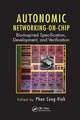
Autonomic Networking-on-Chip: Bio-Inspired Specification, Development, and Verification: Embedded Multi-Core Systems
Editat de Phan Cong-Vinhen Limba Engleză Hardback – 7 dec 2011
The FIRST Book to Assess Research Results, Opportunities, & Trends in "BioChipNets"
The third book in the Embedded Multi-Core Systems series from CRC Press, this is an advanced technical guide and reference composed of contributions from prominent researchers in industry and academia around the world. A response to the critical need for a global information exchange and dialogue, it is written for engineers, scientists, practitioners, and other researchers who have a basic understanding of NoC and are now ready to learn how to specify, develop, and verify ANoC using rigorous approaches.
Offers Expert Insights Into Technical Topics Including:
- Bio-inspired NoC
- How to map applications onto ANoC
- ANoC for FPGAs and structured ASICs
- Methods to apply formal methods in ANoC development
- Ways to formalize languages that enable ANoC
- Methods to validate and verify techniques for ANoC
- Use of "self-" processes in ANoC (self-organization, configuration, healing, optimization, protection, etc.)
- Use of calculi for reasoning about context awareness and programming models in ANoC

Preț: 1120.58 lei
Preț vechi: 1805.05 lei
-38% Nou
Puncte Express: 1681
Preț estimativ în valută:
198.26€ • 230.98$ • 173.13£
198.26€ • 230.98$ • 173.13£
Comandă specială
Livrare economică 29 decembrie 25 - 12 ianuarie 26
Doresc să fiu notificat când acest titlu va fi disponibil:
Se trimite...
Preluare comenzi: 021 569.72.76
Specificații
ISBN-13: 9781439829110
ISBN-10: 143982911X
Pagini: 288
Ilustrații: 68 b/w images and 21 tables
Dimensiuni: 156 x 234 x 23 mm
Greutate: 0.64 kg
Ediția:New.
Editura: CRC Press
Colecția CRC Press
Seria Embedded Multi-Core Systems
ISBN-10: 143982911X
Pagini: 288
Ilustrații: 68 b/w images and 21 tables
Dimensiuni: 156 x 234 x 23 mm
Greutate: 0.64 kg
Ediția:New.
Editura: CRC Press
Colecția CRC Press
Seria Embedded Multi-Core Systems
V-ar putea interesa
-
 -34%Preț: 1261.71 lei1925.05 lei
 -
 3D IC Integration and PackagingJohn Lau-35%Preț: 1128.77 lei1732.06 lei
 -
 -21%Preț: 455.85 lei575.67 lei
 -
 -9%Preț: 526.99 lei579.12 lei
 -
 -32%Preț: 759.87 lei1111.49 lei
 -
 Image Encryption: A Communication PerspectiveFathi E. Abd El-Samie-17%Preț: 328.39 lei394.05 lei
 -
 -25%Preț: 327.88 lei434.83 lei
 -
 SC-FDMA for Mobile CommunicationsFathi E. Abd El-Samie-34%Preț: 278.85 lei421.80 lei
 -
 Computational Electromagnetics with MATLAB, Fourth EditionMatthew N. O. Sadiku-18%Preț: 1098.80 lei1340.00 lei
 -
 -31%Preț: 470.17 lei679.55 lei
 -
 -20%Preț: 1062.38 lei1327.97 lei
 -
 An Introduction to Microwave MeasurementsAnanjan Basu-31%Preț: 381.26 lei549.04 lei
 -
 -30%Preț: 454.00 lei646.80 lei
 -
 LTE Signaling with DiameterTravis Russell-34%Preț: 507.92 lei774.41 lei
 -
 -34%Preț: 350.39 lei527.32 lei
 -
 -34%Preț: 723.14 lei1102.33 lei
 -
 The Unofficial Guide To iOS 10My Ebook Publishing HousePreț: 40.75 lei
 -
 Control SystemsN C Jagan-11%Preț: 514.02 lei577.54 lei
 -
 Geoinformatics for Environmental ManagementM Anji Reddy-13%Preț: 951.35 lei1093.51 lei
 -
 Thermoelectrics for Power GenerationMikhail Nikitin-23%Preț: 1003.14 lei1302.78 lei
Public țintă
Electrical engineers, computer scientists, computer engineers, developers and practitioners in networks-on-chips design.Cuprins
A Bio-Inspired Architecture for Autonomic Network-on-Chip. Bio-Inspired NoC Architecture Optimization. An Autonomic NoC Architecture Using Heuristic Technique for Virtual-Channel Sharing. Evolutionary Design of Collective Communications on Wormhole NoCs. Formal Aspects of Parallel Processing on Bio-Inspired on-Chip Networks. HAMSoC: A Monitoring-Centric Design Approach for Adaptive Parallel Computing. Toward Self-Placing Applications on 2D and 3D NoCs. Self-Adaption in SoCs. Bibliography. Index.
Notă biografică
Phan Cong-Vinh received a Ph.D in computer science from London South Bank University (LSBU) in the United Kingdom, a BS in mathematics and an MS in computer science from Vietnam National University (VNU) in Ho Chi Minh City, and a BA in English from Hanoi University of Foreign Languages Studies in Vietnam. He finished his PhD dissertation with the title Formal Aspects of Dynamic Reconfigurability in Reconfigurable Computing Systems supervised by Prof. Jonathan P. Bowen at LSBU where he was affiliated with the Centre for Applied Formal Methods (CAFM) at the Institute for Computing Research (ICR). From 1983 to 2000, he was a lecturer in mathematics and computer science at VNU, Posts and Telecommunications Institute of Technology (PTIT) and several other universities in Vietnam before he joined research with Dr. Tomasz Janowski at the International Institute for Software Technology (IIST) in Macao SAR, China, as a fellow in 2000. His research interests center on all aspects of formal methods, autonomic computing and networking, reconfigurable computing, ubiquitous computing, and applied categorical structures in computer science.
Descriere
Written for researchers and scientists, this book presents advanced reference material for readers who already have a basic understanding of NoC and are now ready to learn how to specify, develop, and verify ANoC using rigorous approaches. Exploring the theoretical knowledge required to achieve this, the text also presents formal and practical aspects in a straightforward way by detailing elemental components and briefly touching on the more advanced ones. The authors demonstrate how to use formal ANoC methods while making sound judgments and allowing for reasonable justifications.