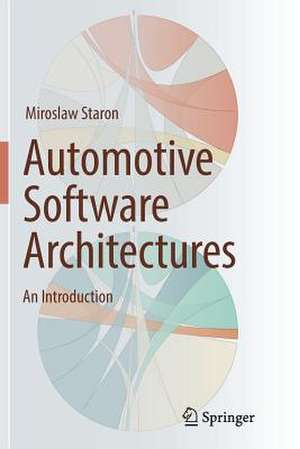
Automotive Software Architectures: An Introduction
Autor Miroslaw Staronen Limba Engleză Paperback – 12 mai 2018
This book introduces the concept of software architecture as one of the cornerstones of software in modern cars. Following a historical overview of the evolution of software in modern cars and a discussion of the main challenges driving that evolution, Chapter 2 describes the main architectural styles of automotive software and their use in cars’ software. In Chapter 3, readers will find a description of the software development processes used to develop software on the car manufacturers’ side. Chapter 4 then introduces AUTOSAR – an important standard in automotive software. Chapter 5 goes beyond simple architecture and describes the detailed design process for automotive software using Simulink, helping readers to understand how detailed design links to high-level design. Next, Chapter 6 presents a method for assessing the quality of the architecture – ATAM (Architecture Trade-off Analysis Method) – and provides a sample assessment, while Chapter 7 presents an alternative way ofassessing the architecture, namely by using quantitative measures and indicators. Subsequently Chapter 8 dives deeper into one of the specific properties discussed in Chapter 6 – safety – and details an important standard in that area, the ISO/IEC 26262 norm. Lastly, Chapter 9 presents a set of future trends that are currently emerging and have the potential to shape automotive software engineering in the coming years.
This book explores the concept of software architecture for modern cars and is intended for both beginning and advanced software designers. It mainly aims at two different groups of audience – professionals working with automotive software who need to understand concepts related to automotive architectures, and students of software engineering or related fields who need to understand the specifics of automotive software to be able to construct cars or their components. Accordingly, the book also contains a wealth of real-world examples illustrating the concepts discussed and requires no prior background in the automotive domain.
| Toate formatele și edițiile | Preț | Express |
|---|---|---|
| Paperback (2) | 318.80 lei 6-8 săpt. | |
| Springer International Publishing – 12 mai 2018 | 318.80 lei 6-8 săpt. | |
| Springer – 4 mar 2022 | 375.66 lei 6-8 săpt. | |
| Hardback (1) | 427.18 lei 3-5 săpt. | +29.17 lei 5-11 zile |
| Springer – 3 mar 2021 | 427.18 lei 3-5 săpt. | +29.17 lei 5-11 zile |
Preț: 318.80 lei
Preț vechi: 398.50 lei
-20%
Puncte Express: 478
Preț estimativ în valută:
56.33€ • 64.87$ • 48.76£
56.33€ • 64.87$ • 48.76£
Carte tipărită la comandă
Livrare economică 11-25 mai
Specificații
ISBN-13: 9783319864419
ISBN-10: 3319864416
Pagini: 237
Ilustrații: XIX, 237 p. 150 illus., 107 illus. in color.
Dimensiuni: 155 x 235 mm
Greutate: 0.39 kg
Ediția:Softcover reprint of the original 1st ed. 2017
Editura: Springer International Publishing
Colecția Springer
Locul publicării:Cham, Switzerland
ISBN-10: 3319864416
Pagini: 237
Ilustrații: XIX, 237 p. 150 illus., 107 illus. in color.
Dimensiuni: 155 x 235 mm
Greutate: 0.39 kg
Ediția:Softcover reprint of the original 1st ed. 2017
Editura: Springer International Publishing
Colecția Springer
Locul publicării:Cham, Switzerland
V-ar putea interesa
-
 Understanding Automotive Electronics: An Engineering PerspectiveWilliam Ribbens-31%Preț: 634.66 lei915.39 lei
 -
 Performance Vehicle Dynamics: Engineering and ApplicationsJames Balkwill-32%Preț: 570.76 lei842.77 lei
 -
 Finite Element Modeling for Materials Engineers Using MATLAB®Oluleke Oluwole-41%Preț: 502.13 lei844.99 lei
 -
 The Automotive Transmission BookRobert Fischer-23%Preț: 967.03 lei1255.89 lei
 -
 -18%Preț: 1087.99 lei1326.82 lei
 -
 -18%Preț: 1186.11 lei1446.49 lei
 -
 -20%Preț: 782.39 lei977.99 lei
Cuprins
1 Introduction.- 2 Software architectures.- 3 Automotive Software Development.- 4 AUTOSAR Standard.- 5 Detailed Design of Automotive Software.- 6 Evaluation of Automotive Software Architectures.- 7 Metrics for Software Design and Architectures.- 8 Functional Safety of Automotive Software.- 9 Current Trends in Automotive Software Architectures.- 10 Summary.
Recenzii
“An experienced software architect could read the book over a weekend due to the excellent organization and lucidity of the writing. This is a perfect reference and companion book for a short course or workshop on automotive software engineering for software professionals transitioning to the automotive industry from other sectors.” (Sundara Nagarajan, Computing Reviews, March, 2018)
Notă biografică
Miroslaw Staron is Professor in the Department of Computer Science and Engineering at the University of Gothenburg, Sweden. He has published extensively on software metrics, model-driven software development and empirical software engineering and cooperates with Ericsson, Volvo and other telecom companies and car manufacturers.
Textul de pe ultima copertă
This book introduces the concept of software architecture as one of the cornerstones of software in modern cars. Following a historical overview of the evolution of software in modern cars and a discussion of the main challenges driving that evolution, Chapter 2 describes the main architectural styles of automotive software and their use in cars’ software. In Chapter 3, readers will find a description of the software development processes used to develop software on the car manufacturers’ side. Chapter 4 then introduces AUTOSAR – an important standard in automotive software. Chapter 5 goes beyond simple architecture and describes the detailed design process for automotive software using Simulink, helping readers to understand how detailed design links to high-level design. Next, Chapter 6 presents a method for assessing the quality of the architecture – ATAM (Architecture Trade-off Analysis Method) – and provides a sample assessment, while Chapter 7 presents an alternative way ofassessing the architecture, namely by using quantitative measures and indicators. Subsequently Chapter 8 dives deeper into one of the specific properties discussed in Chapter 6 – safety – and details an important standard in that area, the ISO/IEC 26262 norm. Lastly, Chapter 9 presents a set of future trends that are currently emerging and have the potential to shape automotive software engineering in the coming years.
This book explores the concept of software architecture for modern cars and is intended for both beginning and advanced software designers. It mainly aims at two different groups of audience – professionals working with automotive software who need to understand concepts related to automotive architectures, and students of software engineering or related fields who need to understand the specifics of automotive software to be able to construct cars or their components. Accordingly, the book also contains a wealth of real-world examples illustrating the concepts discussed and requires no prior background in the automotive domain.
Caracteristici
First textbook on software engineering for automotive systems, combining both theoretical and practical issues from academic courses and industrial experience Includes a wealth of real-world examples, suggestions for further reading, and comprehensive summaries at the end of each chapter Introduces important standards and methods like AUTOSAR, Simulink, ATAM, and ISO/IEC 26262 Includes supplementary material: sn.pub/extras Includes supplementary material: sn.pub/extras