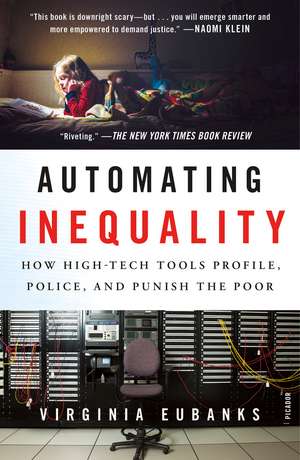
Automating Inequality
Autor Virginia Eubanksen Limba Engleză Paperback – 6 aug 2019
Analizând bazele de date și studiile de caz furnizate de Virginia Eubanks, descoperim o perspectivă critică asupra modului în care digitalizarea serviciilor publice afectează drepturile fundamentale. Automating Inequality nu este doar o analiză teoretică, ci o investigație sistematică a impactului pe care mineritul de date și algoritmii de politici publice îl au asupra claselor defavorizate. Apreciem rigoarea cu care autoarea demonstrează că, deși trăim sub un regim general al datelor, sistemele cele mai invazive și punitive sunt direcționate către cei săraci. Structura volumului este organizată progresiv, începând cu o notă istorică în capitolul „From Poorhouse to Database”, care ancorează tehnologia actuală în practicile de disciplinare a sărăciei din trecut. Capitolele centrale analizează eșecurile tehnocratice concrete: de la sistemul din Indiana, care interpretează erorile umane drept „lipsă de cooperare”, până la algoritmul Allegheny din Pittsburgh, care încearcă să prezică abuzul asupra copiilor pe baza unor profile statistice riscante. Alternativă la Weapons of Math Destruction de Cathy O'Neil pentru cursurile de sociologie sau politici publice, lucrarea de față aduce avantajul unei cercetări de teren aprofundate, oferind chipuri umane cifrelor reci. Spre deosebire de Data Justice de Lina Dencik, care explorează dimensiunile globale ale datificării, Eubanks se concentrează pe mecanismele interne ale statului american, oferind o critică tăioasă la adresa „poorhouse-ului digital”. Textul este echilibrat, evitând jargonul excesiv în favoarea unei narațiuni care evidențiază cum automatizarea deciziilor poate slăbi democrația și valorile echității sociale.
Preț: 109.47 lei
Carte disponibilă
Livrare economică 10-24 noiembrie
Livrare express 24-30 octombrie pentru 53.38 lei
Specificații
ISBN-10: 1250215781
Pagini: 288
Dimensiuni: 139 x 210 x 22 mm
Greutate: 0.24 kg
Editura: Picador USA
V-ar putea interesa
-
 Software Defined Radio using MATLAB & Simulink and the RTL-SDRRobert W. Stewart-20%Preț: 417.40 lei521.76 lei
 -
 Software Defined Radio using MATLAB & Simulink and the RTL-SDRRobert W. Stewart-20%Preț: 540.90 lei676.12 lei
 -
 Software Engineering, Global EditionIan Sommerville-20%Preț: 633.41 lei791.76 lei
 -
 ASIA CCS 15 10th ACM Symposium on Information, Computer and Communication SecurityAsia Ccs 15 Conference Committee-27%Preț: 955.85 lei1309.39 lei
 -
 Algorithmic Game TheoryMartin Hoefer-20%Preț: 336.52 lei420.65 lei
 -
 Ontologiebasierte DokumentenverwaltungAnnett Mitschick-20%Preț: 495.99 lei619.99 lei
 -
 Computational Steering with Reduced ComplexityDaniel Butnaru-20%Preț: 295.64 lei369.54 lei
 -
 -20%Preț: 357.75 lei447.20 lei
 -
 ICTs for Transfer of TechnologiesS. R Verma-20%Preț: 331.70 lei414.63 lei
 -
 JOURNAL OF CYBER SECURITY AND MOBILITY 4-4Ashutosh DuttaPreț: 297.15 lei
 -
 E-LearningBoyka Gradinarova-20%Preț: 1200.55 lei1500.69 lei
 -
 Applications of Digital Signal Processing through Practical ApproachSudhakar Radhakrishnan-20%Preț: 893.49 lei1116.87 lei
De ce să citești această carte
Această carte este esențială pentru studenții la sociologie, etică tehnologică și politici publice. Cititorul va înțelege cum algoritmii pot perpetua discriminarea și de ce automatizarea nu este întotdeauna sinonimă cu eficiența sau obiectivitatea. Este un argument solid pentru necesitatea supravegherii umane în sistemele de asistență socială, oferind instrumente critice pentru a evalua impactul tehnologiei asupra drepturilor civile.
Despre autor
Virginia Eubanks este profesor asociat în cadrul Departamentului de Studii despre Femei la University at Albany, SUNY. Experiența sa academică este dublată de un activism civic susținut, fiind cofondatoare a organizației Our Knowledge, Our Power (OKOP), care luptă pentru drepturile persoanelor aflate în dificultate economică. Expertiza sa în intersecția dintre tehnologie, sărăcie și justiție socială i-a adus numeroase distincții, printre care premiul Lillian Smith Book Award, consolidându-i poziția de voce autoritară în critica sociologică a erei digitale.
Descriere scurtă
Astra Taylor, author of The People's Platform: The single most important book about technology you will read this year.
Dorothy Roberts, author of Killing the Black Body: A must-read. A powerful investigative look at data-based discrimination?and how technology affects civil and human rights and economic equity The State of Indiana denies one million applications for healthcare, foodstamps and cash benefits in three years--because a new computer system interprets any mistake as "failure to cooperate." In Los Angeles, an algorithm calculates the comparative vulnerability of tens of thousands of homeless people in order to prioritize them for an inadequate pool of housing resources. In Pittsburgh, a child welfare agency uses a statistical model to try to predict which children might be future victims of abuse or neglect. Since the dawn of the digital age, decision-making in finance, employment, politics, health and human services has undergone revolutionary change. Today, automated systems--rather than humans--control which neighborhoods get policed, which families attain needed resources, and who is investigated for fraud. While we all live under this new regime of data, the most invasive and punitive systems are aimed at the poor. In Automating Inequality, Virginia Eubanks systematically investigates the impacts of data mining, policy algorithms, and predictive risk models on poor and working-class people in America. The book is full of heart-wrenching and eye-opening stories, from a woman in Indiana whose benefits are literally cut off as she lays dying to a family in Pennsylvania in daily fear of losing their daughter because they fit a certain statistical profile. The U.S. has always used its most cutting-edge science and technology to contain, investigate, discipline and punish the destitute. Like the county poorhouse and scientific charity before them, digital tracking and automated decision-making hide poverty from the middle-class public and give the nation the ethical distance it needs to make inhumane choices: which families get food and which starve, who has housing and who remains homeless, and which families are broken up by the state. In the process, they weaken democracy and betray our most cherished national values. This deeply researched and passionate book could not be more timely.
Cuprins
Introduction: Red Flags
1: From Poorhouse to Database
2: Automating Welfare in the Heartland
3: High-Tech Homelessness in the City of Angels
4: The Allegheny Algorithm
5: The Digital Poorhouse
Conclusion: Dismantling the Digital Poorhouse
Acknowledgments
Sources and Methods
Endnotes
Index