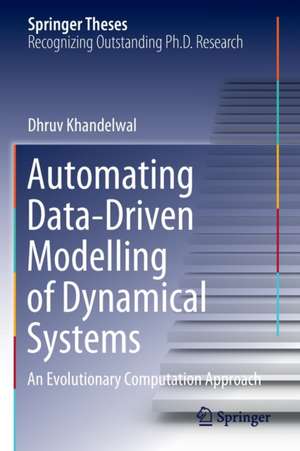
Automating Data-Driven Modelling of Dynamical Systems: Springer Theses
Autor Dhruv Khandelwalen Limba Engleză Paperback – 4 feb 2023
Din seria Springer Theses
- 15%
 Preț: 663.23 lei
 - 15%
 Preț: 661.49 lei
 - 15%
 Preț: 660.04 lei
 - 18%
 Preț: 1438.89 lei
 -
 Preț: 397.39 lei
 - 18%
 Preț: 1150.06 lei
 - 18%
 Preț: 1261.12 lei
 - 15%
 Preț: 665.20 lei
 -
 Preț: 404.91 lei
 -
 Preț: 401.44 lei
 - 18%
 Preț: 1151.50 lei
 -
 Preț: 410.46 lei
 - 18%
 Preț: 1034.72 lei
 - 18%
 Preț: 977.51 lei
 - 18%
 Preț: 1144.10 lei
 - 15%
 Preț: 663.23 lei
 - 18%
 Preț: 1031.60 lei
 - 15%
 Preț: 638.81 lei
 - 18%
 Preț: 978.49 lei
 -
 Preț: 398.83 lei
 - 15%
 Preț: 667.93 lei
 -
 Preț: 399.72 lei
 - 15%
 Preț: 658.80 lei
 - 15%
 Preț: 663.97 lei
 - 15%
 Preț: 664.46 lei
 - 18%
 Preț: 1263.02 lei
 - 15%
 Preț: 663.48 lei
 - 18%
 Preț: 1035.90 lei
 - 18%
 Preț: 1273.75 lei
 - 18%
 Preț: 1152.69 lei
 - 15%
 Preț: 661.99 lei
 - 18%
 Preț: 1152.90 lei
 - 18%
 Preț: 1264.69 lei
 - 18%
 Preț: 1038.03 lei
 - 18%
 Preț: 1036.63 lei
 - 18%
 Preț: 1156.95 lei
 - 18%
 Preț: 1036.70 lei
 - 18%
 Preț: 979.42 lei
 - 15%
 Preț: 642.59 lei
 - 15%
 Preț: 665.96 lei
 - 18%
 Preț: 976.57 lei
 - 18%
 Preț: 1443.18 lei
 -
 Preț: 401.44 lei
 -
 Preț: 399.14 lei
 - 18%
 Preț: 1034.98 lei
 - 18%
 Preț: 1148.15 lei
 - 15%
 Preț: 658.33 lei
 - 15%
 Preț: 662.51 lei
 - 15%
 Preț: 659.03 lei
 - 15%
 Preț: 659.78 lei
Preț: 916.37 lei
Preț vechi: 1117.53 lei
-18%
Puncte Express: 1375
Carte tipărită la comandă
Livrare economică 28 noiembrie-12 decembrie
Livrare prin curier în România Termenul estimat este afișat lângă disponibilitate.
Transport gratuit pentru acest produs Plată online sau ramburs, în funcție de opțiunile comenzii.
Retur gratuit în 14 zile Comandă securizată și suport în română.
Specificații
ISBN-13: 9783030903459
ISBN-10: 3030903451
Pagini: 256
Ilustrații: XXIII, 229 p. 74 illus., 49 illus. in color.
Dimensiuni: 155 x 235 x 15 mm
Greutate: 0.39 kg
Ediția:1st ed. 2022
Editura: Springer
Colecția Springer Theses
Seria Springer Theses
Locul publicării:Cham, Switzerland
ISBN-10: 3030903451
Pagini: 256
Ilustrații: XXIII, 229 p. 74 illus., 49 illus. in color.
Dimensiuni: 155 x 235 x 15 mm
Greutate: 0.39 kg
Ediția:1st ed. 2022
Editura: Springer
Colecția Springer Theses
Seria Springer Theses
Locul publicării:Cham, Switzerland
Cuprins
Introduction.- The State-of-the-art.- Preliminaries - Evolutionary Algorithms.- Tree Adjoining Grammar.- Performance measures.
Textul de pe ultima copertă
This book describes a user-friendly, evolutionary algorithms-based framework for estimating data-driven models for a wide class of dynamical systems, including linear and nonlinear ones. The methodology addresses the problem of automating the process of estimating data-driven models from a user’s perspective. By combining elementary building blocks, it learns the dynamic relations governing the system from data, giving model estimates with various trade-offs, e.g. between complexity and accuracy. The evaluation of the method on a set of academic, benchmark and real-word problems is reported in detail. Overall, the book offers a state-of-the-art review on the problem of nonlinear model estimation and automated model selection for dynamical systems, reporting on a significant scientific advance that will pave the way to increasing automation in system identification.
Caracteristici
Presents a novel approach for automating system identification Offers novel solutions to multi-criteria system identification problems Reviews fundamental concepts of system identification