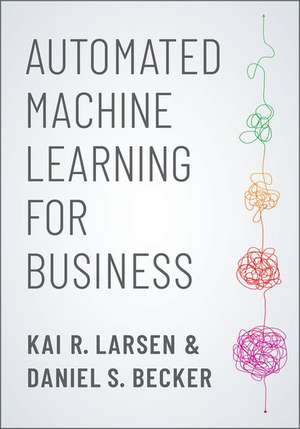
Automated Machine Learning for Business
Autor Kai R. Larsen, Daniel S. Beckeren Limba Engleză Paperback – 20 oct 2021
Preț: 334.01 lei
Preț vechi: 410.76 lei
-19%
Puncte Express: 501
Carte tipărită la comandă
Livrare economică 20-25 noiembrie
Livrare prin curier în România Termenul estimat este afișat lângă disponibilitate.
Transport gratuit de la 400.00 lei Plată online sau ramburs, în funcție de opțiunile comenzii.
Retur gratuit în 14 zile Comandă securizată și suport în română.
Specificații
ISBN-13: 9780190941666
ISBN-10: 0190941669
Pagini: 352
Ilustrații: 186 b/w illustrations
Dimensiuni: 251 x 173 x 20 mm
Greutate: 0.57 kg
Editura: Oxford University Press
Colecția OUP USA
Locul publicării:New York, United States
ISBN-10: 0190941669
Pagini: 352
Ilustrații: 186 b/w illustrations
Dimensiuni: 251 x 173 x 20 mm
Greutate: 0.57 kg
Editura: Oxford University Press
Colecția OUP USA
Locul publicării:New York, United States
V-ar putea interesa
-
 Using Artificial Intelligence Absolute Beginner's GuideMichael Miller-20%Preț: 194.58 lei243.22 lei
 -
 Just Enough Data Science and Machine LearningMark LevenePreț: 342.01 lei
 -
 The Master AlgorithmPedro Domingos-19%Preț: 63.68 lei78.52 lei
 -
 The AI PlaybookEric Siegel-16%Preț: 183.02 lei218.87 lei
 -
 -39%Preț: 391.86 lei645.65 lei
 -
 Mueller, J: Machine Learning For DummiesJohn Paul Mueller-20%Preț: 176.20 lei220.25 lei
 -
 Preț: 103.34 lei
 -
 Applied Machine Learning for Data Science PractitionersVidya Subramanian-19%Preț: 434.04 lei535.85 lei
 -
 -23%Preț: 799.73 lei1038.62 lei
 -
 Automate Your BusyworkAytekin TankPreț: 94.22 lei
 -
 Preț: 142.20 lei
 -
 -23%Preț: 1160.56 lei1507.22 lei
 -
 Machine Learning For DummiesLuca Massaron-20%Preț: 146.59 lei183.23 lei
 -
 -18%Preț: 65.45 lei79.56 lei
 -
 Automated Machine Learning in ActionQingquan Song-20%Preț: 310.42 lei388.02 lei
 -
 Smart BusinessMing ZengPreț: 188.49 lei
 -
 How to Make AI UsefulMagnus Reiner-11%Preț: 83.49 lei93.98 lei
 -
 Automated Machine LearningFrank Hutter-20%Preț: 322.77 lei403.45 lei
 -
 Artificial Intelligence and Machine Learning with RBernd Heesen-20%Preț: 310.73 lei388.41 lei
 -
 More HumanRasmus HougaardPreț: 187.27 lei
Notă biografică
Kai R. Larsen is an Associate Professor of Information Systems in the division of Organizational Leadership and Information Analytics, Leeds School of Business, University of Colorado Boulder. He is a courtesy faculty member in the Department of Information Science of the College of Media, Communication and Information, a Research Advisor to Gallup, and a Fellow of the Institute of Behavioral Science. Daniel S. Becker is a Data Scientist for Google's Kaggle division and founder of Kaggle Learn and Decision.ai.