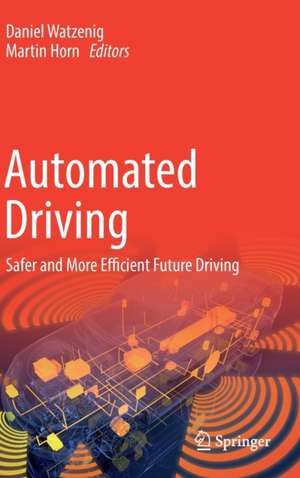
Automated Driving
Editat de Daniel Watzenig, Martin Hornen Limba Engleză Hardback – 4 oct 2016
Subliniem rigoarea tehnică a acestui volum încă din primele capitole, unde exercițiul concret al calculului benzii de referință pentru controlul ghidării autonome (capitolul 6) demonstrează complexitatea matematică din spatele conducerii automatizate. Automated Driving nu este doar o trecere în revistă a conceptelor, ci un manual de inginerie care analizează „cărămizile” tehnologice esențiale: controlul avansat, procesarea cognitivă a datelor și siguranța funcțională. Considerăm că structura sa în patru părți este exemplar organizată pentru o progresie logică: pornește de la cadrul legislativ și securitatea datelor, trece prin algoritmi de urmărire a traseului (path tracking) pe autostrăzi și culminează cu arhitecturile hardware de calcul necesare la bordul vehiculelor. Notăm cu interes capitolul dedicat istoriei senzorilor radar, care oferă contextul necesar pentru a înțelege evoluția către sistemele multi-senzor actuale. Complementar volumului Handbook Assisted and Automated Driving, care se axează pe limitările proceselor de testare și componente mecatronice, această lucrare editată de Daniel Watzenig se concentrează mai mult pe arhitectura sistemelor de calcul și pe validarea lor în scenarii complexe de trafic. De asemenea, față de Control Strategies for Advanced Driver Assistance Systems and Autonomous Driving Functions, care este focalizat strict pe algoritmi de control, Automated Driving oferă o perspectivă mai largă, integrând hărțile digitale și sistemul de poziționare Galileo în ecuația autonomiei. În contextul operei editorului, această carte face tranziția de la cercetările anterioare din Comprehensive Energy Management - Safe Adaptation, Predictive Control and Thermal Management, unde accentul era pus pe eficiența energetică, spre o abordare sistemică a vehiculului autonom ca entitate sigură și eficientă în timp real. Este o resursă fundamentală care sintetizează stadiul actual al inovației europene în domeniu, fiind ancorată în proiectele de cercetare colaborativă de la nivelul UE.
Preț: 1617.58 lei
Preț vechi: 1972.66 lei
-18%
Carte tipărită la comandă
Livrare economică 20 noiembrie-04 decembrie
Specificații
ISBN-10: 3319318934
Pagini: 640
Ilustrații: XVII, 620 p. 255 illus., 171 illus. in color.
Dimensiuni: 160 x 241 x 40 mm
Greutate: 1.12 kg
Ediția:1st edition 2017
Editura: Springer
Locul publicării:Cham, Switzerland
V-ar putea interesa
-
 -14%Preț: 698.81 lei812.58 lei
 -
 Preț: 45.39 lei
 -
 Validation and Verification of Automated SystemsAndrea Leitner-18%Preț: 709.58 lei865.33 lei
 -
 Automotive Battery TechnologyAlexander ThalerPreț: 381.78 lei
 -
 Preț: 372.64 lei
 -
 Preț: 363.99 lei
 -
 Adaptive Modelle für die KraftfahrzeugdynamikChristoph Halfmann-18%Preț: 809.99 lei987.79 lei
 -
 Radführungen der StraßenfahrzeugeWolfgang Matschinsky-18%Preț: 853.90 lei1041.35 lei
 -
 SatellitennavigationHans Dodel-25%Preț: 628.63 lei843.21 lei
 -
 Preț: 312.15 lei
 -
 Preț: 376.55 lei
 -
 -8%Preț: 466.38 lei506.94 lei
 -
 ElektromobilitätMarkus LienkampPreț: 444.89 lei
 -
 Aufladung von VerbrennungsmotorenHelmut Pucher-18%Preț: 947.86 lei1155.93 lei
 -
 Konstruktionen und Schaltungen aus dem Gebiete der elektrischen BahnenOle Sivert BragstadtPreț: 467.30 lei
 -
 -15%Preț: 530.17 lei623.73 lei
 -
 -15%Preț: 649.79 lei764.46 lei
 -
 Der Weg zum Ein-Liter-AutoAlexander DauensteinerPreț: 410.68 lei
 -
 Nawigacionno-posadochnoe awiaoborudowanieViktor Kondrashow-8%Preț: 466.95 lei507.56 lei
 -
 -23%Preț: 939.29 lei1219.87 lei
 -
 Sistema resultado de la interacción de GMDSS con otros equiposAlfonso Isidro López Díaz-8%Preț: 571.63 lei621.33 lei
De ce să citești această carte
Această lucrare este esențială pentru inginerii auto de la OEM-uri și furnizori, oferind soluții concrete pentru arhitecturi hardware și algoritmi de control. Cititorul câștigă o înțelegere profundă a siguranței funcționale și a metodelor de validare, elemente critice pentru trecerea de la asistența la conducere la autonomia deplină. Este un ghid tehnic ce transformă conceptele teoretice în specificații gata de implementat în industria auto modernă.
Despre autor
Daniel Watzenig este un expert recunoscut în domeniul conducerii automatizate și al sistemelor de control, activând ca profesor și coordonator de proiecte de cercetare europene. Lucrările sale, precum Validation and Verification of Automated Systems, reflectă o preocupare constantă pentru fiabilitatea și siguranța vehiculelor inteligente. Alături de Martin Horn, a reușit să reunească în acest volum perspective din mediul academic și industrial, concentrându-se pe integrarea algoritmilor de control cu arhitecturile de calcul de înaltă performanță, fiind un promotor al standardelor de siguranță funcțională în ingineria auto.
Descriere scurtă
The current state of the art of automated vehicle research, development and innovation is given. The book also addresses industry-driven roadmaps for major new technology advances as well as collaborative European initiatives supporting the evolvement of automated driving. Various examples highlight the state of development of automated driving as well as the way forward.
The book will be of interest to academics and researchers within engineering, graduate students, automotive engineers at OEMs and suppliers, ICT and software engineers, managers, and other decision-makers.
Cuprins
Notă biografică
Martin Horn was born in Austria. He received his Master degree in electrical engineering and the doctoral degree in technical science from Graz University of Technology, Graz, Austria, in 1992 and 1998, respectively. From 2003 to 2008 he was is an Associate Professor at the Institute of Automation and Control at Graz University of Technology. From 2008 to 2014 he was full professor for Control and Mechatronic Systems at Klagenfurt University. Since 2014 he is full professor for Automation and Control at Graz University of Technology. He is author or co-author of around 100 peer-reviewed papers, book chapters, patents, and articles. His research interests focus on automotive control systems, robust control, variable structure systems and robust observer design.
Caracteristici
Provides a seamless coverage of all relevant systems for automated driving, their integration and their reliability assurance
Current state-of-the art will be extensively discussed and both progressive and conservative short-/mid-/long-term road maps will be considered