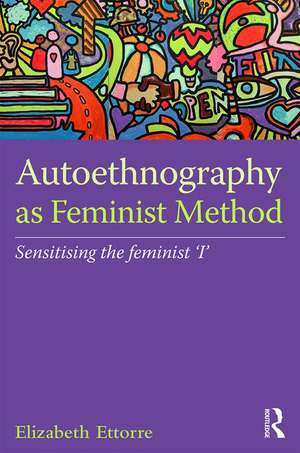
Autoethnography as Feminist Method: Sensitising the feminist 'I'
Autor Elizabeth Ettorreen Limba Engleză Hardback – 2 dec 2016
Preț: 1245.81 lei
Preț vechi: 1519.28 lei
-18%
Puncte Express: 1869
Carte tipărită la comandă
Livrare economică 24 octombrie-07 noiembrie
Livrare prin curier în România Termenul estimat este afișat lângă disponibilitate.
Transport gratuit pentru acest produs Plată online sau ramburs, în funcție de opțiunile comenzii.
Retur gratuit în 14 zile Comandă securizată și suport în română.
Specificații
ISBN-13: 9781138647886
ISBN-10: 1138647888
Pagini: 136
Ilustrații: 1 Tables, black and white
Dimensiuni: 156 x 234 x 15 mm
Greutate: 0.36 kg
Ediția:2 New edition
Editura: Taylor & Francis
Colecția Routledge
Locul publicării:Oxford, United Kingdom
ISBN-10: 1138647888
Pagini: 136
Ilustrații: 1 Tables, black and white
Dimensiuni: 156 x 234 x 15 mm
Greutate: 0.36 kg
Ediția:2 New edition
Editura: Taylor & Francis
Colecția Routledge
Locul publicării:Oxford, United Kingdom
Public țintă
Postgraduate and UndergraduateCuprins
Introduction: Autoethnography as feminist method
1. Being a 'Sexual Pervert' in Academia
2. Finding my Feminist Voice Through an Illness Story: 'An Old Female Body Confronts a Thyroid Problem'
3. Doing Feminist Autoethnography with Drug Using Women
4. "She Wrote it but Look What She Wrote"
5. Sensitizing the Feminist ‘I’
1. Being a 'Sexual Pervert' in Academia
2. Finding my Feminist Voice Through an Illness Story: 'An Old Female Body Confronts a Thyroid Problem'
3. Doing Feminist Autoethnography with Drug Using Women
4. "She Wrote it but Look What She Wrote"
5. Sensitizing the Feminist ‘I’
Notă biografică
Professor Elizabeth Ettorre is an internationally known feminist sociologist. She has written in the areas of substance misuse, genetics, reproduction and autoethnography. Currently, she is Emerita Professor of Sociology, University of Liverpool, Honorary Professor, Aarhuus University, Denmark and University of Plymouth, UK and Docent in Sociology, University of Helsinki and Åbo Akademi University.
Descriere
Autoethnography is an ideal method to study the ‘feminist I’. Through personal stories, the author reflects on how feminists negotiate agency and the effect this has on one's political sensibilities. Speaking about oneself transforms into stories of political responsibility - a key issue for feminists who function as cultural mediators.