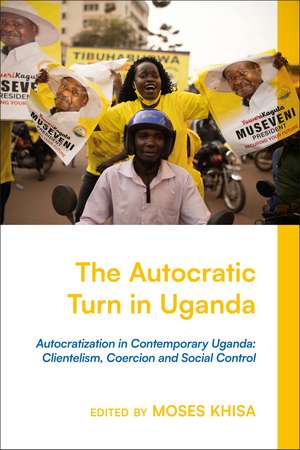
Autocratization in Contemporary Uganda: Clientelism, Coercion and Social Control
Editat de Moses Khisaen Limba Engleză Hardback – 8 feb 2024
Surveying that trajectory since 1986, the book takes as its primary focus the years since 2005; bringing to the fore the 'autocratic turn', placing it within a broader comparative lens, and enriching it with comparative references to cases outside of Uganda. While positing the notion of 'autocratic adaptability' as a defining hallmark of Museveni's rule, the book examines the factors and forces that have made that adaptability possible, analysing the dynamics around three keys themes: institutions, resources, and coalitions. Through empirical research, each chapter seeks to demonstrate how either one or two of these three variables have functioned in propelling autocratization and assuring regime resilience - producing theoretical and and comparative implications that reach beyond Uganda.
Preț: 599.09 lei
Preț vechi: 880.46 lei
-32%
Puncte Express: 899
Carte tipărită la comandă
Livrare economică 23 noiembrie-07 decembrie
Livrare prin curier în România Termenul estimat este afișat lângă disponibilitate.
Transport gratuit pentru acest produs Plată online sau ramburs, în funcție de opțiunile comenzii.
Retur gratuit în 14 zile Comandă securizată și suport în română.
Specificații
ISBN-13: 9781350323537
ISBN-10: 1350323535
Pagini: 320
Dimensiuni: 164 x 236 x 24 mm
Greutate: 0.62 kg
Editura: Bloomsbury Publishing
Colecția Zed Books
Locul publicării:London, United Kingdom
ISBN-10: 1350323535
Pagini: 320
Dimensiuni: 164 x 236 x 24 mm
Greutate: 0.62 kg
Editura: Bloomsbury Publishing
Colecția Zed Books
Locul publicării:London, United Kingdom
Cuprins
PREFACE
ACKNOWLEDGEMENTS
INTRODUCTION: Theory and Trajectory of Autocratization in Contemporary Uganda
Moses Khisa, North Carolina State University, USA
Part I: CLIENTELISM AND RESOURCES
Chapter 1: Political Clientelism and Museveni's Authoritarianism
Nelson Kasfir, Dartmouth College, USA
Chapter 2: "The one and only Revolutionary President": Heritage, Memory and the Personalisation of NRM Rule
Jonathan Fisher, University of Birmingham, UK, and Stephanie Cawood, University of the Free State, South Africa
Chapter 3: Museveni and Government-Foreign Business Relations in the Electricity Sector
Roger Tangri and Andrew M. Mwenda
Part II: CO-OPTATION, COERCION & SOCIAL CONTROL
Chapter 4: State Co-optation of Feminism: Unpacking the Paradoxes of Political Representation
Tabitha Mulyampiti, Makerere University, Uganda
Chapter 5: Obstructing Civil Society: State Backlash, Co-optation and Coping Mechanisms
Mesharch W. Katusiimeh, Kabale University, Uganda
Chapter 6: Uncertainty, Militarism and the Politics of Regime Survival
Sabastian Rwengabo, Centre for Basic Research, Uganda
Chapter 7: The Military as an Instrument of Regime Survival
Gerald Bareebe, York University, Canada
Chapter 8: Institutionalized Arbitrariness as Autocratic Adaptability
Rebecca Tapscott, University of York, UK
Part III: INSTITUTIONS AND COALITION POLITICS
Chapter 9: Between Change and Continuity in the Ruling Coalition
Moses Khisa, North Carolina State University, USA
Chapter 10: Autocratization by Elections
Anders Sjögren, Uppsala University, Sweden
Chapter 11: From Movement to Multiparty: The State and the Role of Political Parties
Frederick Golooba-Mutebi, Uganda Martyrs University, Uganda, and Mesharch W. Katusiimeh, Kabale University, Uganda
CONCLUSION: Uganda at Political Crossroads?
Moses Khisa, North Carolina State University, USA, and Sabastiano Rwengabo, Centre for Basic Research, Uganda
Index
ACKNOWLEDGEMENTS
INTRODUCTION: Theory and Trajectory of Autocratization in Contemporary Uganda
Moses Khisa, North Carolina State University, USA
Part I: CLIENTELISM AND RESOURCES
Chapter 1: Political Clientelism and Museveni's Authoritarianism
Nelson Kasfir, Dartmouth College, USA
Chapter 2: "The one and only Revolutionary President": Heritage, Memory and the Personalisation of NRM Rule
Jonathan Fisher, University of Birmingham, UK, and Stephanie Cawood, University of the Free State, South Africa
Chapter 3: Museveni and Government-Foreign Business Relations in the Electricity Sector
Roger Tangri and Andrew M. Mwenda
Part II: CO-OPTATION, COERCION & SOCIAL CONTROL
Chapter 4: State Co-optation of Feminism: Unpacking the Paradoxes of Political Representation
Tabitha Mulyampiti, Makerere University, Uganda
Chapter 5: Obstructing Civil Society: State Backlash, Co-optation and Coping Mechanisms
Mesharch W. Katusiimeh, Kabale University, Uganda
Chapter 6: Uncertainty, Militarism and the Politics of Regime Survival
Sabastian Rwengabo, Centre for Basic Research, Uganda
Chapter 7: The Military as an Instrument of Regime Survival
Gerald Bareebe, York University, Canada
Chapter 8: Institutionalized Arbitrariness as Autocratic Adaptability
Rebecca Tapscott, University of York, UK
Part III: INSTITUTIONS AND COALITION POLITICS
Chapter 9: Between Change and Continuity in the Ruling Coalition
Moses Khisa, North Carolina State University, USA
Chapter 10: Autocratization by Elections
Anders Sjögren, Uppsala University, Sweden
Chapter 11: From Movement to Multiparty: The State and the Role of Political Parties
Frederick Golooba-Mutebi, Uganda Martyrs University, Uganda, and Mesharch W. Katusiimeh, Kabale University, Uganda
CONCLUSION: Uganda at Political Crossroads?
Moses Khisa, North Carolina State University, USA, and Sabastiano Rwengabo, Centre for Basic Research, Uganda
Index
Recenzii
Autocratization in Contemporary Uganda is an essential reference for all those interested in contemporary and future politicsin Uganda.
This compilation of insightful essays charts the autocratization of Uganda since President Yower Museveni's takeover in 1986, effectively demonstrating how the regime has become increasingly personalized and institutionally fragmented. The book shows how the longevity of the regime is a result of cooptation and coercion. Each chapter examines a different set of institutions to uncover mechanisms of institutional adaptability, pervasive clientelism, and legal manipulation. Taken as a whole, the book provides a significant contribution to our understanding of how autocracy operates today in Africa.
In theorizing Uganda's politics, this book propels the prevailing research agenda beyond current parameters, while its empirical underpinnings provide a scholarly tone for practical future inquiry.
There has been a welcome recent spate of books on the Yoweri Museveni/NRM regime in Uganda, but the breadth and depth of this anthology is quite significant and refreshing; it is also quite timely.
Autocratization in Contemporary Uganda: Clientelism, Coercion and Social Control offers a comprehensive, nuanced and insightful analysis of the complex factors behind regime resilience and autocratic deepening in Uganda and its implications. The group of authors´ collective grasp of autocratic theory and historic and contemporary debates in Ugandan politics has produced a "must read" volume for scholars and students interested in autocratization and the political and economic factors underpinning Uganda's political trajectory under President Museveni.
The current National Resistance Movement government in Uganda rests on a puzzling combination of the stability and resilience of President Museveni's rule on the one hand, and an increasingly personalized and vulnerable system on the other. In this volume, a collective of Uganda-experts offers important and insightful perspectives on this puzzle. A must read to help us understand not only the Ugandan path but processes of autocratization on the African continent and elsewhere.
This compilation of insightful essays charts the autocratization of Uganda since President Yower Museveni's takeover in 1986, effectively demonstrating how the regime has become increasingly personalized and institutionally fragmented. The book shows how the longevity of the regime is a result of cooptation and coercion. Each chapter examines a different set of institutions to uncover mechanisms of institutional adaptability, pervasive clientelism, and legal manipulation. Taken as a whole, the book provides a significant contribution to our understanding of how autocracy operates today in Africa.
In theorizing Uganda's politics, this book propels the prevailing research agenda beyond current parameters, while its empirical underpinnings provide a scholarly tone for practical future inquiry.
There has been a welcome recent spate of books on the Yoweri Museveni/NRM regime in Uganda, but the breadth and depth of this anthology is quite significant and refreshing; it is also quite timely.
Autocratization in Contemporary Uganda: Clientelism, Coercion and Social Control offers a comprehensive, nuanced and insightful analysis of the complex factors behind regime resilience and autocratic deepening in Uganda and its implications. The group of authors´ collective grasp of autocratic theory and historic and contemporary debates in Ugandan politics has produced a "must read" volume for scholars and students interested in autocratization and the political and economic factors underpinning Uganda's political trajectory under President Museveni.
The current National Resistance Movement government in Uganda rests on a puzzling combination of the stability and resilience of President Museveni's rule on the one hand, and an increasingly personalized and vulnerable system on the other. In this volume, a collective of Uganda-experts offers important and insightful perspectives on this puzzle. A must read to help us understand not only the Ugandan path but processes of autocratization on the African continent and elsewhere.