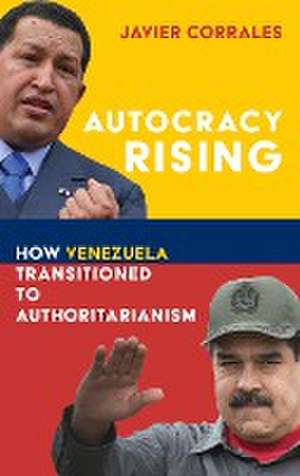
Autocracy Rising: How Venezuela Transitioned to Authoritarianism
Autor Javier Corralesen Limba Engleză Hardback – mar 2023
Corrales focuses on two themes: party systems and institutional capacity. He argues that Venezuela's democratic backsliding advanced when the ruling party obtained far too much electoral clout while the opposition fragmented. The state then took control of formerly independent agencies of the state. This allowed the ruling party to use and abuse of the law to favor the president-which in turn generated a permanent economic crisis.
After succeeding Hugo Chávez in 2013, Nicolás Maduro confronted, unexpectedly, another change in the party system: a rising opposition. This triggered deeper autocratization. To survive, the state was compelled to modernize autocratic practices and seek alliances with sinister partners. In short, Maduro concentrated power, paradoxically, by sharing power.
Autocracy Rising compares what occurred in Venezuela to twenty other cases throughout Latin America where presidents were forced out of office. Corrales illuminates the depressing cycle in which semi-authoritarian regimes become increasingly autocratic in response to crisis, only to cause new crises that lead to even greater authoritarianism.
Preț: 419.66 lei
Preț vechi: 580.73 lei
-28%
Puncte Express: 629
Carte tipărită la comandă
Livrare economică 01-15 decembrie
Livrare prin curier în România Termenul estimat este afișat lângă disponibilitate.
Transport gratuit pentru acest produs Plată online sau ramburs, în funcție de opțiunile comenzii.
Retur gratuit în 14 zile Comandă securizată și suport în română.
Specificații
ISBN-13: 9780815740070
ISBN-10: 0815740077
Pagini: 256
Ilustrații: 18 b/w illustrations; 21 tables
Dimensiuni: 157 x 237 x 21 mm
Greutate: 0.54 kg
Editura: Bloomsbury Publishing
Colecția Brookings Institution Press
Locul publicării:New York, United States
ISBN-10: 0815740077
Pagini: 256
Ilustrații: 18 b/w illustrations; 21 tables
Dimensiuni: 157 x 237 x 21 mm
Greutate: 0.54 kg
Editura: Bloomsbury Publishing
Colecția Brookings Institution Press
Locul publicării:New York, United States
Cuprins
Preface
Acknowledgments
1 Introduction: Party Systems, Institutional Capturing, and Autocratization
2 Rethinking Democratic Backsliding: Politics before Maduro
3 The Worst Economic Crisis outside of War: The Political Economy of Collapse
4 Rising Opposition: Party-building in Times of Autocratization
5 Rising Autocracy: Autocratic Tools to Survive Crises
6 Comparisons: Nicaragua, Colombia, and Ecuador
7 Function Fusion: A Survival Tool for Embattled States
8 Conclusion: Vulnerable Autocracy, Collapsing Nation
Notes
References
Index
Acknowledgments
1 Introduction: Party Systems, Institutional Capturing, and Autocratization
2 Rethinking Democratic Backsliding: Politics before Maduro
3 The Worst Economic Crisis outside of War: The Political Economy of Collapse
4 Rising Opposition: Party-building in Times of Autocratization
5 Rising Autocracy: Autocratic Tools to Survive Crises
6 Comparisons: Nicaragua, Colombia, and Ecuador
7 Function Fusion: A Survival Tool for Embattled States
8 Conclusion: Vulnerable Autocracy, Collapsing Nation
Notes
References
Index
Recenzii
A worthy sequel to Corrales's earlier classic Dragon in the Tropics, Autocracy Rising rigorously examines the paradox of the perseverance of the Venezuelan dictator Nicolás Maduro in the midst of economic collapse and severe international sanctions. Corrales offers three compelling explanations for Maduro's survival: asymmetric party system fragmentation, wherein the strength of the ruling party (rooted in deep networks of clientelism and cronyism) eclipses a fragmented opposition; institutional destruction and colonization, with the state exercising tremendous control over the electoral authorities, the coercive apparatus, and the courts (what Corrales labels 'autocratic legalism'); and, most originally, institutional innovation ('functional fusion') in which institutions begin to multitask. The military acquires business functions, a constituent assembly becomes a legislature, local political councils become food distribution networks, and criminal syndicates acquire some of the functions of the state. In addition, Corrales provides valuable comparative case studies: Nicaragua offers a similar story of ascendant authoritarianism, but Colombia and Ecuador suggest that liberal democracy can fight back. Somewhat surprisingly, Corrales concludes that Maduro's rule remains tenuous, well short of true autocratic consolidation.
Autocracy Rising is a timely and important contribution to the study of a country that has been perplexing to policy-makers and under studied by academics.. Well-documented, carefully argued, accessible research on Venezuela, from experts with experience in the country, is hard to come by. In light of this gap, the book deserves the attention of anyone interested in the rise of autocracy in Venezuela. The issue has spurred countless op-eds, speeches and even episodes of TV shows, but it had yet to be the subject of the careful treatment that Corrales undertakes in his book. In addition to making a valuable contribution to comparative politics, the book is relevant to policy-makers tackling the thorny question of democratic recession in the western hemisphere.
In this empirically and theoretically important book, Corrales explains Venezuela's transition to full authoritarianism under Nicolás Maduro. This transition seems surprising because the multiple crises the semi-authoritarian regime faced by the mid-2010s might well have caused its collapse instead. Corrales anchors his explanation on two key variables, both broadly useful for comparative analysis..This is a pathbreaking work based on a comprehensive literature and is both definitive on the case of Venezuela and innovative for broader analysis of democratic backsliding. Highly recommended. Advanced undergraduates through faculty; professionals.
Venezuela's political and economic implosion has baffled analysts, policy-makers and investors. Not Javier Corrales. His rigorous and original body of work sheds powerful light on the sources of Venezuela's tragedy and their likely evolution. Corrales' insightful new book will be an indispensable reference for those seeking to understand where Venezuela is going and why. A must read.
Javier Corrales did it again! After coauthoring the definitive account on the rise of Hugo Chávez, now he explains how his anointed successor, Nicolás Maduro, was able to become a full-fledged autocrat, despite the multiple obstacles in his path. The book offers major contributions on the institutional sources of democratic backsliding and for understanding the downfall of Venezuela into one of the poorest and most autocratic nations in Latin America. A must read.
This is a must-read book for scholars and practitioners interested in the causes of democratic backsliding and authoritarian entrenchment, written by one of the world's foremost experts on these themes. Using rich and nuanced evidence from contemporary Venezuela, Autocracy Rising shows how asymmetrical party system fragmentation and executive institutional capturing and innovation help explain transitions from semi- to full-fledged authoritarianism. In this way, Javier Corrales sheds light on one of the most important -- yet poorly understood -- political dynamics of our time.
Well-documented, carefully argued, accessible research on Venezuela, from experts with experience in the country, is hard to come by. In light of this gap, the book deserves the attention of anyone interested in the rise of autocracy in Venezuela. The issue has spurred countless op-eds, speeches and even episodes of TV shows, but it had yet to be the subject of the careful treatment that Corrales undertakes in his book. In addition to making a valuable contribution to comparative politics, the book is relevant to policy-makers tackling the thorny question of democratic recession in the western hemisphere.
Autocracy Rising is a timely and important contribution to the study of a country that has been perplexing to policy-makers and under studied by academics.. Well-documented, carefully argued, accessible research on Venezuela, from experts with experience in the country, is hard to come by. In light of this gap, the book deserves the attention of anyone interested in the rise of autocracy in Venezuela. The issue has spurred countless op-eds, speeches and even episodes of TV shows, but it had yet to be the subject of the careful treatment that Corrales undertakes in his book. In addition to making a valuable contribution to comparative politics, the book is relevant to policy-makers tackling the thorny question of democratic recession in the western hemisphere.
In this empirically and theoretically important book, Corrales explains Venezuela's transition to full authoritarianism under Nicolás Maduro. This transition seems surprising because the multiple crises the semi-authoritarian regime faced by the mid-2010s might well have caused its collapse instead. Corrales anchors his explanation on two key variables, both broadly useful for comparative analysis..This is a pathbreaking work based on a comprehensive literature and is both definitive on the case of Venezuela and innovative for broader analysis of democratic backsliding. Highly recommended. Advanced undergraduates through faculty; professionals.
Venezuela's political and economic implosion has baffled analysts, policy-makers and investors. Not Javier Corrales. His rigorous and original body of work sheds powerful light on the sources of Venezuela's tragedy and their likely evolution. Corrales' insightful new book will be an indispensable reference for those seeking to understand where Venezuela is going and why. A must read.
Javier Corrales did it again! After coauthoring the definitive account on the rise of Hugo Chávez, now he explains how his anointed successor, Nicolás Maduro, was able to become a full-fledged autocrat, despite the multiple obstacles in his path. The book offers major contributions on the institutional sources of democratic backsliding and for understanding the downfall of Venezuela into one of the poorest and most autocratic nations in Latin America. A must read.
This is a must-read book for scholars and practitioners interested in the causes of democratic backsliding and authoritarian entrenchment, written by one of the world's foremost experts on these themes. Using rich and nuanced evidence from contemporary Venezuela, Autocracy Rising shows how asymmetrical party system fragmentation and executive institutional capturing and innovation help explain transitions from semi- to full-fledged authoritarianism. In this way, Javier Corrales sheds light on one of the most important -- yet poorly understood -- political dynamics of our time.
Well-documented, carefully argued, accessible research on Venezuela, from experts with experience in the country, is hard to come by. In light of this gap, the book deserves the attention of anyone interested in the rise of autocracy in Venezuela. The issue has spurred countless op-eds, speeches and even episodes of TV shows, but it had yet to be the subject of the careful treatment that Corrales undertakes in his book. In addition to making a valuable contribution to comparative politics, the book is relevant to policy-makers tackling the thorny question of democratic recession in the western hemisphere.