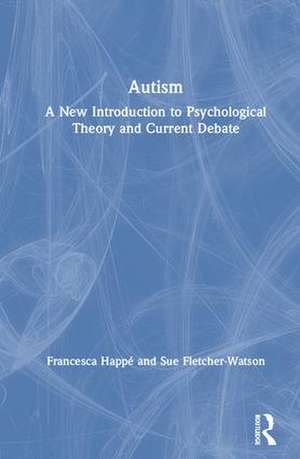
Autism: A New Introduction to Psychological Theory and Current Debate
Autor Sue Fletcher-Watson, Francesca Happéen Limba Engleză Hardback – 5 feb 2019
Notăm cu interes apariția celei de-a doua ediții a lucrării Autism, un text fundamental care se poziționează la intersecția programelor universitare de psihologie, educație specială și asistență socială. Spre deosebire de prima ediție, acest volum reprezintă o restructurare completă a modului în care teoria psihologică este prezentată studenților și profesioniștilor, ancorând dezbaterile academice în realitatea neurodiversității. Credem că relevanța acestui curs rezidă în capacitatea autorilor Sue Fletcher-Watson și Francesca Happé de a sintetiza trecerea de la modelele tradiționale ale „deficitului primar” către perspectivele contemporane ale procesării informației.
Cartea este organizată riguros, pornind de la un istoric al diagnosticului și avansând prin analize detaliate ale nivelurilor comportamental și biologic, pentru a culmina cu o explorare extinsă a nivelului cognitiv. Suntem de părere că includerea unor subiecte de actualitate, precum „Problema Dublei Empatii” și teoriile Bayesiene, oferă cititorului o imagine fidelă a dinamicii actuale din cercetare. Autism acoperă aceeași arie tematică precum Autistic Spectrum Disorders de Rita Jordan, dar cu o abordare mai orientată spre dezbaterea critică și spre integrarea vocii comunității autiste în textul academic prin comentariile incluse în fiecare capitol.
În contextul operei autorilor, volumul completează viziunea practică din Educational Psychology Perspectives on Supporting Young Autistic People, oferind fundamentul teoretic necesar pentru înțelegerea mecanismelor cognitive. Dacă lucrările anterioare ale autorilor se concentrau pe mediul școlar și sprijinul aplicat, acest titlu oferă rigoarea științifică necesară pentru a evalua critic validitatea modelelor psihologice actuale, transformând teoria abstractă într-un instrument util pentru practica clinică și educațională.
Preț: 1063.50 lei
Preț vechi: 1296.96 lei
-18%
Carte tipărită la comandă
Livrare economică 29 mai-12 iunie
Specificații
ISBN-10: 1138106119
Pagini: 208
Ilustrații: 5 Tables, black and white
Dimensiuni: 156 x 234 x 13 mm
Greutate: 0.45 kg
Ediția:2nd edition
Editura: Taylor & Francis
Colecția Routledge
Locul publicării:Oxford, United Kingdom
Public țintă
General, Postgraduate, Professional, and UndergraduateDe ce să citești această carte
Suntem de părere că această carte este esențială pentru studenții la psihologie și practicienii care doresc o înțelegere nuanțată a autismului. Cititorul câștigă nu doar o sinteză a modelelor clasice, precum Teoria Minții, ci și o perspectivă critică modernă, validată de experiențele reale ale persoanelor neurodivergente. Este un ghid teoretic care nu ignoră impactul clinic și social al cercetării, facilitând o abordare mai empatică și fundamentată științific.
Despre autor
Francesca Happé este profesor de neuroștiințe cognitive la King's College London și o figură centrală în cercetarea autismului la nivel mondial, fiind recunoscută pentru studiile sale asupra coerenței centrale slabe. Sue Fletcher-Watson este profesor de psihologie la Universitatea din Edinburgh, specializată în modul în care tehnologia și intervențiile timpurii pot sprijini dezvoltarea copiilor autiști. Împreună, autorii combină rigoarea academică de la Routledge cu o viziune progresistă asupra neurodiversității, adaptând teoriile complexe la nevoile reale ale comunității și ale specialiștilor din domeniu.
Descriere scurtă
The authors summarise what is known about the biology and behavioural features of autism, and provide concise but comprehensive accounts of all influential psychological models including ‘Theory of Mind’ (ToM) models, early social development models and alternative information processing models such as ‘weak central coherence’ theory. The book also discusses more recent attempts to understand autism, including the ‘Double Empathy Problem’ and Bayesian theories. In each case, the authors describe the theory, review the evidence and provide critical analysis of its value and impact. Recognising the multiplicity of theoretical views, and rapidly changing nature of autism research, each chapter considers current debates and major questions that remain for the future.
Importantly, the book includes the voices of autistic people, including parents and practitioners, who were asked to provide commentaries on each chapter, helping to contextualise theory and research evidence with accounts of real-life experience. The book embraces neurodiversity whilst recognising the real needs of autistic people and their families. Thus Autism: A New Introduction to Psychological Theory and Current Debate provides the reader with a critical overview of psychological theory but also embeds this within community perspectives, making it a relevant and progressive contribution to understanding autism, and essential reading for students and practitioners across educational, clinical and social settings.
Cuprins
Chapter 1 – Introduction
Chapter 2 – The History of Autism
Chapter 3 - Autism at the Behavioural Level?
Chapter 4 - Autism at the Biological Level
Chapter 5 - Autism at the Cognitive Level: What makes a Good Theory?
Chapter 6 - Autism at the Cognitive Level: Primary Deficit Models
Chapter 7 - Autism at the Cognitive Level: Developmental Trajectory Models
Chapter 8 - Autism at the Cognitive Level: Domain-General Information Processing Models
Chapter 9 - The Impact of Cognitive Models on Autism Understanding and Practice
Chapter 10 - Looking to the Future
Bibliography
Notă biografică
Francesca Happé (FBA FMedSci) is Professor of Cognitive Neuroscience and Director of the Social, Genetic and Developmental Psychiatry Centre at the Institute of Psychiatry, Psychology and Neuroscience, King's College London. She has worked in autism research for over 30 years, was President of the International Society for Autism Research and has been awarded the British Psychological Society Spearman Medal, the Experimental Psychology Society Prize and the Royal Society Rosalind Franklin Award.
Recenzii
"This book gives an accessible overview of psychological theory in regard to autism, including recent developments and controversies. The highlight however is the commentary remarks at the end of each chapter by autistic people. A must read for all those studying autism and those working with autistic people." - Damian Milton, Lecturer in Intellectual and Developmental Disability, Tizard Centre, University of Kent, UK.
"For more than two decades, Francesca Happé has led the way in explaining the psychology of autistic people to students and experts alike. Now joining forces with Sue Fletcher-Watson, this new introduction brings the voices of autistic people themselves, their families and communities to the forefront of their analysis. The result is a magnificent book that will cause us all to think anew about autistic psychology and experience." - Professor Liz Pellicano, Macquarie University, Australia
"This book is a must-read for everyone interested in understanding the current landscape of autism. It includes everything you will want to know from history to biology; from theory to practice; presented in a balanced and lucid style that will engage all readers. The book is remarkable achievement that will, like the first edition, become an instant classic." - Helen Tager-Flusberg, Ph.D., Boston University, USA.
"For many people, myself included, Francesca Happé’s 1995 book was their gateway to autism research. This update, written with Sue Fletcher-Watson is much-needed and long overdue. Like the first edition, it provides a wonderfully lucid yet concise introduction to psychological accounts of autism. But it also serves as an historical document, reflecting the seismic changes in our understanding of and attitudes towards autism over the past quarter century and the growing voice of autistic people in challenging preconceptions about their own condition and influencing the priorities and goals of autism science." – Dr. Jon Brock, Macquarie University, Australia.