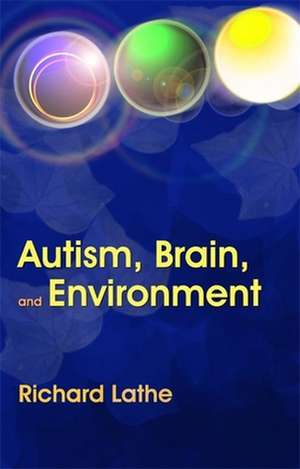
Autism, Brain, and Environment
Autor Richard Latheen Limba Engleză Hardback – 11 mai 2006
Autism, Brain, and Environment proposes that autism is a disorder of the limbic brain, which is damaged by toxic heavy metals present in the environment. Lathe argues that most ASD children have additional physiological problems and that these, far from being separate from the psychiatric aspects of ASD, can produce and exacerbate the condition.
This important and groundbreaking text provides a closely-argued scientific case for the involvement of both environmental and physiological factors in autism. Lathe's argument will also have a direct impact on treatment strategies and options. It will be of great interest to the scientific community, professionals, researchers, political and environmental lobbyists, teachers, psychologists, and parents and people with ASDs.
Preț: 204.56 lei
Preț vechi: 267.59 lei
-24%
Puncte Express: 307
Carte disponibilă
Livrare economică 16-30 noiembrie
Livrare prin curier în România Termenul estimat este afișat lângă disponibilitate.
Transport gratuit de la 400.00 lei Plată online sau ramburs, în funcție de opțiunile comenzii.
Retur gratuit în 14 zile Comandă securizată și suport în română.
Specificații
ISBN-13: 9781843104384
ISBN-10: 1843104385
Pagini: 288
Dimensiuni: 172 x 242 x 25 mm
Greutate: 0.6 kg
Ediția:1
Editura: JESSICA KINGSLEY PUBLISHERS
Colecția Jessica Kingsley Publishers
Locul publicării:London, United Kingdom
ISBN-10: 1843104385
Pagini: 288
Dimensiuni: 172 x 242 x 25 mm
Greutate: 0.6 kg
Ediția:1
Editura: JESSICA KINGSLEY PUBLISHERS
Colecția Jessica Kingsley Publishers
Locul publicării:London, United Kingdom
V-ar putea interesa
-
 Psychology, Mental Health and DistressJohn Cromby-21%Preț: 432.62 lei545.57 lei
 -
 Cry of Pain: Understanding Suicide and the Suicidal MindProfessor Mark Williams-25%Preț: 92.34 lei122.97 lei
 -
 Clinical Sports PsychiatryDavid A Baron-8%Preț: 685.24 lei744.82 lei
 -
 Mental Health WorldwideS. Fernando-15%Preț: 660.72 lei777.31 lei
 -
 -26%Preț: 80.32 lei107.83 lei
 -
 From Isolation to Intimacy: Making Friends without WordsPhoebe Caldwell-20%Preț: 130.47 lei163.18 lei
 -
 -19%Preț: 148.24 lei183.49 lei
 -
 -25%Preț: 434.37 lei578.58 lei
 -
 -18%Preț: 122.83 lei149.59 lei
 -
 -18%Preț: 167.91 lei205.12 lei
 -
 An Exceptional Children's Guide to Touch: Teaching Social and Physical Boundaries to KidsMcKinley Hunter ManascoPreț: 130.08 lei
 -
 Living with VoicesJacqui DillonPreț: 213.50 lei
Recenzii
The author covers the problems of recognition and diagnosis, genetic contributions, brain abnormalities, limbic dysfunction, physiological dysregulation, body and mind, biomedical therapy, and links with other disorders, as part of a detailed positioning of this arguments... The argument is concisely presented, extensively referenced and made easy to follow to its conclusion... Overall this is an important book, well argued and referenced. It should be read by all concerned with ASD.
I would recommend this book to psychologists working in the field of ASD who want a clear and well argued introduction to a subject which, although undoubtedly controversial, deserves serious attention.
Autism. Brain and Environment provides a new account of the biological basis for autism, with consequences for a wide range of professionals as well as for families.
This densely informative book is a comfort to read. One can browse or follow through. The index is enormous and useful. Definitions are strengthened. Gene and brain variations are covered and the nature/nurture interaction exposed.
This is a well- written user- friendly book. The key points at the end of the chapters give a helpful summary. The book presents a comprehensive overview of the aetiological factors in autistic disorders with extensive bibliography... Richard Lathe makes an excellent case for the interplay of factors and gives an unbiased presentation of the available evidence for all the possible hypotheses in the causation of autistic syndromes. The section on the impact of heavy metal toxicity is particularly interesting... This is an important book that brings together all the current issues in the aetiology of autistic disorders. The chapter on biomedical therapy, subtyping and interventions gives possible ways forward in management which may seem well worth adapting in clinical practise. This is a must- read book for trainees in psychiatry and paediatrics and for practitioners in the field.
Autism, Brain and Environment engages with wider scientific debate and is comprehensively researched.
I would recommend this book to psychologists working in the field of ASD who want a clear and well argued introduction to a subject which, although undoubtedly controversial, deserves serious attention.
Autism. Brain and Environment provides a new account of the biological basis for autism, with consequences for a wide range of professionals as well as for families.
This densely informative book is a comfort to read. One can browse or follow through. The index is enormous and useful. Definitions are strengthened. Gene and brain variations are covered and the nature/nurture interaction exposed.
This is a well- written user- friendly book. The key points at the end of the chapters give a helpful summary. The book presents a comprehensive overview of the aetiological factors in autistic disorders with extensive bibliography... Richard Lathe makes an excellent case for the interplay of factors and gives an unbiased presentation of the available evidence for all the possible hypotheses in the causation of autistic syndromes. The section on the impact of heavy metal toxicity is particularly interesting... This is an important book that brings together all the current issues in the aetiology of autistic disorders. The chapter on biomedical therapy, subtyping and interventions gives possible ways forward in management which may seem well worth adapting in clinical practise. This is a must- read book for trainees in psychiatry and paediatrics and for practitioners in the field.
Autism, Brain and Environment engages with wider scientific debate and is comprehensively researched.
Cuprins
1. Introduction. 2. Autism and autism spectrum disorders: the problem of recognition and diagnosis. 3. Genetic contribution to autistic spectrum disorders: diversity and insufficiency. 4. New phase autism: rising prevalence. 5. Brain abnormalities: focus on the limbic brain. 6. Limbic dysfunction correlates with the autistic phenotype. 7. Environmental factors, heavy metals, and brain function. 8. Gut, hormones, immunity: physiological dysregulation in autism. 9. Body and mind: impact of physiological changes on brain and behaviour in ASD. 10. Biomedical Therapy: typing and correction. 11. The Environmental threat: From autism and ADHD to Alzheimer's. Index.